Stand on the viewing platform at the Soo Locks in Sault Ste. Marie on a July afternoon and you will watch something that should not be possible. A freighter longer than the Empire State Building is tall — a thousand feet of steel loaded with iron ore — slides into a concrete box with a couple of feet to spare on either side. Gates the size of barn doors swing shut behind it. Then the whole ship, all seventy thousand tons of it, quietly sinks twenty-one feet.
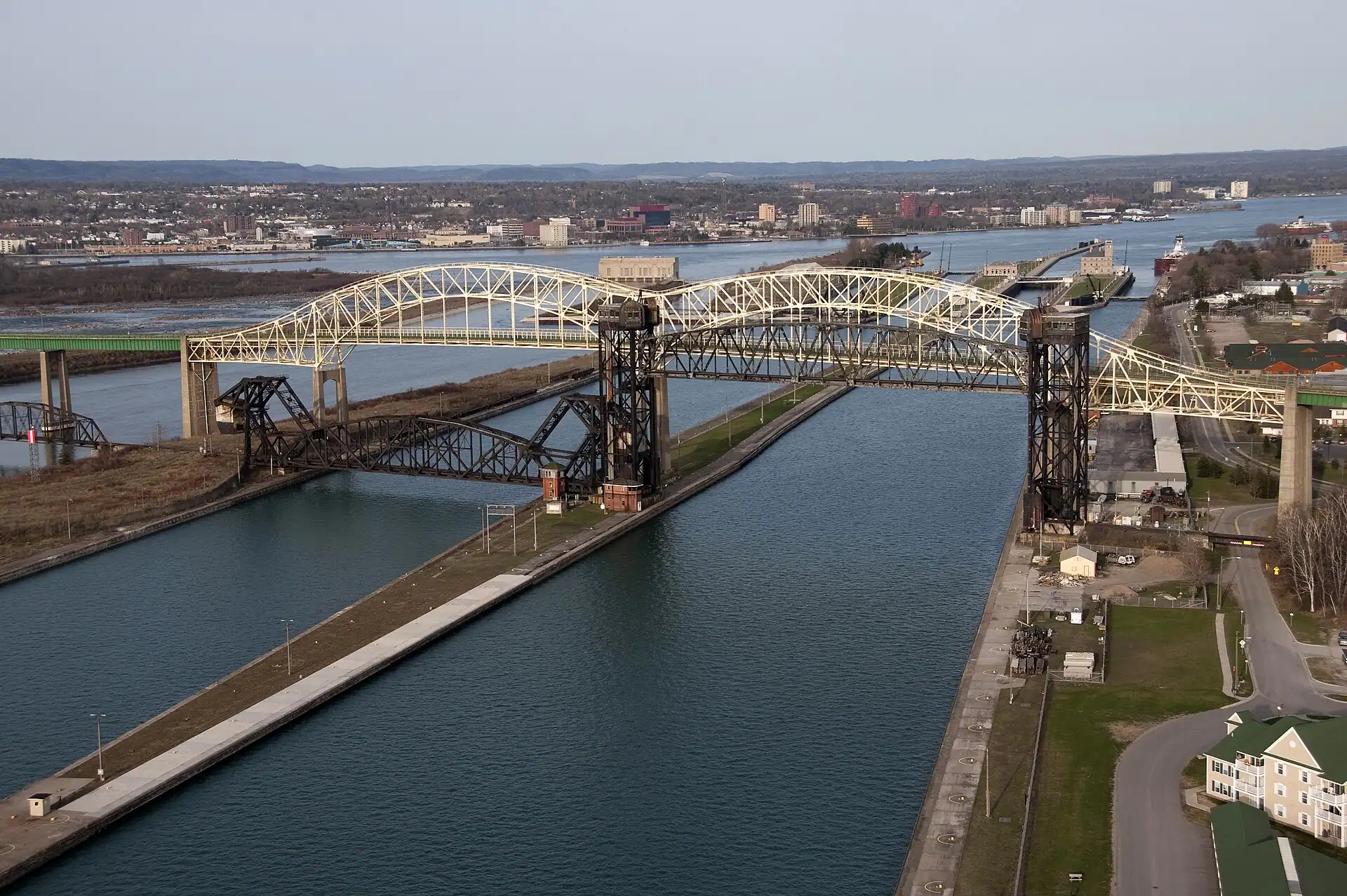
No pumps are involved. Nothing gets switched on. Valves open, gravity does the rest, and about twenty-two million gallons of Lake Superior drains out from under the boat until it sits level with Lake Huron. The gates open. The freighter leaves. The whole thing takes less time than an oil change.
That twenty-one feet is the entire reason the U.P. has a shipping industry at all. Lake Superior sits higher than the rest of the Great Lakes, and it dumps that difference into the St. Marys River as a stretch of whitewater the Ojibwe knew as Bawating — the place of the rapids. For centuries, every pound of cargo that came out of Lake Superior had to be carried around those rapids by hand.
How the Soo Locks got here
The first permanent lock on the American side opened in 1855, built for the State of Michigan by, of all outfits, a scale company. Ships paid a toll of four cents a ton to use it. By 1881 the traffic had outgrown what a single state could manage, the federal government took over, and the U.S. Army Corps of Engineers has run the place ever since — free of charge to every vessel, right up to this morning.
Locks came and went as the boats got bigger: the Weitzel in 1881, the first Poe in 1896, the Davis and the Sabin before World War I, the MacArthur during it. Today four chambers sit side by side in the canal. Only two of them still work.
And that is where the story stops being a nice bit of engineering history and starts being a problem.
The one gate everything fits through
The working pair are the MacArthur, built in 1943 and good for boats up to 730 feet, and the Poe, rebuilt in 1968 at 1,200 feet long and 110 wide. Over the decades the Great Lakes fleet replaced its older boats with 1,000-footers — vessels like the Paul R. Tregurtha, 1,013.5 feet of her — and those giants fit through exactly one chamber on Earth. The Poe.
Which is why roughly 88 percent of all the tonnage that moves through the Soo is locked to that single gate. The iron ore that leaves Minnesota and the U.P. — ore from the ranges that hollowed out towns like Negaunee and built machines like the Cornish Pump — has one door to the rest of the country, and it is 110 feet wide.
In 2015 the Department of Homeland Security ran the numbers on what happens if that door jams. The report is not subtle. Six months without the Poe, and roughly 75 percent of American integrated steel production stops inside two to six weeks. About 80 percent of iron ore mining shuts down with it. Production of cars, appliances, farm equipment, construction equipment — nearly all of it in North America — goes dark. The estimate came to eleven million jobs lost and $1.1 trillion knocked off U.S. GDP, with unemployment in Michigan pushing toward 22 percent. Homeland Security called the locks “the Achilles heel of the North American industrial economy.”
Not a hurricane. Not a cyberattack. One aging lock in a town of 13,000 people in the Upper Peninsula.
The fix, forty years later
Congress authorized a second Poe-sized lock back in 1986 and then did essentially nothing about it for three decades. Construction finally began in 2019, in the footprint of the abandoned Davis and Sabin chambers. The new lock will match the Poe exactly — 1,200 by 110 by 32 feet — at a cost the Corps has since revised to about $2.6 billion, with completion targeted for the summer of 2030.
Until then, the arrangement holds. The locks close every winter from January 15 to March 25, the Corps rebuilds what it can in the cold, and the 2026 shipping season opened right on schedule at one minute past midnight on March 25.
Here is the part Yoopers already know and the rest of the country mostly doesn’t. You can walk up and watch it happen. The observation deck is free, the boats come through at all hours, and the crews will wave at your kids. There is no fence keeping you back from the most consequential 1,200 feet of concrete in America — just a railing, a park bench, and a hundred and seventy years of the U.P. quietly holding the door open for everybody else.
More worth reading


Sources, credits, and reporting details
Sources & accountability
How this story was reported
Editorial methodArchival synthesis
Last verifiedJul. 22, 2026
Corrections statusNo material correction note is recorded on this article.
AI assistanceResearched and drafted with AI tools. Reviewed and approved by editor Keegan O’Brien.
Verification note: Initial ledger, verified 2026-07-22 during publication prep. Lock dimensions, tonnage share, the 2015 DHS closure scenario, the 2026 season opening and current New Lock cost and schedule checked against Army Corps releases, the DHS study itself, and industry and local reporting. Sole direct quotation is the nine-word DHS phrase. The MacArthur vessel-size figure was corrected before publication. Featured image public domain USACE, resized without cropping. No AI-generated or AI-assisted media.
Primary sources
-
Soo Locks to open for 2026 shipping season — U.S. Army Corps of Engineers, Great Lakes and Ohio River Division
Featured image record. Published Mar. 10, 2026. Accessed Jul. 22, 2026. Federal public information.
-
The Perils of Efficiency: An Analysis of an Unexpected Closure of the Poe Lock and Its Impact — U.S. Department of Homeland Security, Office of Cyber and Infrastructure Analysis
Featured image record. Published Jun. 1, 2015. Accessed Jul. 22, 2026. Federal public information.
Primary federal study underlying the economic figures.
Additional reporting
-
Soo Locks fact sheet — Lake Carriers Association
Featured image record. Published May. 9, 2018. Accessed Jul. 22, 2026. Industry association publication; brief quotation with attribution.
Sole direct quotation in the article is the nine-word DHS phrase quoted here.
-
The Soo Locks: Connecting Lake Superior to the World for Over 150 Years — Upper Peninsula Travel and Recreation Association
Featured image record. Published May. 1, 2025. Accessed Jul. 22, 2026. Copyright UPTRA; cited.
-
The Soo Locks, Sault Ste Marie — Sault Ste. Marie Convention and Visitors Bureau
Featured image record. Accessed Jul. 22, 2026. Visitor bureau content; cited.
-
GALLERY: Major transformation of Soo Locks since 2020 — SooLeader
Featured image record. Published May. 23, 2025. Accessed Jul. 22, 2026. Copyright SooLeader; cited.
-
Soo Lock Expansion Cost Revised Down to $2.62B — Engineering News-Record
Featured image record. Published Sep. 15, 2025. Accessed Jul. 22, 2026. Copyright ENR; cited.
-
Soo Locks project underway; MacArthur and Poe vessel limits — Michigan Farm News
Featured image record. Published Sep. 15, 2020. Accessed Jul. 22, 2026. Copyright Michigan Farm News; cited.
Used to correct the MacArthur vessel-size figure.
Photo and media credits
-
Soo Locks International Bridge 2010 (USACE) — U.S. Army Corps of Engineers / Wikimedia Commons
Featured image record. Accessed Jul. 22, 2026. Public domain; credit U.S. Army Corps of Engineers.