Michigan didn’t choose the U.P. It got stuck with it. Then it got rich.
If you’ve ever wondered why Michigan has the Upper Peninsula and not Wisconsin, the answer is a war. Michigan lost a fight over the city of Toledo, and got handed the entire U.P. as a runner-up prize instead. It turned out to be the best trade the state ever made.
Here’s how the strangest border fight in the country played out. Back in the 1830s, Michigan was a territory itching to become a state, and it claimed a 468-square-mile sliver of land along the Ohio line called the Toledo Strip, with the busy port city of Toledo sitting right on it. Ohio, already a state, wanted that same strip just as badly. The whole mess traced back to some sloppy old maps that had drawn the border in two different spots.
So in 1835, both sides called out their militias and marched them to opposite banks of the Maumee River. Michigan’s troops answered to Stevens T. Mason, a 24-year-old nicknamed the Boy Governor.
And then, after all that chest-thumping, the war barely happened. The two armies mostly stood across the river and traded insults. The only real injury in the entire Toledo War was a sheriff’s deputy who got nicked with a penknife. One account swears the only other casualty was a pig.

President Andrew Jackson, with an election around the corner and no interest in angering Ohio, stepped in and shut the whole thing down. In June 1836, Congress put a deal on the table: hand Toledo to Ohio, and in exchange Michigan gets statehood plus the western Upper Peninsula. And no, the land couldn’t have just gone to Wisconsin. Wisconsin Territory didn’t even exist yet.
Michigan was not grateful. Trade a promising Great Lakes port for a frozen slab of wilderness you couldn’t even reach without crossing two lakes? The Detroit Free Press scoffed at the U.P. as a land of perpetual snows. Voters rejected the deal outright the first time it was offered. They only caved when the territory was nearly broke, and a second convention held in the dead of winter finally said yes. On January 26, 1837, Michigan became the 26th state, minus Toledo, plus the U.P.
And then came the punchline. That “worthless” frozen wilderness was sitting on one of the richest copper deposits on earth, plus a fortune in iron and timber. The Keweenaw copper boom alone pulled more wealth out of the ground than the California Gold Rush. Ohio kept its port. Michigan got a treasure chest and didn’t even know it yet.

Of course, ask plenty of Yoopers and the deal left one lasting mark: the U.P. has spent the better part of two centuries feeling like an afterthought to the folks below the bridge. It’s no accident there’s a long-running, only-half-joking push to break off and form a 51st state called Superior. When your relationship starts as a consolation prize, you don’t exactly forget it.
So the next time somebody asks why a big chunk of Michigan sits way up above Wisconsin, connected to the rest of the state by a five-mile bridge, you can give them the real answer. Michigan lost a war, took the runner-up prize, and accidentally won the whole thing. Ohio can keep the traffic. We’ll keep the lakeshore.
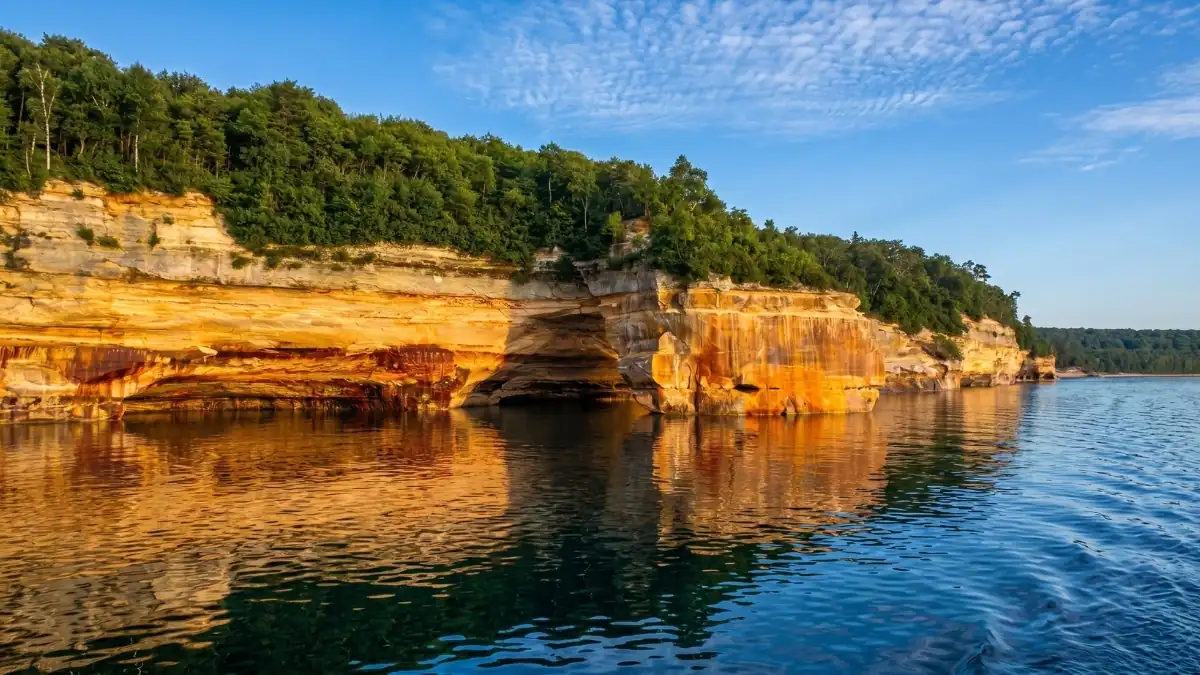
Featured image: Pictured Rocks along Lake Superior in Michigan’s Upper Peninsula. Photo by Sarah Shull on Unsplash.
Explore more: Keweenaw Stories
More worth reading


Yooper Hub community
The conversation
Know something this story missed? Corrections and additions get read by an editor and folded into the article, with credit.
Real neighbors, real names. A Yooper Hub editor reads your first comment before it appears; after that you’re a known neighbor and your comments post right away. No account required. Community guidelines
Nothing here yet. A sentence is plenty: a correction, a name, or what you remember about this place.
Golden 25 trust review · #21
Verified context for this Yooper Hub story
- Evidence refreshed
- July 13, 2026
- Source readiness
- Live source review complete.
- Corrections status
- No material correction note is recorded on this article.
- Image rights
- One or more image-rights records still need review.
Sources, credits, and reporting details
Sources & accountability
How this story was reported
Editorial methodArchival synthesis
Accountable editor:Keegan O’Brien, publisher and editor.
Last verifiedJul. 13, 2026
Corrections statusNo material correction note is recorded on this article.
AI assistanceResearched and drafted with AI tools. Reviewed and approved by editor Keegan O’Brien. Tool: Claude Max.
Verification note: Michigan statehood, the Toledo boundary dispute, and the Upper Peninsula settlement were checked against state historical sources. Featured image rights and attribution independently verified against the retained source record on 2026-07-14; attachment 1139 restored under Keegan O'Brien dated approval.
Primary sources
-
The Toledo War — Michigan Department of Military and Veterans Affairs
Accessed Jul. 13, 2026.
-
Michigan in Brief — Library of Michigan
Accessed Jul. 13, 2026.
Supports: State chronology for the Toledo War, Upper Peninsula exchange, and 1837 statehood.
Original URL https://www.michigan.gov/libraryofmichigan/public/michigan/featured-michigan-materials/the-library-of-michigan-presents-michigan-in-brief returned 404 on 2026-08-15; link points to the Internet Archive capture of 2026-01-18, which the archive reports as a 200.
Photo and media credits
-
Pictured Rocks near Munising — Sarah Shull
Featured image record. Published Sep. 4, 2019. Accessed Jul. 14, 2026. Unsplash License; published 2019-09-04; source location Pictured Rocks, Munising Township, Michigan.
Supports: Pictured Rocks cliffs along Lake Superior near Munising. Photo: Sarah Shull / Unsplash.
modern landscape illustration. It is not a map, boundary record, or image from the Toledo War period.