For years the DNR figured the U.P.’s big cats were lone males just passing through. Then a mother and two cubs walked across a trail camera — and rewrote the whole story.
Update, September 18, 2026: a confirmed sighting between Marquette and Big Bay
A mill yard security camera between Marquette and Big Bay recorded a cougar at 12:10 a.m. on August 29, 2026. The property owner, Michelle Hill, submitted stills to the Michigan Department of Natural Resources through its cougar observation reporting system. Brian Roell of the DNR replied: “After review we certainly agree that the animal in question is a cougar. Your report will be added to our list of confirmed reports.”
The DNR told her it publishes only a general location for confirmed sightings and does not share exact locations. We are following the same practice here.
Video: Michelle Hill, SDS-Hill LLC
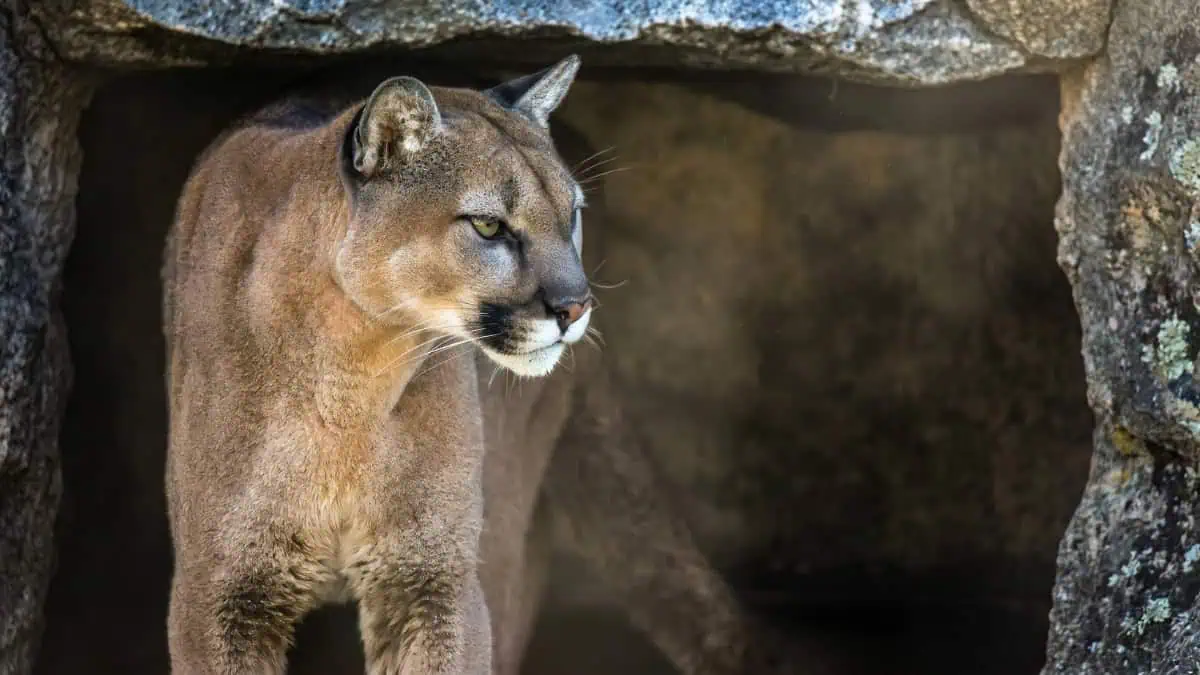
Yes, there are mountain lions in the Upper Peninsula. And in 2025 the proof stopped being a campfire argument and turned official: the Michigan DNR logged its highest confirmed cougar numbers since record-keeping began in 2008. But the real headline was not the count. It was a family.
The same woods you pass on the way to camp. The same two-tracks near Houghton and Ontonagon. There are wild cougars out there right now — and biologists no longer believe all of them are just travelers. Some of them, it turns out, live here.
The cubs that changed everything
On March 6, 2025, a resident’s trail camera in Ontonagon County caught two cougar cubs, roughly 7 to 9 weeks old. DNR biologists confirmed them — the first verified cougar reproduction in Michigan in more than 100 years. The DNR’s large carnivore specialist, Brian Roell, has called it genuinely historic: the first documented cougar reproduction anywhere east of the Mississippi in over a century.
Here is why that lands so hard. For two decades, every cougar the DNR confirmed had been a transient male — a young cat dispersing east from the Dakotas and beyond, passing through and moving on. Cubs meant a female. A female with kittens meant, for the first time in living memory, a cougar family actually settling into the U.P.
Then came the sequel. On December 6, 2025, another trail camera — a private cam in central Ontonagon County — caught the mother padding down a snowy trail with both cubs, now close to a year old, trailing behind her. Nine months on, the whole family was still alive, with the DNR enhancing the image to confirm all three cats. Roell likes the kittens’ odds: like bears, cougars pour everything into their young, and these two had already survived a full year alongside mom.
So is it 39 reports, or 42 cougars?
You will see different numbers thrown around, and almost nobody explains the gap — so here it is. As of October 1, 2026, the Michigan DNR’s confirmed-sightings dashboard lists 39 separate cougar reports for 2025. Some of those reports each contained more than one cat (the mom-and-cubs frames). Count the individual animals and the dashboard’s total is 42.
And neither number means 42 mountain lions are prowling the Peninsula. Roell has been blunt that rising confirmations do not equal a booming population — one territorial male can rack up report after report. In fact, two neighboring landowners accounted for nine of 2025’s reports by themselves. The likelier story is a few more cougars trickling in, plus a lot more people running trail cameras than ever before.
A hundred-year comeback, by the numbers
Cougars are native to Michigan — they were simply hunted out by the early 1900s. The last known wild one in the state was killed near Newberry around 1906, caught, as Roell tells it, in a wolf trap. For roughly a century afterward, officially, there were none.
The silence broke in 2008, when the DNR confirmed cougar tracks in the U.P. The trend has climbed ever since: single digits in the early years, 15 confirmed in 2020, and, as of October 1, 2026, 42 cougars in 2025 on the DNR’s dashboard — a record for the third straight year. As of October 1, 2026, the Michigan DNR’s confirmed-sightings dashboard lists 207 confirmed cougar sightings in the Upper Peninsula since 2008, 208 statewide. The DNR notes that some may be the same animal seen by different people. (There has been exactly one downstate this whole century, in Clinton County back in 2017.)
The 8,000 sightings that were not
Want some perspective on how hard those 42 are to earn? The DNR says it received more than 8,000 cougar submissions through its reporting system in 2025 alone. The overwhelming majority get ruled out — dog tracks, blurry house cats, a bobcat caught at a bad angle. A confirmation takes a biologist studying DNA, clear prints, or unmistakable photo or video.
Think you spotted one? Here is how to actually report it
The DNR genuinely wants legitimate sightings — they are how the agency tracks this comeback. You can file one through the DNR’s Eyes in the Field online reporting system, where you can upload photos for the cougar team to review. A few things worth knowing before you do:
- Bring real evidence. A confirmation needs something solid — a clear photo, video, tracks, scat, or DNA. Note the exact location, but do not disturb the area.
- Your spot stays yours. The form asks for contact info, but you can keep your sighting from going public if you want. No need to broadcast your honey hole or the road to camp.
- Not sure what you saw? A nearby DNR customer service center can help you tell a cougar from an oversized house cat.
Should you be worried? Short answer: no
Cougars are shy, and attacks are vanishingly rare. Roell’s own yardstick is the one to keep in mind — in Michigan, a lightning strike and your morning drive to work are both far more dangerous than a cougar. They sit on the state’s endangered species list, which makes it illegal to hunt one or even to go actively tracking one down. Crowding a female can also push her to abandon her cubs, so the DNR’s ask is simple: give them their space.
That said, if you ever do come face to face with one in the wild, the standard advice is worth knowing. Do not run. Stand your ground, make yourself look as big as possible, and make noise. Back away slowly while staying assertive — and if a cougar actually attacks, fight back hard and protect your head and neck.
A hundred and twenty years after the U.P. lost its last cougar, the big cats are quietly writing themselves back onto the map — on private trail cams, in the kind of country where a thing can vanish for a century and then just walk back down the trail like it never left. If any corner of Michigan was going to get its mountain lions back first, of course it was up here.
Correction, October 1, 2026. This article previously gave the number of confirmed Upper Peninsula cougar sightings as 161 and a lower count for 2025. Both were updated to match the Michigan DNR’s confirmed-sightings dashboard: 207 in the Upper Peninsula since 2008, and 42 cougars in 2025.
Explore more: U.P. Wildlife Stories
More worth reading


Yooper Hub community
The conversation
Know something this story missed? Corrections and additions get read by an editor and folded into the article, with credit.
Real neighbors, real names. A Yooper Hub editor reads your first comment before it appears; after that you’re a known neighbor and your comments post right away. No account required. Community guidelines
Nothing here yet. A sentence is plenty: a correction, a name, or what you remember about this place.
Sources, credits, and reporting details
Sources & accountability
How this story was reported
Editorial methodOriginal reporting
Last verifiedOct. 1, 2026
Corrections statusCorrection, October 1, 2026. This article previously gave the number of confirmed Upper Peninsula cougar sightings as 161 and a lower count for 2025. Both were updated to match the Michigan DNR’s confirmed-sightings dashboard: 207 in the Upper Peninsula since 2008, and 42 cougars in 2025.
AI assistanceThe September 18 update is original reporting by the author, built from footage and a DNR reply supplied by their owner, Michelle Hill, and used with her permission. The rest of the article was drafted from published sources. AI tools assisted with drafting.
Verification note: Corrected Oct. 1, 2026: the confirmed-sighting count was updated from 161 to 207 in the Upper Peninsula (208 statewide) and the 2025 figure to 42, to match the Michigan DNR’s confirmed-sightings dashboard as read that day. Oct. 4, 2026: the dashboard’s yearly chart was re-read (2023: 18, 2024: 26, 2025: 42) to source “a record for the third straight year”; the dashboard total now reads 209, and the counts in this article are as of Oct. 1. CEO-directed review checked the central claims against 1 direct public evidence link on July 13, 2026. Featured image rights and attribution independently verified against the retained source record on 2026-07-14; attachment 1147 restored under Keegan O'Brien dated approval.
Primary sources
-
Direct evidence for: Are There Mountain Lions in the Upper Peninsula? The DNR Just Confirmed Cubs for the First Time — State of Michigan
Accessed Jul. 13, 2026.
Direct public evidence reviewed against the article on July 13, 2026.
-
Confirmed cougar sightings dashboard (Confirmed sightings, all data) — Michigan Department of Natural Resources
Accessed Oct. 1, 2026.
Read Oct. 1, 2026. Dashboard states “2008 to present”, updated regularly, with no snapshot date. The Upper Peninsula figure is calculated: 208 statewide minus 1 Lower Peninsula sighting (June 21, 2017). The DNR notes some sightings may be the same animal seen by different people.
-
Confirmed cougar sightings by year (Confirmed sightings, all data), chart tooltips — Michigan Department of Natural Resources
Accessed Oct. 4, 2026.
Read live Oct. 4, 2026, from the dashboard chart "Confirmed cougar sightings by year", by hovering each point. 2020: 15. 2021: 14. 2022: 15. 2023: 18. 2024: 26. 2025: 42. Quote: "Confirmed cougar sightings by year", 2023 "Confirmed sightings 18", 2024 "26", 2025 "42". The "third straight year" wording is our calculation from these values; the DNR does not state it. The dashboard total on Oct. 4 reads 209.
Photo and media credits
-
Mountain lion on a rock — Dylan Crawford
Featured image record. Published Aug. 24, 2024. Accessed Jul. 14, 2026. Unsplash License; published 2024-08-24.
the photograph is not from the U.P. and does not show an animal confirmed by Michigan DNR. Clear the attachment's false AI-generated classification; the verified source is a real photograph.