Most Copper Country towns were torn down, burned, or swallowed by second-growth forest. Victoria is still standing where it was built, and it may be one of the oldest log-cabin villages left on its original site anywhere in the United States.
It is four miles southwest of Rockland, in Ontonagon County, up a road steep and rocky enough to explain the whole story before you arrive.

A mine chasing ancient holes
Miners came into these hills in 1849 looking for copper and silver. They were not guessing at random. They were working near pits dug by people who had been taking copper out of this ground for thousands of years, and the new companies used those ancient workings as a map.
Victoria Consolidated was organized by Thomas B. Dunstan, a Cornishman from Camborne who was busy nearly everywhere in the district — he also organized the Adventure Mining Company, served as an attorney for the Quincy Mining Company, sat on the Board of Control of the Michigan College of Mines, and went to Lansing as a state representative, then a senator, and was elected lieutenant governor in 1896.
Victoria was never a rich mine. It was a low-grade operation. But it produced steadily enough to stay worth working, which in that district counted as success — plenty of better-funded outfits, including the Delaware, never paid a dividend at all.
The cabins
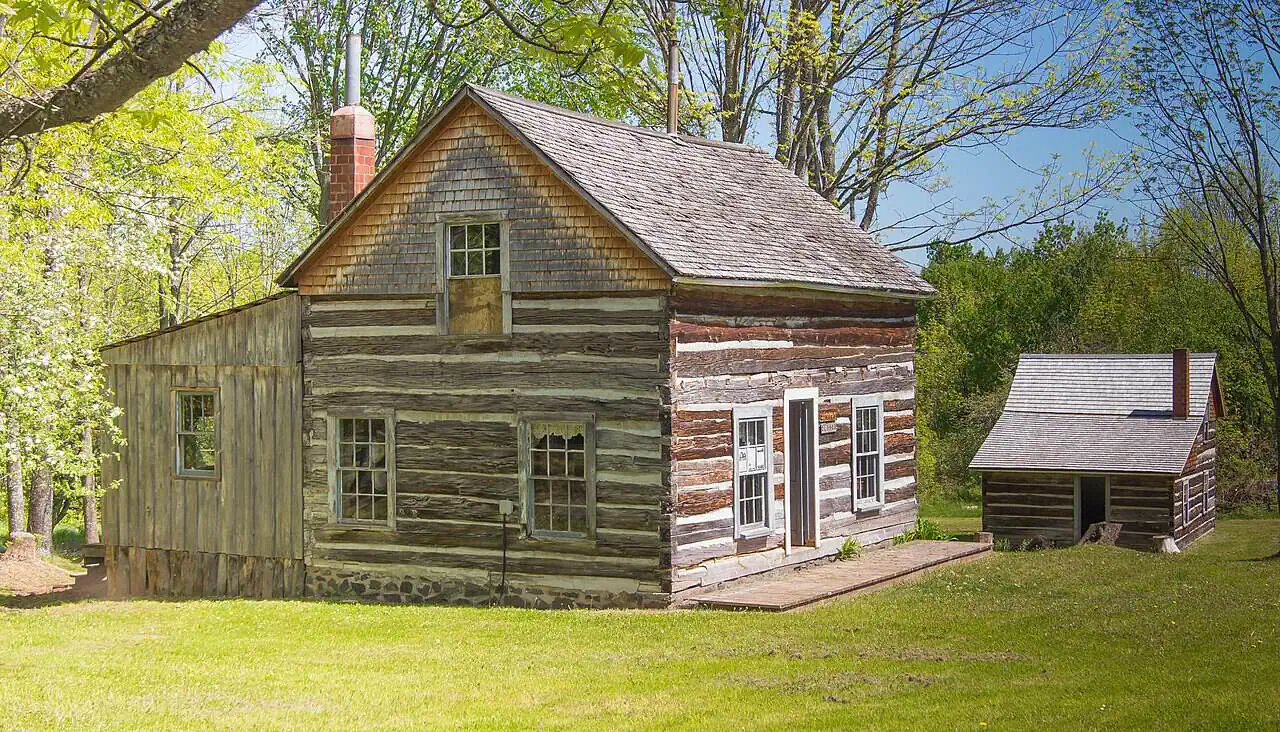
The log houses went up in 1899 to hold workers for the Victoria Copper Mining Company. They are hand-hewn, and many of the families in them were Finnish — part of the wave that made this corner of the state the most Finnish place in America.
Four of them have been restored. Walk inside and the first thing that registers is how small they are. Crude furniture, a wood cookstove, very little room. Comfort was not part of the arrangement.

Nothing is behind glass
This is what separates Old Victoria from a museum. Copper samples sit out on crocheted tablecloths. Goods from the 1800s are arranged on the stove. The site’s own description is that Victoria is as it was and you are free to reach out and touch a bit of the past — and they mean it literally.
The Society for the Restoration of Old Victoria runs the place, funded by donations. They have cut hiking trails, kept up a picnic area, and marked out where the mine buildings stood. You can walk the same paths the miners used to the mine site and pick through the poor rock pile for copper.
A local school once ran a heritage project where students actually lived in the village as the pioneers had.
Cinnamon rolls out of a woodstove
Two events anchor the year, and both are locally famous for the same reason: volunteers bake cinnamon rolls from scratch in a vintage coal and wood range in one of the cabin kitchens.
Log Cabin Day lands on the last Sunday in June, with open cabins, old-fashioned kids’ races, and Finnish folk dancing by the Kivajat Dancers, a Finnish-American youth group from Hancock. The Old Victoria Craft Fair runs the third Sunday in August.
The drive up Victoria Dam Road
From US-45 in Rockland, take Victoria Dam Road southwest about four miles; the turn is marked. The season runs roughly mid-June through the fall color season in October, daily late morning to late afternoon.
Walking the grounds yourself is free and donations are welcome. The hour-long guided tour inside the restored cabins costs a few dollars — recently $5 for adults and $2 for children 5 to 12, with under-5 free. Hours have been inconsistent in past seasons, so it is worth confirming before making the drive.
Victoria Dam, a hydroelectric plant on the west branch of the Ontonagon River, is about a mile further on, and the Porcupine Mountains are the obvious pairing for the rest of the day.
More worth reading


Yooper Hub community
The conversation
Know something this story missed? Corrections and additions get read by an editor and folded into the article, with credit.
Real neighbors, real names. A Yooper Hub editor reads your first comment before it appears; after that you’re a known neighbor and your comments post right away. No account required. Community guidelines
Nothing here yet. A sentence is plenty: a correction, a name, or what you remember about this place.
Sources, credits, and reporting details
Sources & accountability
How this story was reported
Editorial methodArchival synthesis
Last verifiedAug. 15, 2026
Corrections statusNo material correction note is recorded on this article.
AI assistanceResearched and drafted with AI tools. Reviewed and approved by editor Keegan O’Brien. Tool: Claude Opus 5.
Verification note: Ledger reconstructed 2026-08-15 from the National Park Service's Old Victoria heritage-site page, the Society for the Restoration of Old Victoria, and Wikipedia's Victoria Mine article as a pointer to the National Register record.
Primary sources
-
Old Victoria (Keweenaw National Historical Park heritage site) — National Park Service
Accessed Aug. 15, 2026.
-
Old Victoria Restoration Site — Society for the Restoration of Old Victoria, via Pure Michigan
Accessed Aug. 15, 2026.
Additional reporting
-
Victoria Mine, Michigan — Wikipedia contributors
Accessed Aug. 15, 2026.
Supports: The mine's earlier history and the 1899 reorganization; National Register listing.
Pointer.
-
Old miners' house gets new roof at Old Victoria — The Daily News (Iron Mountain)
Published Jul. 1, 2024. Accessed Aug. 15, 2026.
Supports: Recent preservation work by the society.
Photo and media credits
-
Victoria company town cabins (featured image) — Rossograph, via Wikimedia Commons
Featured image record. Accessed Aug. 3, 2026. CC BY-SA 4.0.
Creator and license from the attachment caption. Attachment 2096, 1280×732.