Calumet Street in Lake Linden is three blocks of two-story brick and stone storefronts with cast-iron trim, the kind of downtown that photographs well and that most Copper Country towns lost to fire, demolition or both. Lake Linden’s is still there. The reason is that Lake Linden burned first, all at once, on a single afternoon in 1887, and rebuilt itself under orders.
The town existed because of Calumet and Hecla. In 1867 the company began building a stamp mill on the Torch Lake shore to crush the ore coming down from the mines on the hill, and a village grew up beside it. By 1870 the mill employed nearly 150 men. The village was organized in 1868 as Torch Lake, took the name Lake Linden, and incorporated in 1885. Like every boom town in the district it was built fast and built of wood.
It also had no fire department. On May 20, 1887, around noon, a fire was spotted on the roof of a two-story building belonging to Newman & Tretease in the middle of town. The next morning’s Detroit Free Press said it plainly: the fire could easily have been put out if the village had owned any fire apparatus. It owned none. Someone telegraphed for help, and in under an hour the steamers from Hancock, Houghton, Calumet and Red Jacket were working the fire. By then it was a town fire, not a roof fire. When it was done, twelve city blocks were gone by the National Register’s count, sixteen by the Free Press’s, and about three quarters of the village with them. A meat market and several churches were saved.
The buildings could be replaced. What forced the town’s hand was the money. Property insurers who had taken heavy losses told the village they would pull out of Lake Linden entirely unless it made itself harder to burn. So the village council wrote a fire code: inside a defined district, buildings had to be brick or stone, roofed in metal, gravel or slate. Wood was out.
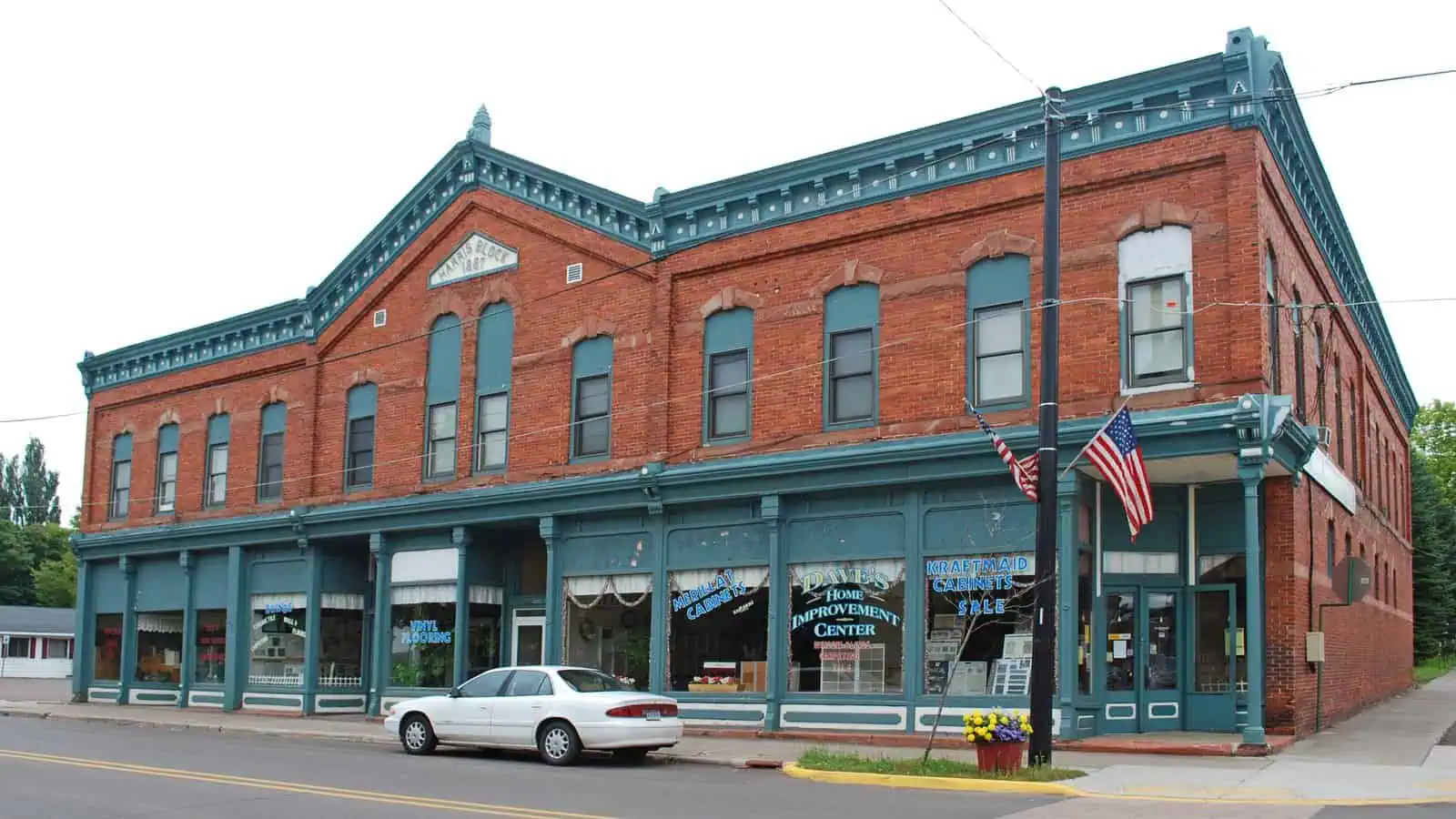
That code is the downtown you see today. The Harris Block at 118-120 Calumet went up in 1887, the year of the fire, and carries the date on its pediment. Joseph Bosch, the brewer, put up his building at 300 Calumet in 1888. Most of the district was built between the fire and about 1930, and the 100 through 300 blocks of Calumet are brick and stone from one end to the other because the ordinance said they had to be. Even the frame village hall, which had survived the fire, was eventually replaced: in 1901 the village hired Charles K. Shand of Calumet to design a fireproof village hall with a fire station in it, and it opened in 1902 at 401 Calumet, Richardsonian Romanesque in brick, because by then Lake Linden did have a fire department and meant to keep it.
The National Register listed the district in 2009: 52 acres, 83 buildings, 69 of them contributing to the history. Which is a dry way of saying that a town’s worst day is still standing on its main street, and looks good.
There is a lesson in it that towns keep having to relearn. Lake Linden did not rebuild in brick because it was wise. It rebuilt in brick because the people who would have to pay for the next fire refused to unless it did. Sometimes the reason a place is beautiful is that somebody, somewhere, ran the numbers.
Go See It
Calumet Street Historic District, Lake Linden
- Hours
- No hours: it is a public downtown street. The Village Hall office is open 8 a.m. to 4 p.m. Monday, Tuesday, Thursday and Friday, closed Wednesdays (village website). Shop hours are not listed here.
- Cost
- No admission is listed. It is a public downtown street.
- Season
- No season is listed.
- Drive
- From Marquette: 2 hr 8 min (110 mi) via US-41 N
From the Bridge: 4 hr 43 min (273 mi) via M-28 W and US-41 N (Google Maps flags tolls on this route)
More worth reading


Yooper Hub community
The conversation
Know something this story missed? Corrections and additions get read by an editor and folded into the article, with credit.
Real neighbors, real names. A Yooper Hub editor reads your first comment before it appears; after that you’re a known neighbor and your comments post right away. No account required. Community guidelines
Nothing here yet. A sentence is plenty: a correction, a name, or what you remember about this place.
Sources, credits, and reporting details
Sources & accountability
How this story was reported
Editorial methodArchival synthesis
Last verifiedAug. 15, 2026
Corrections statusNo material correction note is recorded on this article.
AI assistanceResearched and drafted with AI tools. Reviewed and approved by editor Keegan O’Brien. Tool: Claude.
Verification note: Drafted 2026-08-15. The block count is given both ways in the copy (twelve per the National Register summary, sixteen per the Detroit Free Press of 1887-05-21). Losses in dollars, deaths and the ordinance date were not found and are not claimed. The NRHP nomination PDF (Atwood 2008) could not be fetched; its Wikipedia summary was used.
Primary sources
-
Lake Linden, MI (station history, transcribing the Detroit Free Press of 1887-05-21) — michiganrailroads.com, citing DFP-1887-0521
Published May. 21, 1887. Accessed Aug. 15, 2026.
-
Lake Linden Historic District (Wikipedia, summarizing Stephanie K. Atwood, NRHP Registration Form, 2008) — National Park Service / Wikipedia contributors
Published Aug. 17, 2008. Accessed Aug. 15, 2026.
The nomination PDF at nps.gov was not reachable on 2026-08-15; the summary was used.
Additional reporting
-
Lake Linden Village Hall and Fire Station (Wikipedia, citing the National Register record) — Wikipedia contributors / National Register of Historic Places
Accessed Aug. 15, 2026.
-
Lake Linden's Disastrous Fire of 1887 (Copper Country local history series) — Clarence J. Monette
Accessed Aug. 15, 2026.
Supports: The fuller local account of the fire.
Print booklet, not read for this piece; listed as the source a reader would go to next. No public link.
Photo and media credits
-
Lake Linden Historic District 2009c.jpg (Harris Block, featured image) — Andrew Jameson, via Wikimedia Commons
Featured image record. Published Aug. 10, 2009. Accessed Aug. 15, 2026. CC BY-SA 3.0.
Original 3744×2176, cropped 16:9 (box 0,35,3744,2141), resized to 1600×900 q85. Attachment 2434.
