In 1903 a 64-room mansion left a bluff in Marquette in 190 railroad cars, and part of the reason is a grudge.
John Munro Longyear made his money in Upper Peninsula land, timber and iron. In 1890 he and his wife Mary began building a house on the high ground between Ridge and Arch streets, above the Lake Superior shore, with the lot running from Spruce Street down to the water. It took two years and about half a million dollars. The architects were Charlton and Gilbert, the builder Charles G. Van Idderstine, the material red sandstone. When the family moved in, in 1892, it had 64 rooms.
Then two things happened. In 1900 the Longyears’ son Howard drowned in Lake Superior. His parents proposed giving the waterfront below the house to the city as a memorial park in his name. At the same time a railroad wanted that same shoreline for a line into town, and the city sided with the railroad. The Longyears fought it in court and lost. When the blasting for the rail bed began under their windows, Mary Longyear was done with Marquette. The family history is blunt about it: she vowed never to set foot in the city again, and she never lived there again.
What happened next is the part people remember. The story goes that the Longyears were riding down the Champs-Elysees when John suggested that if they were going to move to Massachusetts, they should take the house with them. Mary agreed. Part of the pull east was her own work: she was collecting material on Mary Baker Eddy and wanted to be near the Christian Science Mother Church in Boston. In January 1903 crews began taking the mansion apart. Each block of stone was numbered, wrapped in straw and cloth, and loaded. It took 190 railroad cars, in two freight trains, to carry the house to Beaconsfield station in Brookline, outside Boston.
Reassembly began on Fisher Hill in June 1903 and the family moved back in on March 25, 1906. It had taken three years, longer than building it the first time. It was also a bigger house when they were done: reworked from a square plan into an L, the kitchen brought up to the first floor, a bowling alley, a music room and a sun porch added, about 100 rooms in all, half again the space it had in Marquette. The architects also traded the lopsided Romanesque design for a symmetrical one, so the house that went back up did not read like the house that came down.
After Mary Beecher Longyear’s death in 1931 the house became something neither of them had planned. She had spent her later years collecting material on Mary Baker Eddy and the early history of Christian Science, and had set up a foundation in 1926 to hold it. In 1937 the mansion opened to the public as the Longyear Museum. It stayed that way for six decades. In 1997 the house was sold and later turned into condominiums, and the museum moved to nearby Chestnut Hill.
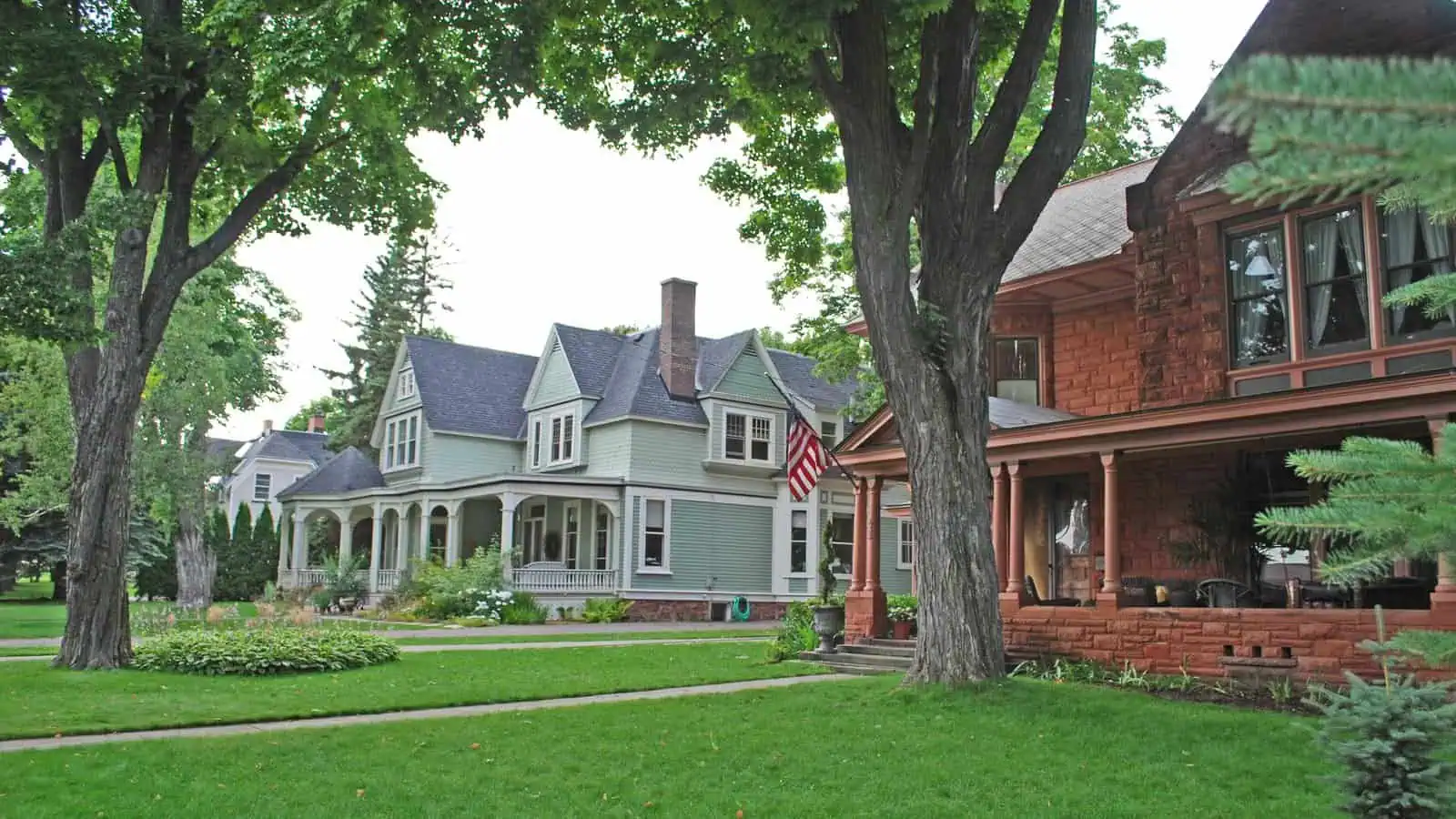
Back in Marquette, the bluff between Ridge and Arch stayed empty for a while and then filled in with other big houses. The neighborhood is a National Register historic district now, a few blocks of the mansions the iron and timber money built in the 1880s and 1890s. Walk it and you are looking at what the Longyear house was supposed to be one of. It is the one that got away, in the most literal sense a house can.
There is a version of this story that is a rich man’s tantrum, and it is not entirely wrong. But it is worth holding the other half of it too. They had lost a son. They wanted the shore under their house to be his park. The city gave it to a railroad instead. Taking the house apart and carrying it 1,300 miles was an extravagant way to leave, but the leaving itself is not hard to understand.
More worth reading


Sources, credits, and reporting details
Sources & accountability
How this story was reported
Editorial methodArchival synthesis
Last verifiedSep. 11, 2026
Corrections statusNo material correction note is recorded on this article.
AI assistanceResearched and drafted with AI tools. Reviewed and approved by editor Keegan O’Brien. Tool: Claude.
Verification note: Drafted 2026-08-15 from the Longyear Museum's research archive and Tyler Tichelaar's Mining Journal and blog accounts. The railroad is unnamed in the copy because Tichelaar's name for it (Marquette and Southwestern) does not match the line chartered along that shore (Marquette & Southeastern). No usable photograph of the mansion exists on Commons; the featured image is the surrounding historic district, stated as such. Updated 2026-09-11 after a re-verification pass. Corrections: the lead superlative ("the most spectacular house move in American history") was unverifiable and is cut; "red Jacobsville sandstone" narrowed to "red sandstone" (SAH Archipedia says red sandstone and no source ties the stone to Jacobsville); the sale year corrected from 1996 to 1997 and the unsourced $6.5 million price removed (Longyear Museum, "The Final Days at the Longyear Mansion"); the museum's move given as nearby Chestnut Hill (Longyear Museum, About: moved 1999, reopened 2001); "a thousand miles" corrected to 1,300 miles (Brookline Historical Society); added the rebuild's change from asymmetrical Romanesque to symmetrical (Brookline Preservation Commission, Fisher Hill) and Mary Longyear's wish to be near the Christian Science Mother Church. Open item: the post still has no in-body images, against the 3-image rule. Awaiting Keegan's re-attestation.
Primary sources
-
Longyear Mansion Moves from Marquette (1903) — Longyear Museum
Accessed Aug. 15, 2026.
-
Time Travel and the Longyear Mansion — The Mining Journal (Tyler R. Tichelaar)
Published Jan. 10, 2024. Accessed Aug. 15, 2026.
-
The Final Days at the Longyear Mansion — Longyear Museum
Featured image record. Accessed Sep. 11, 2026.
Supports: The mansion was sold in 1997 with the intent of constructing a purpose-built museum.
-
About Longyear Museum — Longyear Museum
Featured image record. Accessed Sep. 11, 2026.
Supports: The museum moved to nearby Chestnut Hill in 1999 and reopened to the public in 2001.
Additional reporting
-
Longyear Mansion (My Marquette, tag archive) — Tyler R. Tichelaar
Accessed Aug. 15, 2026.
-
Fisher Hill, Tour One — Brookline Historical Society
Accessed Aug. 15, 2026.
Supports: The Longyear estate built on its Fisher Hill site 1903-05.
-
Longyear Estate, MA-01-BR32 — SAH Archipedia (Society of Architectural Historians)
Featured image record. Accessed Sep. 11, 2026.
-
Fisher Hill (Preservation Commission tour) — Brookline Preservation Commission
Featured image record. Accessed Sep. 11, 2026.
Photo and media credits
-
Arch and Ridge Streets Historic District 2009e.jpg (featured image) — Andrew Jameson, via Wikimedia Commons
Featured image record. Published Aug. 9, 2009. Accessed Aug. 15, 2026. CC BY-SA 3.0.
Documentary stand-in: the historic district the mansion stood in, not the mansion. Original 3872×2436, cropped 16:9 (box 0,129,3872,2307), resized to 1600×900 q85. Attachment 2432.
