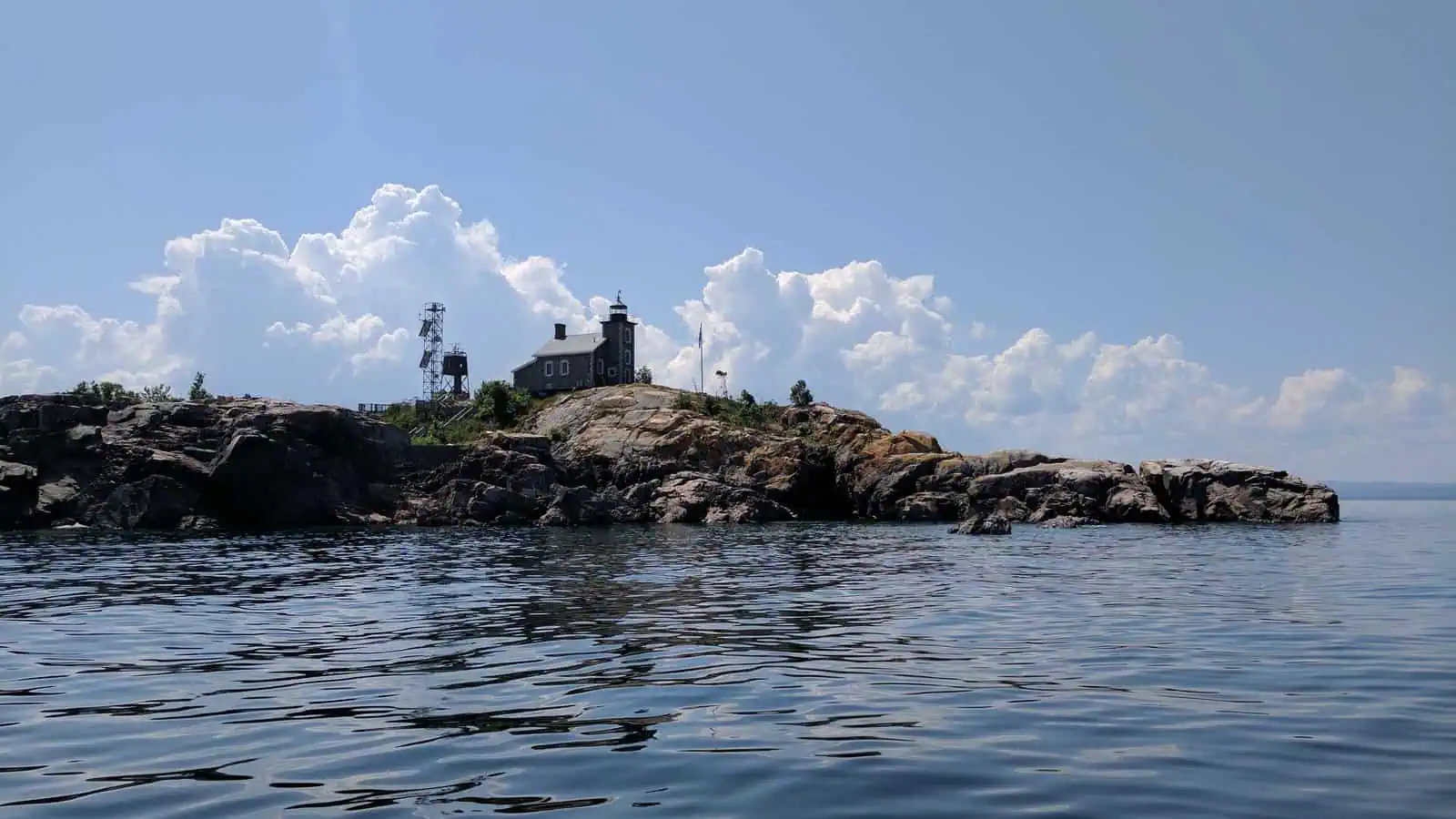
About ten miles north of Marquette, out where the lake stops looking like a lake, there is a bare hump of rock two acres across called Granite Island. On top of it there is a square stone tower and a keeper’s house, both built in 1868 out of granite that a crew cut on the Huron Islands, thirty miles up the shore, and shipped over.
For 131 years it belonged to the United States. In 1999 the government put it up for sale by sealed bid, and 85 people made offers. The high bid was $86,003. The second highest was $80,000. The lowest was eleven dollars.
The Lighthouse Board had asked Congress for $20,000 for a light on the island in 1866, and got it the following March. The site was a problem from the start: there is nothing there but rock, and the rock is not much bigger than the building. The tower is ten feet square and 40 feet tall, with the story-and-a-half dwelling attached, and the whole thing stands 90 feet above the water at the top of the island. It was fitted with a fourth-order lens with ruby glass screens and first lit for the 1869 season.
Then it started killing keepers. The first, Isaac P. Bridges, was 57 when he took the post in 1868. On August 30, 1872, on his way home to the mainland, his boat capsized in sight of his family, and he drowned. James Wheatley kept the light for years afterward with his son William as assistant; on April 30, 1898, William’s boat went over and he drowned too. Five years after that, on October 2, 1903, an assistant named John D. McMartin died when his boat was smashed against the island’s rocks. The father, James Wheatley, stayed on through 1913 and died two years later at 82. Three men lost to the same short stretch of water in thirty-one years, all of them just trying to get on or off the rock.
The station got a 1,500-pound fog bell in 1879, secondhand from Thunder Bay Island. Its wooden tower was replaced with a steel one in 1910. The light was switched to acetylene in 1937, which is the technology that let the Lighthouse Service run a light without a keeper living under it, and the fog signal was discontinued in 1943. The light was still lit, but nobody was home.
By the 1990s the Coast Guard had no use for the buildings, and in 1999 the General Services Administration sold them. The man who won was Scott Holman of Freeland, Michigan, who had dived Great Lakes shipwrecks as a student and gone on to found a steel casting company. He then spent two and a half summers and, by his own account, six figures putting the place back together: a carpenter from Covington named Stan Stenson, new windows and doors made to the historic pattern, rewiring, wind generators and solar panels, the walkway and the steps. Holman’s line about it deserves to be remembered by anyone who has ever sat through a fundraiser: you cannot restore a lighthouse with bake sales.
The Holmans made it a summer place. They also put weather instruments on the island that feed a website, so a private lighthouse ten miles out ended up being one of the more useful weather stations on that stretch of the lake.
It is closed to the public, all of it, grounds included. You see it the way the keepers’ families saw it, from the water, a small square shape on a rock with nothing else around. The stone came from the Huron Islands. The men who kept it are in the ground on the mainland. The house is somebody’s cottage. It is a strange thing for a federal building to become, and it is also probably the reason it is still standing.
More worth reading


Yooper Hub community
The conversation
Know something this story missed? Corrections and additions get read by an editor and folded into the article, with credit.
Real neighbors, real names. A Yooper Hub editor reads your first comment before it appears; after that you’re a known neighbor and your comments post right away. No account required. Community guidelines
Nothing here yet. A sentence is plenty: a correction, a name, or what you remember about this place.
Sources, credits, and reporting details
Sources & accountability
How this story was reported
Editorial methodArchival synthesis
Last verifiedAug. 15, 2026
Corrections statusNo material correction note is recorded on this article.
AI assistanceResearched and drafted with AI tools. Reviewed and approved by editor Keegan O’Brien. Tool: Claude.
Verification note: Drafted 2026-08-15 from Lighthousefriends' station history and the Mackinac Center's account of the 1999 sale. Holman's outlay is given as 'six figures' (his own words) rather than the Mackinac Center's 'more than $1 million'; the sale price uses the exact bid, $86,003.
Primary sources
-
Granite Island Lighthouse — Lighthousefriends.com
Accessed Aug. 15, 2026.
Compiles Lighthouse Board reports and Marquette newspapers.
Additional reporting
-
Granite Island Lighthouse Privatization Shines — Mackinac Center for Public Policy
Accessed Aug. 15, 2026.
-
Granite Island Light Station — Scott and Martine Holman
Accessed Aug. 15, 2026.
Supports: The owners' site, with the weather station data.
Not read in detail; listed because the copy refers to it.
Photo and media credits
-
Granite Island, MI.jpg (featured image) — Ben Harris, via Wikimedia Commons
Featured image record. Published Jul. 30, 2017. Accessed Aug. 15, 2026. CC BY-SA 4.0.
Original 4048×3036, cropped 16:9 (box 0,342,4048,2619), resized to 1600×900 q85. Attachment 2436.
