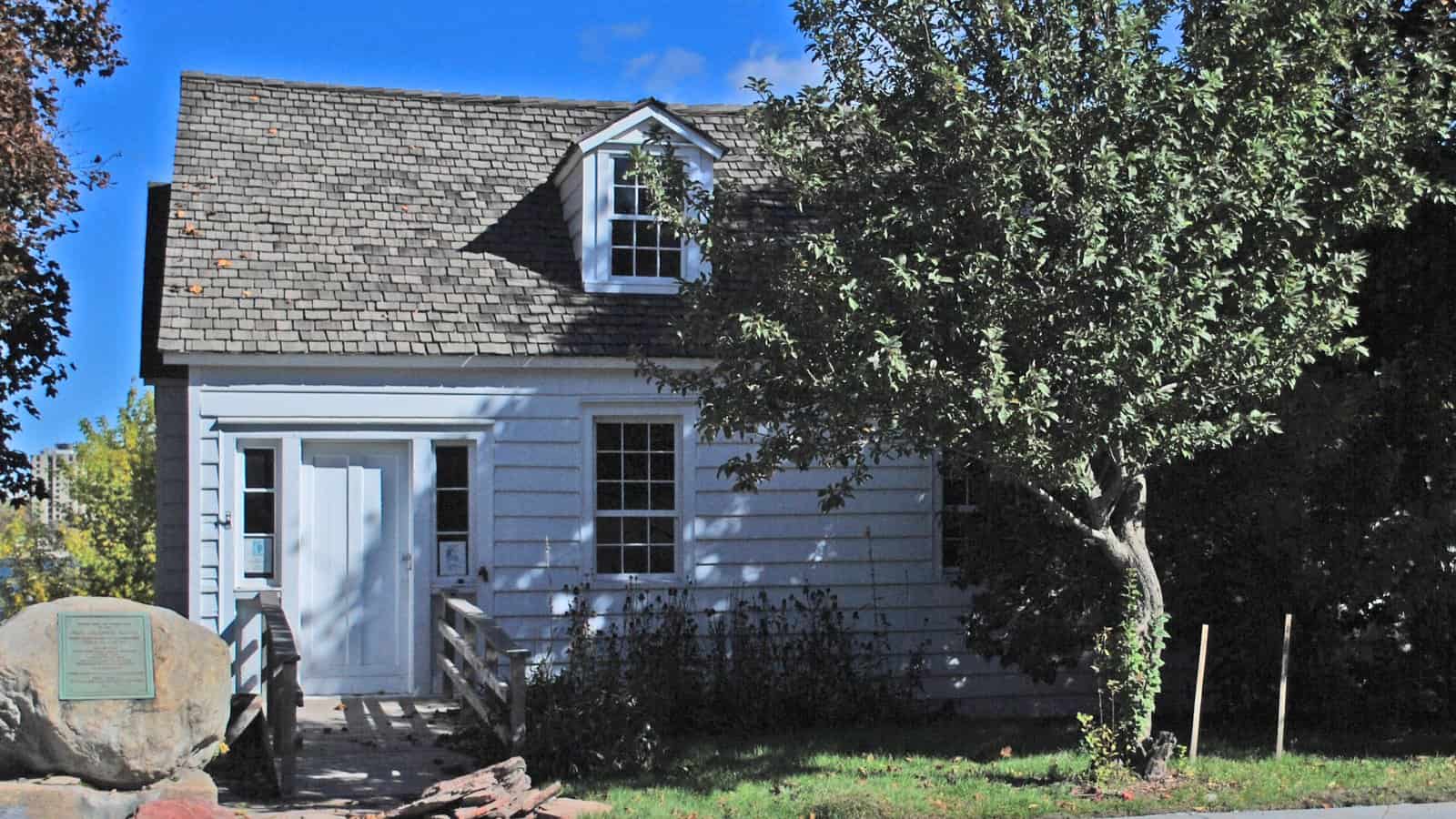
There is a small white house on Water Street in Sault Ste. Marie with a plaque on a boulder out front. It does not look like much. A great deal of what Americans think they know about Ojibwe stories passed through it.
The marriage that made it
John Johnston was born in Northern Ireland on August 25, 1762, to wealthy landowners, and came into the fur trade with the North West Company out of Montreal in 1790. He tried the Bad River near present-day Ashland, Wisconsin, in 1791.
In 1792 he married Ozhaguscodaywayquay, the daughter of the Ojibwe war chief Waubojeeg. The next year the couple settled at the Sault, and in 1794 Johnston built a house on this site.
That order matters. The marriage came first, and it was the marriage that gave an Irish trader standing in a place where Ojibwe families, not British ones, decided who could do business. They had eight children, four sons and four daughters.
Burned for choosing the wrong side
In 1812 Johnston helped British troops take Fort Mackinac. Two years later the Americans came for him and burned the house, along with $40,000 of his goods, in retaliation.
He rebuilt in 1815. In 1822 he added a substantial extension for one of his daughters and her new husband.
The daughter was Jane. The husband was Henry Rowe Schoolcraft, the Indian agent for the Michigan Territory.
What Jane did
Jane Johnston Schoolcraft, Waubojeeg’s granddaughter, is considered by literary scholars to be the first known Native American writer. Her Ojibwe name was Baamewaawaagizhigokwe, which translates as Woman of the Sound the Stars Make Rushing Through the Sky.
She began writing around 1815. She produced something like fifty poems along with translations of Ojibwe stories and songs, and she and Henry published a handwritten periodical from the Sault called the *Literary Voyager*, also known as *Muzzeniegun*. She published very little in her own lifetime.
Her husband published a great deal. Henry Schoolcraft’s collections of Ojibwe material became the standard American reference on the subject, and in 1855 Henry Wadsworth Longfellow used those publications as the main source for The Song of Hiawatha. One tale Jane recorded, Mon-daw-min, the origin of Indian corn, went into the poem directly.
So the most famous American poem ever written about Native life drew its substance from an Ojibwe woman’s work, gathered in and around a house at the Sault, and published under her husband’s name.
That is not a hidden story any more. The Library of Congress holds the Schoolcraft papers and says plainly whose writing is in them. But it took a very long time, and if you have heard of anyone in this house, it is probably Henry.
The house now
The John Johnston House was designated a Michigan State Historic Site on February 19, 1958, and added to the National Register of Historic Places on July 8, 1970. It stands today as an exhibit of its own architecture and construction, which is a modest role for a building this consequential.
Go See It
John Johnston House, Sault Ste. Marie
- Hours
- Wednesday to Sunday, noon to 5 p.m., from Engineers Day (the last Friday of June) to Labor Day, per the Sault Ste. Marie CVB. By those dates the house closed for 2026 on Labor Day, Sept. 7. The Google Maps listing still shows "Opens 12 PM Wed" (a visitor-updated entry). Michigan.org says "Call for information." Call before you go.
- Cost
- Adults $5, children $3 (free for 5 and younger), families $15 (Sault Ste. Marie CVB, the only source that lists prices; Michigan.org says to call).
- Season
- Engineers Day (last Friday of June) to Labor Day (Sault Ste. Marie CVB).
- Drive
- From Marquette: 2 hr 47 min (165 mi) via M-28 E (Google Maps, usual traffic, read Oct. 5, 2026)
From the Bridge: 55 min (55.6 mi) via I-75 N (Google Maps flags tolls on this route; usual traffic, read Oct. 5, 2026)
More worth reading


Sources, credits, and reporting details
Sources & accountability
How this story was reported
Editorial methodArchival synthesis
Last verifiedAug. 15, 2026
Corrections statusNo material correction note is recorded on this article.
AI assistanceResearched and drafted with AI tools. Reviewed and approved by editor Keegan O’Brien. Tool: Claude.
Verification note: CREDIT QUESTION, HANDLED DELIBERATELY. "First known Native American writer" is ATTRIBUTED to literary scholars, not asserted flatly, because it is a judgement about the surviving record rather than a countable fact. The piece states that Jane Johnston Schoolcraft's work reached the public under Henry Schoolcraft's name and that he is the better-known figure, but it does NOT accuse him of theft: they collaborated, jointly published the Literary Voyager, and 1820s-30s attribution practice was not modern practice. The sourcing supports "under-credited", which is what the copy says. Do not sharpen it. SPELLING TRAP: the Commons file is named "JohnJohnsonHouse" and its description says "John Johnson House". The building is the John JOHNSTON House; do not let that spelling reach a caption or alt text. NOT ASSERTED: Ozhaguscodaywayquay's baptismal name, given in some accounts as Susan, is left out as it comes from no source read here. INTERNAL LINK: post 2312, the Ironwood Hiawatha statue, exists because of the Longfellow poem this house supplied source material for. Best internal pairing on the site.
Primary sources
-
John Johnston House (Sault Ste. Marie, Michigan), National Register of Historic Places record — National Register of Historic Places, via Wikipedia
Accessed Aug. 15, 2026.
-
Biographical essay on Jane Johnston Schoolcraft (1800-1842), Henry Rowe Schoolcraft Papers — Library of Congress
Accessed Aug. 15, 2026.
Additional reporting
-
Jane Johnston Schoolcraft — Poetry Foundation, with the Academy of American Poets and Michigan Women Forward
Accessed Aug. 15, 2026.
Photo and media credits
-
John Johnston House, Sault Ste. Marie, by Andrew Jameson — Andrew Jameson, via Wikimedia Commons
Featured image record. Accessed Aug. 15, 2026. CC BY-SA 3.0.
16:9 crop box (0,100,2518,1516) from the 2518×1560 original down to 1600×900. WEAKEST featured image of this batch and knowingly so: source is only 1.57x the delivered width, a tree obscures about a third of the building, and it is a plain frontal record shot. It is the better of exactly two usable Commons files. Commons filename misspells Johnston as Johnson; do not carry that into a caption. A better exterior, or anything showing the 1822 addition, is worth asking the Chippewa County Historical Society for.
