Mackinac State Historic Parks calls Mission Church “Michigan’s oldest surviving church building.” The claim holds. But the word carrying it is surviving, and the reason that word is there is standing about a mile away.
Ste. Anne’s parish on the same island is far older. A log church was moved across the ice to Mackinac around 1780. That congregation has been worshipping on the island since before the United States existed. What it does not have is its original building, because in 1874 the parish replaced it with a new one.
So the record is not for the oldest church. It is for the oldest church building still standing, and Mission Church holds it by outlasting rather than by predating.
Who built it, and why
In 1823 the Reverend William Ferry and his wife Amanda arrived on Mackinac Island as missionaries with the American Board of Commissioners for Foreign Missions. They established a Protestant mission, and its purpose was a school: the Ferrys set out to educate Indigenous children brought in from around the Great Lakes.
By the end of the decade the mission had outgrown whatever it had been using. Lumber was cut on the mainland at Michael Dousman’s sawmill and hauled across to the island, and the church was finished in 1829.
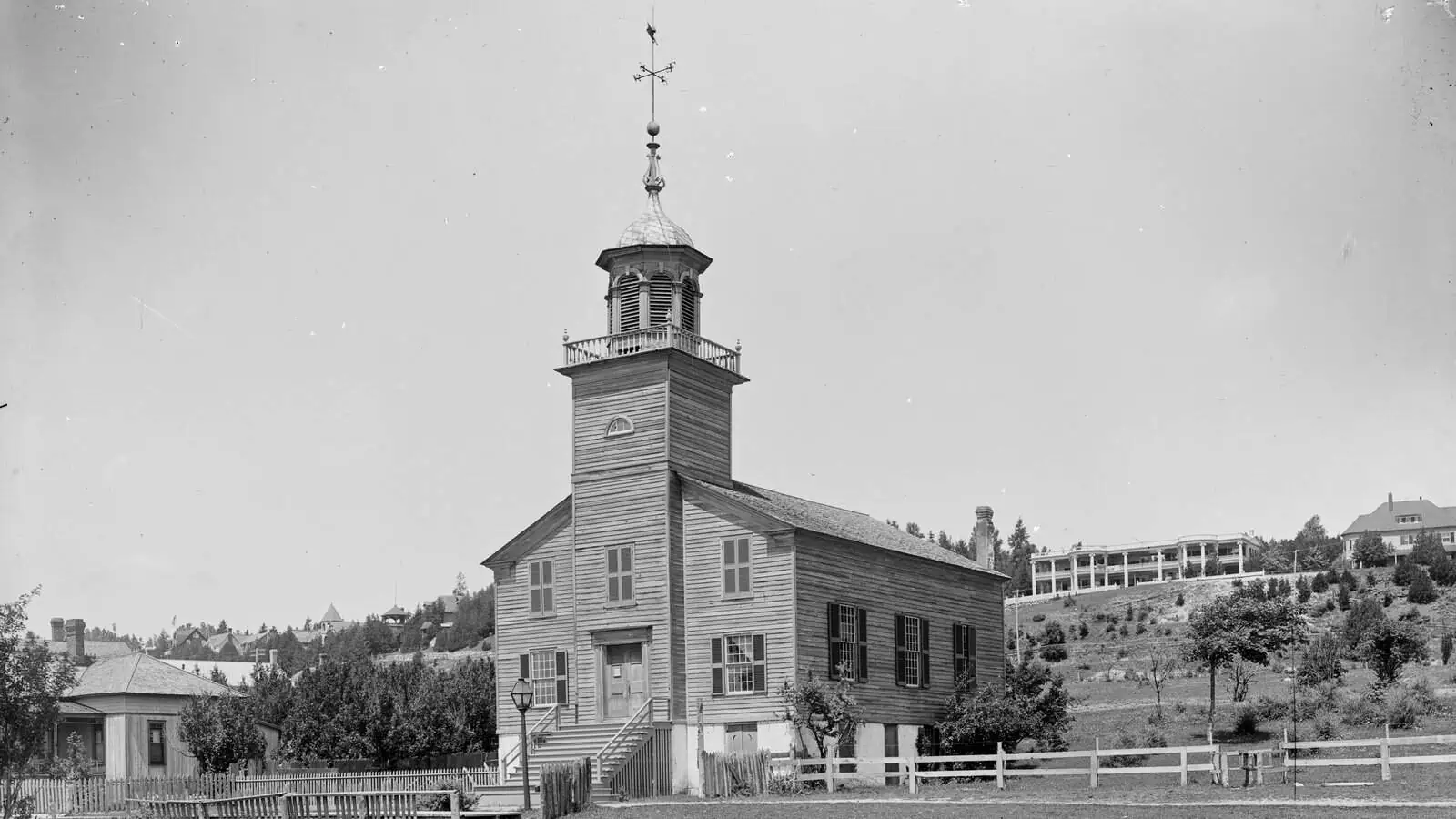
What went up is a piece of New England set down on a Straits island. The Ferrys built in the New England Colonial manner they had grown up with, white clapboard with a square tower and an open belfry, and it is reckoned the best example of that style in Michigan and one of the earliest anywhere in the Midwest. It does not look like anything else in the region because it was never meant to.
The congregation was a snapshot of who ran the Straits in the 1830s. Robert Stuart of the American Fur Company attended. So did Henry Schoolcraft, the Indian agent whose name is on half the maps in the Upper Peninsula.
Then the money left
The mission did not last long. The American Fur Company moved on, the island’s economy went with it, attendance fell away, and the mission closed in the late 1830s. A church built to serve a fur-trade town stopped making sense once there was no fur-trade town.
For the next fifty years the building did other work. By the 1890s it was in poor repair and had served variously as a theatre and a meeting hall, which is usually the last stop before a wooden building comes down.
What saved it was a summer resident. The Reverend Meade C. Williams led an effort to buy the church and restore it, and services resumed on July 25, 1895. That project is recognised as Mackinac’s first historic restoration, which makes this building not only the oldest survivor but the start of the preservation habit that now defines the whole island.
The state of Michigan took it over in 1955. It went onto the National Register of Historic Places on January 25, 1971. Today Mackinac State Historic Parks runs it as a museum and, from May through October, a wedding venue.
A church that closed for lack of a congregation now mostly hosts people getting married in it. There are worse afterlives for a building that was nearly firewood in 1890.
More worth reading


Sources, credits, and reporting details
Sources & accountability
How this story was reported
Editorial methodArchival synthesis
Last verifiedAug. 15, 2026
Corrections statusNo material correction note is recorded on this article.
AI assistanceResearched and drafted with AI tools. Reviewed and approved by editor Keegan O’Brien. Tool: Claude.
Verification note: SUPERLATIVE CHECKED, NOT REPEATED. The verified claim is "Michigan's oldest SURVIVING church building", wording taken verbatim from Mackinac State Historic Parks. "Oldest church in Michigan" would be FALSE: Ste. Anne's on the same island has an older congregation, its log church moved there around 1780, but it replaced its building in 1874. If a headline, caption or social post drops "surviving" or "still standing" for length, the claim becomes wrong. HONEST GAP: the mission existed to school Indigenous children brought from around the Great Lakes, and none of the sources read describe those children, where they came from, what happened to them, or what the schooling was meant to replace. The article states the purpose plainly and characterises it no further in either direction, because doing so from this sourcing would be invention. Worth a proper follow-up via the Ferry family papers, the ABCFM records, and Mackinac State Historic Parks.
Primary sources
-
Historic Mission Church — Mackinac State Historic Parks
Accessed Aug. 15, 2026.
-
Mission Church (Michigan), National Register of Historic Places record — National Register of Historic Places, via Wikipedia
Accessed Aug. 15, 2026.
Photo and media credits
-
Old Mission Church, Mackinac Island, c1900 (Detroit Publishing Co.) — Detroit Publishing Co., via Wikimedia Commons
Featured image record. Published Jan. 1, 1900. Accessed Aug. 15, 2026. Public domain.
Public domain Detroit Publishing plate, 9147×6258, circa 1900, about five years after the restoration that saved the building. 16:9 crop box (0,250,9147,5395) down to 1600×900, keeping the weathervane clear of the frame edge. FILE HANDLING TRAP: this is an 88 MB 16-bit greyscale PNG (mode I;16). A straight convert to RGB clips the entire frame to white and looks like a failed download. It must be rescaled from its real extrema (2000, 62999) using the scale-and-offset point form, since Pillow rejects an arbitrary lambda on I;16, and needs MAX_IMAGE_PIXELS disabled. Full recipe in the credit sidecar.
