There is a fifty-two-foot man standing on a hill in Ironwood, and he has been there since June of 1964, looking out over a town that was already losing the industry that built it.
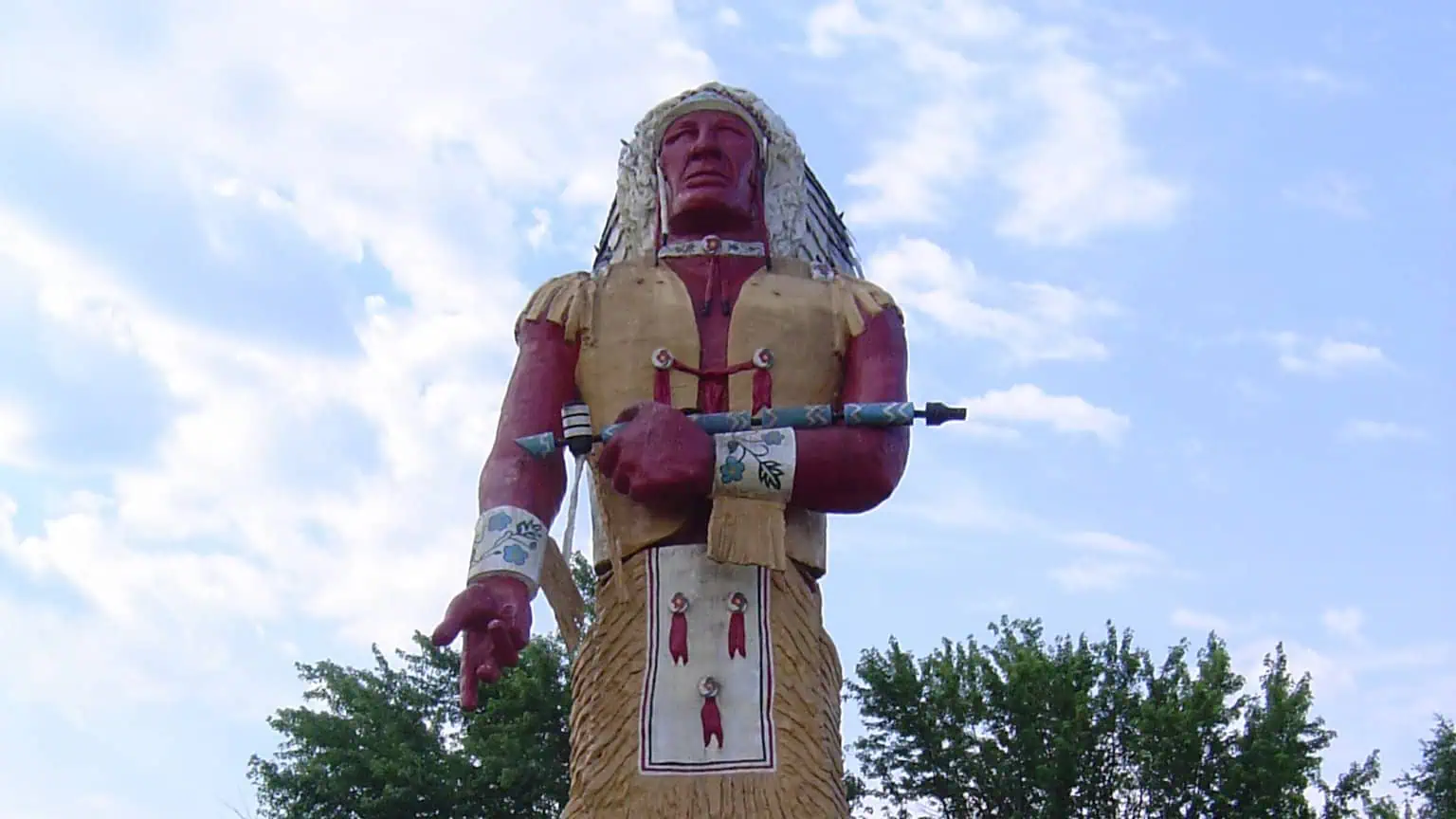
He is made of fiberglass. He weighs nine tons once you count the steel skeleton holding him up, and he is engineered to stand through 140 mile per hour winds, which is a specification you only write down if you have spent a winter in Gogebic County. He was built by a company called Gordon Displays in St. Paul, Minnesota, trucked across Wisconsin, and set up on the site of the old Norrie iron mine.
The reason he exists is one man’s idea about traffic.
Charlie Gotta sold cars in Ironwood. Driving through Minnesota he had seen what that state does with roadside sculpture, the oversized figures that make people tap the brakes and pull over, and he paid to bring one home. The placement was deliberate and it was commercial. He did not put the statue out by a highway where it would be easy to see and easy to keep driving past. He put it where seeing it meant coming into Ironwood, at the top of Suffolk Street, so anybody curious enough to stop had to drive through the town to do it.
That is the part worth sitting with. This is not a monument somebody built out of civic pride after the fact. It is a piece of infrastructure aimed at a problem, put up by a private citizen in a mining town whose mines were closing, and the problem was that people were driving past.

The plaque at the base calls him the World’s Tallest and Largest Indian. Half of that holds up. By bulk he appears to be the largest such statue anywhere. By height he is not: a considerably slimmer figure in Skowhegan, Maine stands about ten feet taller. Ironwood has been claiming the full title for sixty years anyway, and it is hard to be too annoyed about it, because the boast is doing exactly the job Gotta bought it to do.
He is called Hiawatha, and that name carries its own tangle. The Hiawatha most Americans know comes from Longfellow’s 1855 poem, which borrowed the name of a real Haudenosaunee leader from what is now New York and attached it to stories belonging to Ojibwe tradition, largely those of Nanabozho. The poem was enormously popular and the confusion it created outlived it by a century and a half. The statue is a product of that confusion rather than of the Ojibwe history of the western U.P., and it is worth knowing which one you are looking at. The Lake Superior Ojibwe were, and are, here. The figure on the hill is a 1964 fiberglass idea of them, commissioned from a display company four hundred miles away.
Ironwood has looked after him. He was repainted and restored in 2004, and again in 2019, which for an outdoor fiberglass object in a place that takes two hundred inches of snow a year is not a small commitment. Sixty years of Gogebic winters would take most things apart.
What makes him worth the detour now is not the record, disputed or otherwise. It is the scale of the gamble. Ironwood’s iron mines were shutting down through the 1960s, the population was heading for a long decline, and somebody’s answer was to spend real money on a nine-ton advertisement for the town itself and point it at the people passing through. It did not save the mines. It did give the place something that is still standing, still photographed, and still doing the one job it was built for, which is making you stop.
He stands at the top of Suffolk Street in Ironwood, up the hill, free to visit, and visible from a good distance once you know where to look.
Go See It
Hiawatha Statue, Hiawatha Park, Ironwood
- Hours
- No hours are listed by the City of Ironwood or the Chamber. The Google Maps listing says "Open 24 hours", which is not an official source.
- Cost
- No fee is listed.
- Season
- No season is listed. The statue looks north toward Lake Superior (Chamber).
- Drive
- From Marquette: 2 hr 37 min (145 mi) via US-41 N and M-28 W (Google Maps, usual traffic, read Oct. 5, 2026). Ironwood is in the Central time zone.
From the Bridge: 5 hr 14 min (308 mi) via M-28 W (Google Maps flags tolls on this route; usual traffic, read Oct. 5, 2026). Ironwood is in the Central time zone.
More worth reading


Yooper Hub community
The conversation
Know something this story missed? Corrections and additions get read by an editor and folded into the article, with credit.
Real neighbors, real names. A Yooper Hub editor reads your first comment before it appears; after that you’re a known neighbor and your comments post right away. No account required. Community guidelines
Nothing here yet. A sentence is plenty: a correction, a name, or what you remember about this place.
Sources, credits, and reporting details
Sources & accountability
How this story was reported
Editorial methodAggregation
Last verifiedAug. 13, 2026
Corrections statusNo material correction note is recorded on this article.
AI assistanceResearched and drafted with AI tools. Reviewed and approved by editor Keegan O’Brien. Tool: Claude.
Verification note: Two open questions from image research were closed before drafting: the Chamber's own page confirms Gotta rather than the Chamber as originator, and the street reference was set to "the top of Suffolk Street", which holds under both the Roadside America address and the current Burma Road/E. Houk Street park listings.
Primary sources
-
Hiawatha Statue — Ironwood Area Chamber of Commerce
Accessed Aug. 13, 2026.
-
Hiawatha: World's Largest Indian, Ironwood, Michigan — Roadside America
Accessed Aug. 13, 2026.
Additional reporting
-
Hiawatha – The World's Tallest Indian Statue — Upper Peninsula Travel and Recreation Association
Accessed Aug. 13, 2026.
Supports: Regional tourism listing corroborating the statue's dimensions, date and public access.
-
The Song of Hiawatha — Wikipedia
Accessed Aug. 13, 2026.
Photo and media credits
-
Hiawatha – panoramio — Ian Shackleford / Wikimedia Commons
Featured image record. Published Jul. 8, 2007. Accessed Aug. 13, 2026. CC BY 3.0.
