The town put a clock tower on it. That is the detail that gives away what Calumet thought it was building in 1900, because a clock tower is not something you add to a room where people watch plays. It is something you add to a building you expect to be looked at.
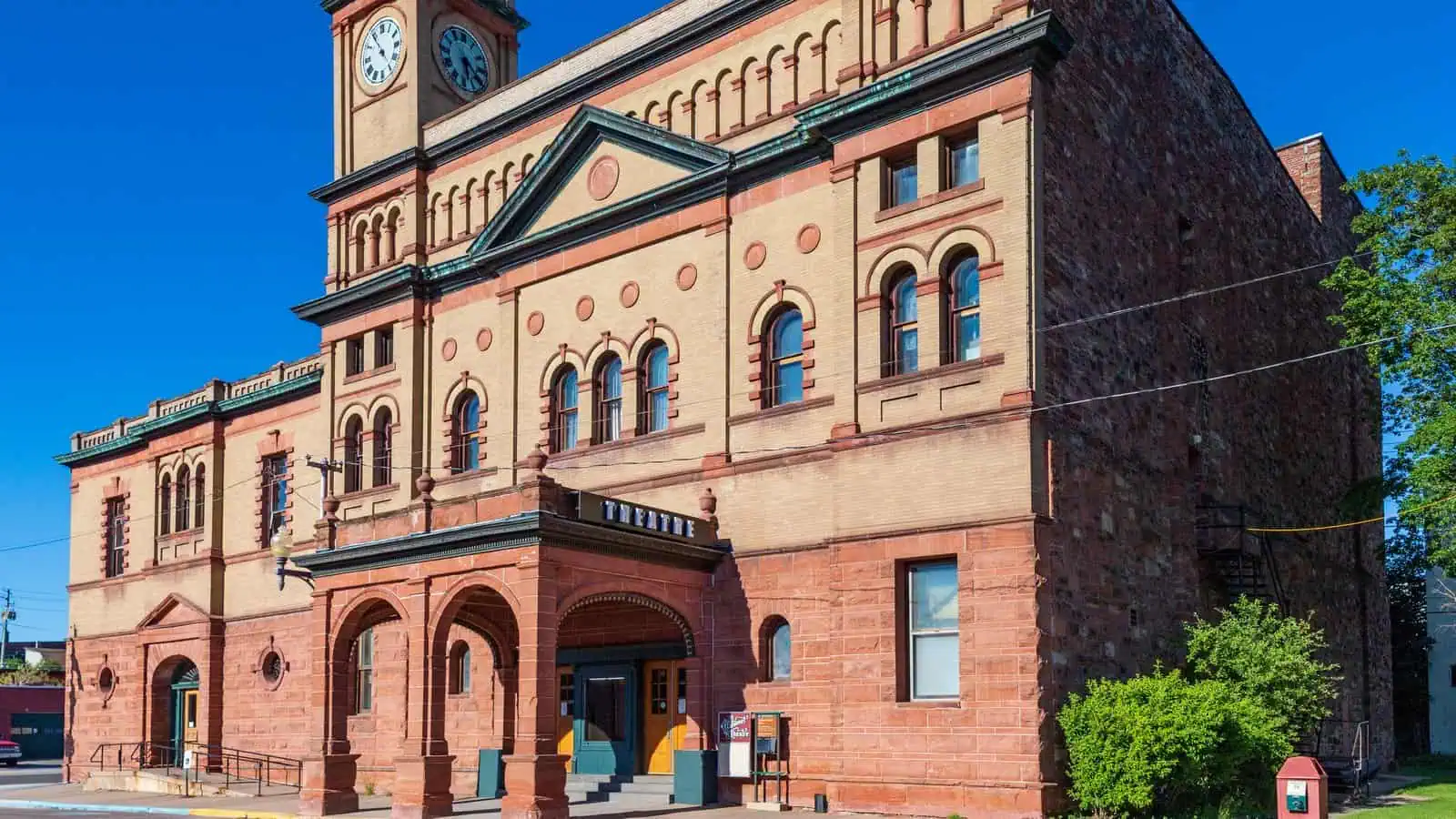
Calumet had the money to mean it. The Calumet and Hecla mine underneath the village was one of the richest copper operations in the world, the population had climbed into the tens of thousands, and the village decided to spend some of that on an opera house it owned outright. It opened on March 20, 1900, with a touring Broadway production of The Highwayman, and the night was reported as the greatest social event the district had ever seen.
Charles K. Shand, an architect who lived and worked in the copper country, drew it. William Eckert came up from Chicago to do the interior in crimson, gold and ivory. The building went up in yellow-brown brick on a foundation of Jacobsville sandstone quarried down the peninsula, with copper on the roof and copper in the cornices, because of course there was. Inside were twelve hundred seats, murals on a vaulted ceiling, and an electric chandelier when electricity itself was still worth mentioning in a sentence.
Then the performers came, which is the part that still sounds implausible.
Sarah Bernhardt played Calumet. So did John Philip Sousa, and Helena Modjeska, and Lillian Russell. Douglas Fairbanks Sr. and Lon Chaney Sr. both worked that stage before Hollywood existed in the form we think of it. James O’Neill came through, and William S. Hart, and Frank Morgan, who would become the man behind the curtain in The Wizard of Oz, and the Beery brothers. A person living in a mining village four hundred miles north of Chicago could buy a ticket and watch the most famous stage actress in the world do her work.
That happened because the touring circuits followed the money, and in 1900 the money was here. A company crossing the country by rail would play Chicago and Milwaukee and then run north to a town that could fill twelve hundred seats at a good price. Calumet was not a cultural outpost being generously visited. It was a market. The same copper boom that wired a growing America is what put Bernhardt on a northbound train.

Markets close. The copper went into a long decline, the touring circuits rerouted, and the movies arrived. From the Depression through the late 1950s the Calumet Theatre was essentially a movie house, which is a quiet way of saying it survived by becoming something less than it was built to be. That is also why it is still standing. Buildings that stay useful do not get torn down.
The recovery came in pieces and took decades. Summer stock returned in 1958. The auditorium was restored in 1975 for the village’s centennial, the exterior in 1988 and 1989, and an elevator went in as recently as 2018. It had been listed as a Michigan State Historic Site in April 1971 and added to the National Register that August, and it is now a heritage site of Keweenaw National Historical Park.
It runs something like sixty events a year now, in front of something like eighteen thousand people. Symphony, folk, jazz, opera, dance, community nights. For a village whose population is a fraction of what it was when the doors opened, that is a remarkable amount of use.
What makes the place worth understanding is not the celebrity list, though the celebrity list is fun. It is that a mining town at its peak looked at its own money and decided the thing to build was a room where people sit together in the dark. Then the ore ran out, the crowds thinned, the town got smaller, and the room stayed. It is still doing the only thing it was ever for.
Go See It
Calumet Theatre, Calumet
- Hours
- Guided tours: prescheduled, Wednesday to Friday at 1 p.m., about two hours (the theatre’s tours page, which also shows an October 2026 calendar). Box office: Monday to Friday 10 a.m. to 5 p.m., Saturday and Sunday noon to 4 p.m. Book by calling 906-337-2610 or emailing boxoffice@calumettheatre.com. The National Park Service listing (last updated April 2, 2025) says tours run seasonally Tuesday to Saturday at 1 p.m.
- Cost
- The theatre’s site lists no tour price. The National Park Service listing, last updated April 2, 2025, lists $15 per person. The theatre says children under 6 are free with a paid adult. Event ticket prices vary.
- Season
- The theatre’s tours page lists no season dates. The National Park Service listing says tours are run seasonally, that winter and private tours can be scheduled through the box office, and that the theatre is open year-round.
- Drive
- From Marquette: 2 hr 10 min (112 mi) via US-41 N
From the Bridge: 4 hr 44 min (275 mi) via M-28 W and US-41 N (Google Maps flags tolls on this route)
More worth reading


Yooper Hub community
The conversation
Know something this story missed? Corrections and additions get read by an editor and folded into the article, with credit.
Real neighbors, real names. A Yooper Hub editor reads your first comment before it appears; after that you’re a known neighbor and your comments post right away. No account required. Community guidelines
1 comment
I was told, my Great Grandfather, Barney Holmstrom, worked on the building of the Opera house. His company built half of the houses in Laurium.
Sources, credits, and reporting details
Sources & accountability
How this story was reported
Editorial methodAggregation
Last verifiedAug. 13, 2026
Corrections statusNo material correction note is recorded on this article.
AI assistanceResearched and drafted with AI tools. Reviewed and approved by editor Keegan O’Brien. Tool: Claude.
Verification note: The widely repeated claim that this was the first municipally built and owned theatre in the United States was deliberately kept out of the copy: the theatre's own history does not make it, and no primary source was found for a national first. The piece says only that the village built and owned it, which every source supports.
Primary sources
-
Our History — The Calumet Theatre
Accessed Aug. 13, 2026.
-
Calumet Theatre, Keweenaw National Historical Park heritage site — National Park Service
Accessed Aug. 13, 2026.
Additional reporting
-
Calumet Theatre — Wikipedia
Accessed Aug. 13, 2026.
Photo and media credits
-
Calumet Theater Calumet Michigan 2021-4308 — Paul R. Burley / Wikimedia Commons
Featured image record. Published Jun. 19, 2021. Accessed Aug. 13, 2026. CC BY-SA 4.0.
Supports: Photo credit for the featured image.
-
Proscenium stage at the Calumet Theatre — CyclingSal / Wikimedia Commons
Published Oct. 3, 2019. Accessed Aug. 13, 2026. CC BY-SA 4.0.
Supports: Photo credit for the inline stage image.

