Everyone knows the night of October 8, 1871, as the night Chicago burned. Far fewer know that the same night, hundreds of miles north, the deadliest wildfire in American history tore through the forests around Green Bay, and that before it was done, it crossed the Menominee River and reached into the Upper Peninsula. In a scattered farming settlement in Menominee County called Birch Creek, families were burned out of their homes with almost no warning, and at least 22 people, by some counts closer to 40, did not survive the night.
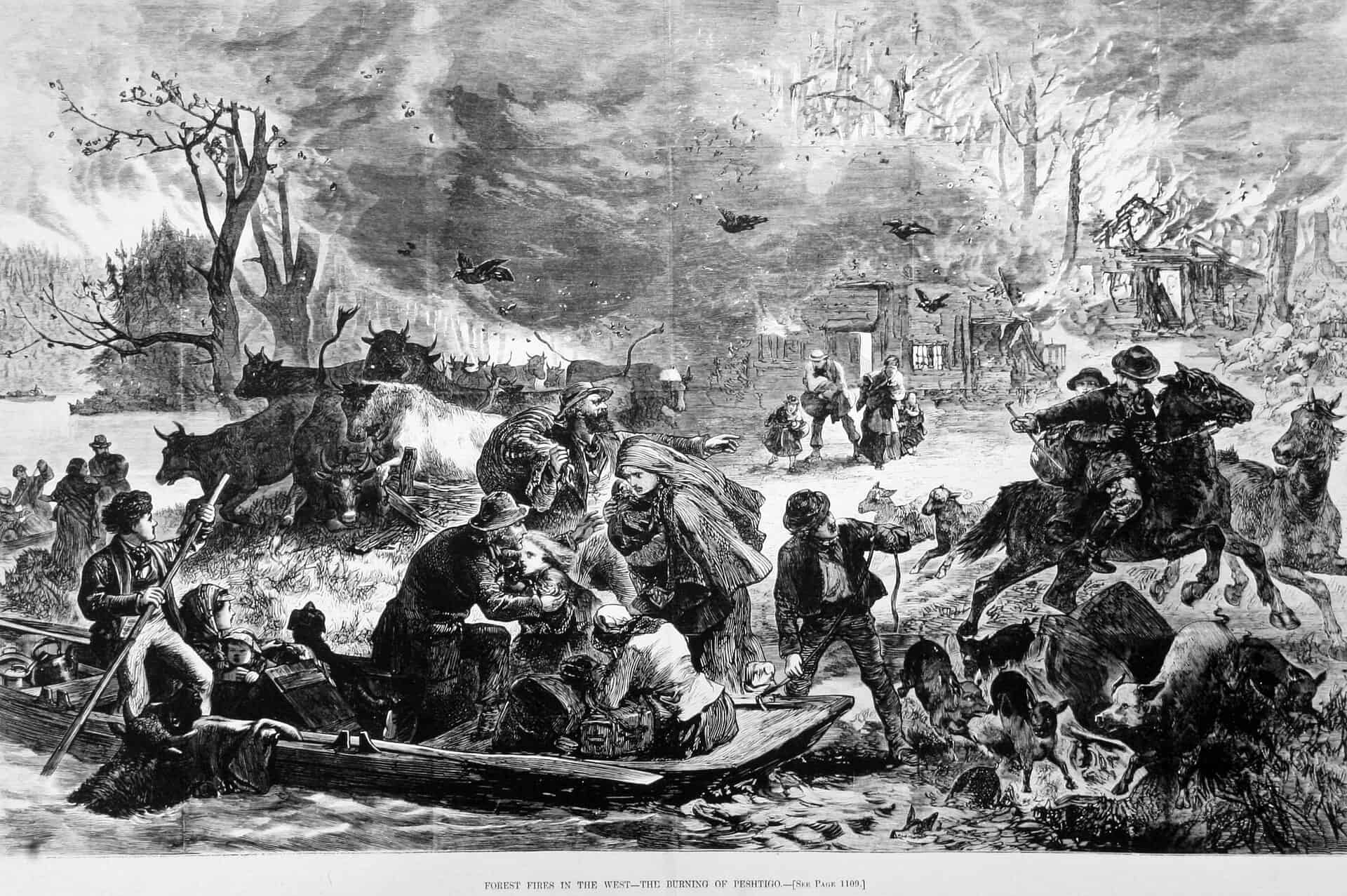
The great fire is remembered, when it is remembered at all, by the name of the Wisconsin town it erased: Peshtigo. Roughly 800 people died there in about an hour. Across the whole fire region, the toll ran somewhere between 1,200 and 2,500 lives, several times the count of the Chicago fire that took all the headlines. Birch Creek was the fire’s Michigan chapter, and it has been a footnote to a footnote ever since. It should not be.

A dry summer, a loaded forest
The summer of 1871 had been a drought for the record books. Swamps dried out, corduroy roads smoldered, and small fires burned in the woods for weeks across the whole region. The logging boom had left the forest floor covered in slash, the dried tops and branches left behind by the cutting crews, which is about the most flammable material on earth. On October 8, a powerful cold front swept in with ferocious winds, and everything that had been smoldering exploded at once, from Chicago all the way up the shore of Green Bay.
The main firestorm consumed Peshtigo and the surrounding farm country with a speed survivors could barely describe, a wall of flame witnesses compared to a tornado of fire. Then it split. One fork burned toward the villages at the mouth of the Menominee River. The other jumped the river itself, flinging burning debris ahead of it, and came down on the Michigan side.

Birch Creek
Birch Creek was a small farming community that had taken root in the 1850s, families spread out across their clearings rather than gathered in a village. When the fire came over the river it came fast, and people simply ran. By the detailed accounting made afterward, the dead at Birch Creek included eight men, two women, and twelve children. Every house in the settlement burned. One farmer, William Sieman, saved his family by putting them in a plowed field, where there was nothing left to burn, and covering them with wet blankets while the fire went over. Stories like his are most of what survived.
Why nobody remembers
The reason the country forgot is simple and a little cruel. Chicago burned the same night, and Chicago had the telegraph lines, the newspapers, and the famous cow story. Relief poured toward the city while the burned-over farm country to the north waited. Even Peshtigo, with its hundreds of dead, slid out of the national memory, and Birch Creek slid out of Peshtigo’s shadow in turn. Today the Menominee County Historical Society keeps the records, the Peshtigo Fire Museum and cemetery across the river keep the story, and the anniversary passes every October with the woods quiet and green again.
It is worth pausing on, especially in a dry U.P. summer. The deadliest fire this country has ever seen did not stop at the state line, and the people it took in Michigan were farm families who had maybe ten minutes’ notice that the world was ending. They deserve to be more than a footnote.
More worth reading


Sources, credits, and reporting details
Sources & accountability
How this story was reported
Editorial methodArchival synthesis
Accountable editor:Keegan O’Brien, publisher and editor.
Last verifiedJul. 12, 2026
Corrections statusNo material correction note is recorded on this article.
AI assistanceResearched and drafted with AI tools. Reviewed and approved by editor Keegan O’Brien.
Verification note: Facts, dates, quotes, and image licenses verified against the listed sources at time of writing; each source is tied to the specific claims it supports; assisted editorial review completed at K. O’Brien’s direction.
Primary sources
-
Menominee Township history (Sieman family account) — Menominee Township
Accessed Jul. 12, 2026.
Supports: Sieman family survived in a plowed field under wet blankets; many Birch Creek families died.
-
Wisconsin Historical Society reader: The Great Peshtigo Fire epilogue — Wisconsin Historical Society
Accessed Jul. 12, 2026.
Supports: Birch Creek toll recorded as eight men, two women, and twelve children.
-
Clarke Historical Library, CMU: A Fall of Fires — Clarke Historical Library
Accessed Jul. 12, 2026.
Supports: Every house in Birch Creek reported burned; regional 1871 devastation.
Additional reporting
-
US Deadly Events: 1871 wildfires incl. Birch Creek MI tolls — USDeadlyEvents
Accessed Jul. 12, 2026.
Supports: Accounts place Birch Creek deaths between 27 and 40; fire crossed into Menominee County.
-
Wikipedia: Peshtigo fire — Wikipedia
Accessed Jul. 12, 2026.
Supports: Oct 8, 1871; deadliest wildfire in recorded history; 1,500–2,500 dead; 1.2M acres.
Photo and media credits
-
Featured image: 1871 Peshtigo firestorm illustration, U.S. Forest Service archives — Wikimedia Commons
Featured image record. Accessed Jul. 12, 2026. Public domain.
Supports: Featured image is accurately identified, licensed, and credited in the caption.