Drive into Ishpeming and look at the skyline. Rising over the west end of town, above Lake Bancroft, are two enormous Egyptian obelisks.
They are not a monument. They are not a folly some eccentric put up. They are working mine buildings — the headframes that stood over the A and B shafts of the Cliffs Shaft Mine, and for decades they hauled men and iron ore up out of the ground beneath the city.

Why a mine hired a real architect
By 1919, the original wooden headframes over those shafts, dating back to the sinking of the mine in the 1870s, were worn out and unsafe. Replacing them was routine. What Cleveland-Cliffs did next was not.
Company president William G. Mather looked at where these structures stood — right in the middle of Ishpeming, visible from everywhere in town — and decided that if the whole community had to look at them, they ought to be worth looking at. Practicality was not enough. He wanted architecture.
So an iron mining company hired George Washington Maher, a Chicago School architect with a serious reputation, and paired him with the Condron Company, structural engineers out of Chicago. An architect of that standing collaborating with mining engineers on industrial equipment was close to unheard of at the time.
What Maher gave them was a matched pair of reinforced-concrete Egyptian Revival obelisks, mirror images of each other, in pale brown and pink. Each sits on a base of about 37 by 57 feet and rises nearly 97 feet from its footings to the point of the roof. The profiles are blunt and the geometry austere — austere enough that architectural historians see the shadow of H. H. Richardson’s Ames Monument in Wyoming in them.
The part that should not have been possible
Here is the detail that makes engineers grin.
The mine could not afford to stop hoisting. Iron was moving, men were working, and shutting down the shafts for a construction project was out of the question. So they built the new concrete obelisks around the old wooden headframes while those headframes were still running.
The towers went up encasing the working structures inside them. Then, on successive weekends, crews switched the hoisting ropes over from the old rigging to the new. Only after that did they dismantle the wooden headframes — from inside the concrete shells that had grown up around them. The hoist never stopped.

Sixty-five miles of tunnel under the town
What those obelisks served was, by the numbers, one of the most productive iron mines in the country. Opened by the Iron Cliffs Company in 1879 and acquired by Cleveland-Cliffs in 1891, the Cliffs Shaft became the nation’s largest producer of hard specular hematite. It shipped ore every year but one from 1887 onward, and gave up more than 26 million tons before it was through.
To get it, crews drove roughly 65 miles of tunnels running under most of Ishpeming, reaching a depth of about 1,358 feet. As late as the 1930s there were eight iron mines operating in town. The Cliffs Shaft outlasted every one of them.
A larger modern C shaft took over the hoisting work in 1955, and the mine finally closed in 1967 — the end of underground iron mining in the area. The obelisks stayed standing over a town that no longer had a mine, in the same way nearby Negaunee kept living on top of its own hollowed-out ground.
What is there now
The complex went onto the National Register of Historic Places in 1992. In 1998 the former owners donated most of the property to a nonprofit formed to preserve Marquette Iron Range mining history, and the Cliffs Shaft Mine Museum opened in 1999.
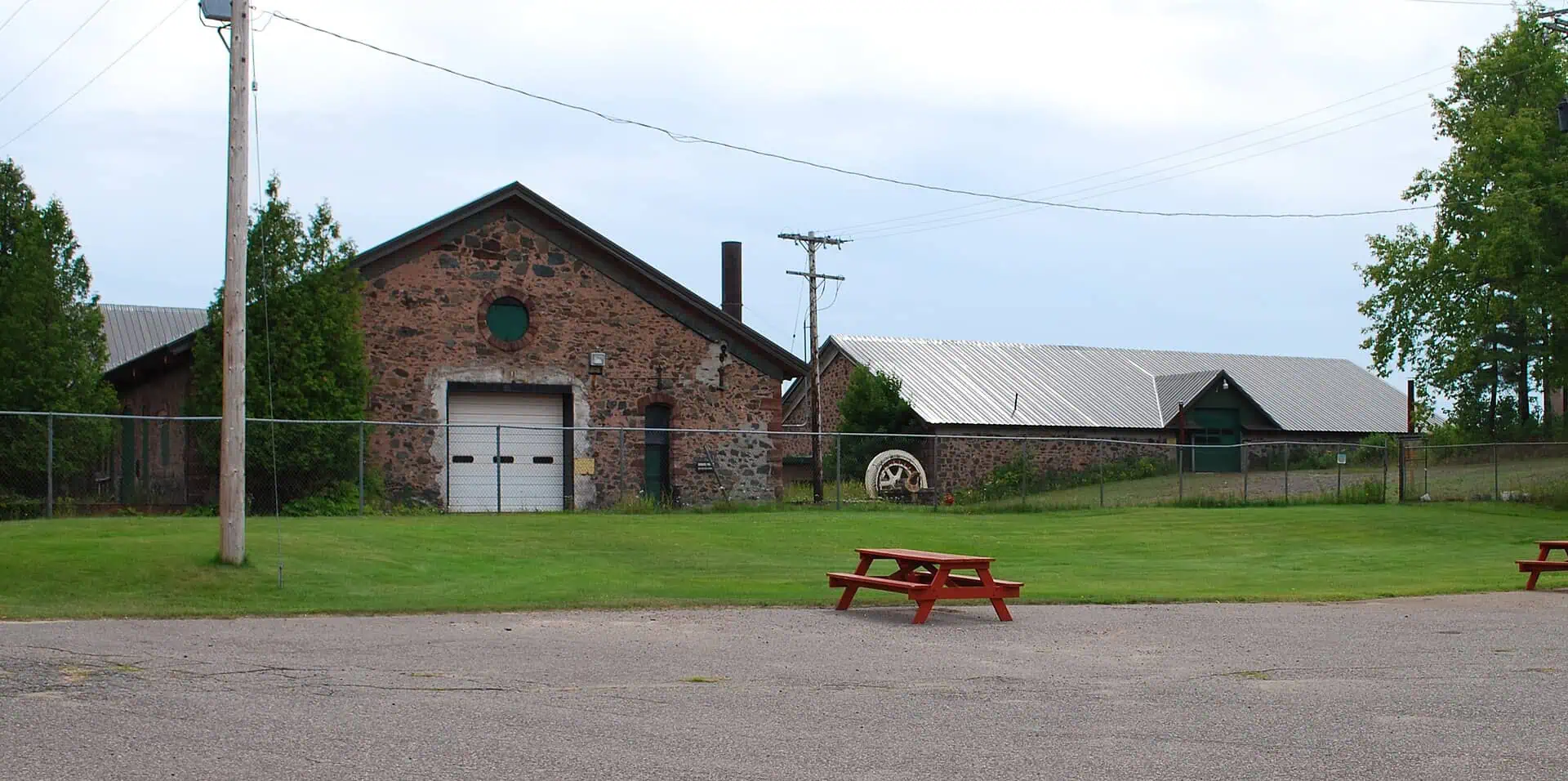
Today the 15-acre site holds three headframes and eight other buildings. The museum occupies the old dry house, with mining artifacts, photographs, a chemical lab, blasting displays, and more than 500 mineral specimens from the Ishpeming Rock and Mineral Club. Outside sits heavy equipment including a 170-ton ore truck whose tires stand about 12 feet high. Former miners guide underground tours down to the base of the C shaft, and the 47-mile Iron Ore Heritage Trail runs right through the property.
Every mining town in the U.P. has ruins. Ishpeming is the one where the company looked at a piece of industrial equipment, decided the neighbors deserved better than a rusting timber frame, and put up something with the nerve to still be beautiful a century after the ore ran out. Like the giant pumping engine down in Iron Mountain, the machinery outlived the mine that needed it.
Go See It
Cliffs Shaft Mine Museum, Ishpeming
- Hours
- Museum Tuesday to Saturday, 10 a.m. to 4 p.m. Guided tours at 10 a.m., 11:30 a.m., 1 p.m. and 2:30 p.m.
- Cost
- Museum only: $12 adults, $6 kids 6 to 17, 5 and under free. Guided tour: $18 adults, $9 kids 6 to 17, 5 and under free.
- Season
- The museum listed regular 2026 hours from May 22 through late September (its site reads "Saturday, September 25th"; the Saturday is the 26th). As of September 29 it has closed for the year; the next season opens in mid-May.
- Drive
- From Marquette: 21 min (15.4 mi) via US-41
From the Bridge: 3 hr (179 mi) via US-2 W and M-28 W (toll on the Bridge)
More worth reading


Sources, credits, and reporting details
Sources & accountability
How this story was reported
Editorial methodArchival synthesis
Last verifiedJul. 23, 2026
Corrections statusNo material correction note is recorded on this article.
AI assistanceResearched and drafted with AI tools. Reviewed and approved by editor Keegan O’Brien.
Verification note: Initial ledger, verified 2026-07-23 during publication prep. The 1919 construction, Maher and Condron collaboration, dimensions, build-around-the-working-headframe method, production figures, tunnel extent and museum history were checked against the sources listed. Two conflicts are noted and resolved on the record: one railroad-history site dates the concrete headframes to 1910 against the 1919 consensus of the Library of Congress, SAH Archipedia and contemporaneous reporting, and the article follows 1919; and an encyclopedia infobox gives an 1868 opening against the state marker 1879, and the article follows the marker. Maher is described using the scholarly source wording. No direct quotations. Featured image CC BY-SA 4.0, credit Andrew Jameson, resized without cropping. No AI-generated or AI-assisted media.
Primary sources
-
Cliffs Shaft Mining Museum (Cliffs Shaft Mine Headframes) — SAH Archipedia (Kathryn Bishop Eckert, Buildings of Michigan, University of Virginia Press)
Featured image record. Accessed Jul. 23, 2026. Scholarly architectural reference; cited.
Primary scholarly source; origin of the build-around-the-working-headframe detail that anchors the article.
-
Michigan historical marker text, Cliffs Shaft Mine, quoted in full — Michigan Historical Commission marker, reproduced by Travel the Mitten
Featured image record. Published Nov. 11, 2017. Accessed Jul. 23, 2026. Public marker text, reproduced; cited.
State marker text; used for production figures, tunnel extent and dates.
Additional reporting
-
Cliffs Shaft Mine Museum — Wikipedia
Featured image record. Accessed Jul. 23, 2026. CC BY-SA text; cited.
Infobox gives an opening year of 1868 that conflicts with the state marker 1879 date; the article follows the marker.
-
Then and Now: Standing tall for 100 years — The Mining Journal (Marquette)
Featured image record. Published Jan. 3, 2024. Accessed Jul. 23, 2026. Copyright Ogden Newspapers; cited.
Source of the dimensions.
-
Cliffs Shaft Mine Museum — Kiddle encyclopedia (Wikipedia-derived)
Featured image record. Published Oct. 17, 2025. Accessed Jul. 23, 2026. CC BY-SA derivative; cited.
-
Show Mines of the United States: Cliffs Shaft Mine Museum — showcaves.com
Featured image record. Accessed Jul. 23, 2026. Copyright showcaves.com; cited.
Source of the ore truck figures; tire height converted to about 12 feet in the article.
-
Cliffs Shaft Mine Museum in Ishpeming — Atlas Obscura
Featured image record. Published Jul. 10, 2016. Accessed Jul. 23, 2026. Copyright Atlas Obscura; cited.
Describes Maher as Prairie School while SAH Archipedia says Chicago School; the article uses the scholarly source wording.
Photo and media credits
-
Cliffs Shaft Mine 2009a.jpg — Andrew Jameson / Wikimedia Commons
Featured image record. Accessed Jul. 23, 2026. CC BY-SA 4.0; credit Andrew Jameson.
