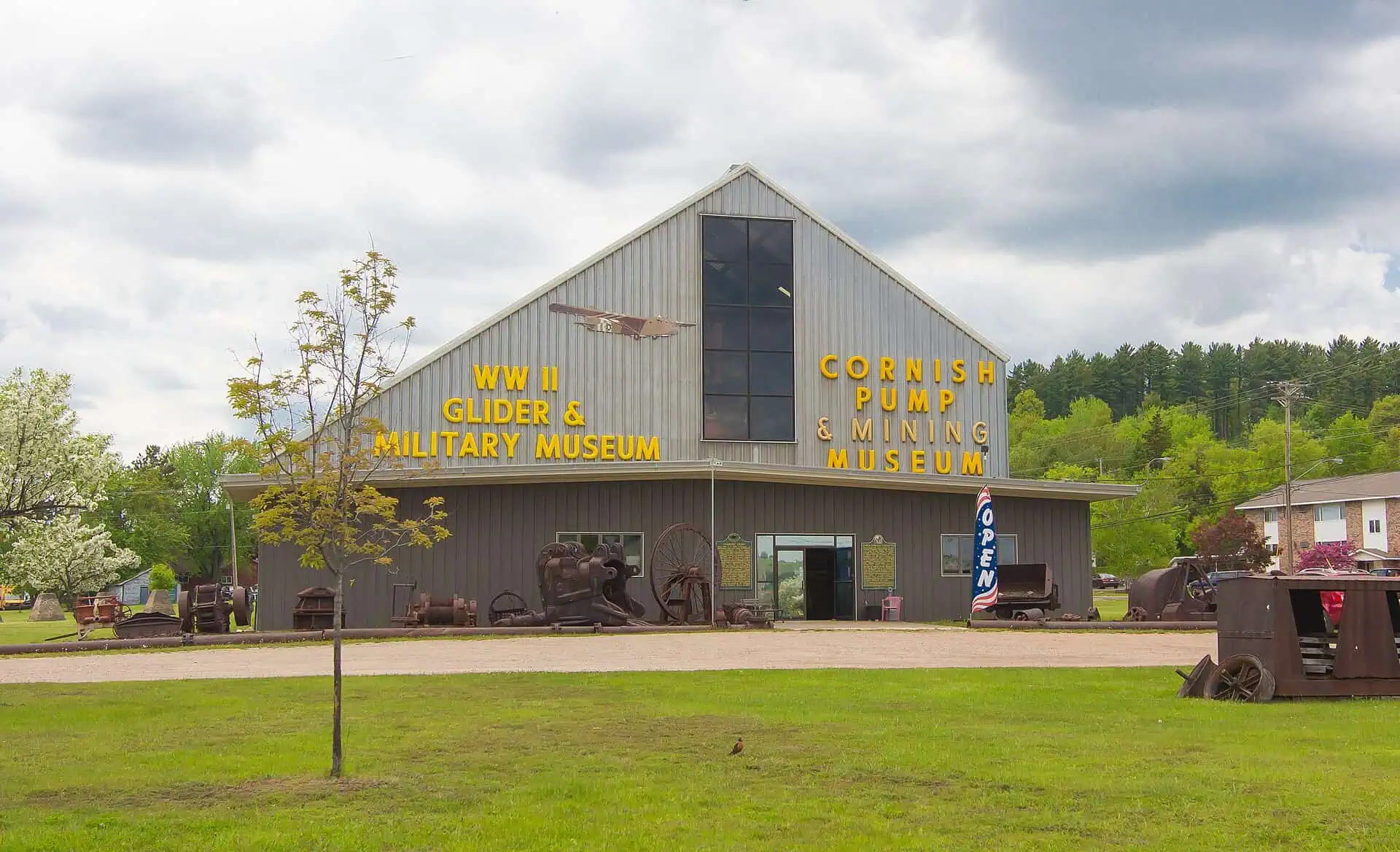
In a museum on Kent Street in Iron Mountain stands a machine 54 feet tall and 75 feet long, with a flywheel four stories across that spins partly in a trench cut below the floor. It weighs 725 tons. Nothing else in the Upper Peninsula towers over a room the way it does, and it was never built to dig a single pound of ore. It was built to fight water — and the water very nearly won.
Iron Mountain exists because of the Chapin Mine, the strike that birthed the town in 1879 and became the biggest producer on the whole Menominee Iron Range. The catch revealed itself almost immediately: part of that beautiful ore body sat underneath a cedar swamp. To sink the first deep shaft, crews had to get through some 90 feet of quicksand — which they did by freezing it solid with two of the largest refrigeration compressors ever built, then lining the shaft with cast iron like a giant pipe driven into the earth. That was the easy part.
One of the wettest mines ever worked
The deeper the Chapin went, the harder the water came. The museum that tends its story today calls it one of the wettest mines ever worked, and for its first decade the operation limped along on conventional and compressed-air pumps that were slowly losing the argument. So in the early 1890s the mine’s owners went to the E.P. Allis Company of Milwaukee, where engineer Edwin Reynolds — assisted by his nephew Irving — designed something without precedent on this side of the Atlantic. It was running by 1893, at an estimated cost of a quarter of a million dollars at the time.
The numbers still read like a tall tale. A 160-ton flywheel, 40 feet in diameter, turning a stately 10 revolutions per minute. A chain of eight pumps stacked down the shaft roughly every 170 to 190 feet, each lifting water into a 3,000-gallon tank for the next one to grab — a bucket brigade reaching 1,500 feet underground. Every stroke moved 319 gallons. That worked out to 3,190 gallons a minute, better than four and a half million gallons a day, on more than 1,200 horsepower and a diet of thousands of tons of coal a year. The American Society of Mechanical Engineers would later certify what Iron Mountain already knew: it proved to be the largest steam-driven pumping engine ever built in the United States, and engineers and mine men traveled from around the world to watch it run.
The name is a lie, and a tribute
Everyone called it the Cornish Pump, a tip of the hard hat to Cornwall, whose miners had spent generations learning how to work deep, wet ground — and whose sons filled the U.P.’s mining towns. Engineers will cheerfully point out that a true Cornish engine has no flywheel at all, which makes the most famous “Cornish” engine in America technically not one. Nobody in Dickinson County has ever much cared.
The giant did its job. It was relocated to a second Chapin shaft around 1909 and helped the mine pull more than 27 million tons of iron ore out of the ground before the Chapin finally closed in 1932. Two years later the company handed the engine to Dickinson County as a monument. During World War II the scrap drives came for it — 600-plus tons of steel is a tempting target — and the community said no. In 1978 the Menominee Range Historical Foundation took over its care and built a museum around the machine, because moving it was never really an option. The plaques have piled up since: Michigan Historic Site in 1958, National Register of Historic Places in 1981, and in 1987 the ASME landmark designation that put it alongside the great machines of American history.
The ore is long gone. The town the mine built is still here. And the machine built to hold back the water has now stood in Iron Mountain longer than the mine it saved ever operated. Visitors who walk in for the first time all do the same thing: stop, look up, and keep looking up. America’s biggest steam pumping engine was never for digging. It was for bailing — and it never quit until the digging did.
Correction, August 17, 2026: an earlier version of this story called the Cornish Pump the U.P.’s biggest machine. A reader noted that the Nordberg steam hoist at the Quincy Mine in Hancock is the heavier machine at more than 880 tons. The sourced claim, certified by the American Society of Mechanical Engineers, is that the Chapin pump is the largest steam-driven pumping engine ever built in the United States, and the story now says that.
More worth reading


Sources, credits, and reporting details
Sources & accountability
How this story was reported
Editorial methodArchival synthesis
Last verifiedJul. 19, 2026
Corrections statusNo material correction note is recorded on this article.
AI assistanceResearched and drafted with AI tools. Reviewed and approved by editor Keegan O’Brien.
Verification note: Initial ledger, verified 2026-07-19 during publication prep. Specifications and history checked against ASME landmark records, the stewarding museum, and supporting coverage; where figures differ between sources, the museum and ASME figures were used. Sole direct quotation is the ASME superlative phrase. Featured image CC BY-SA 4.0, credit rossograph, resized without cropping. No AI-generated or AI-assisted media.
Primary sources
-
Chapin Mine Pumping Engine, National Historic Mechanical Engineering Landmark brochure — American Society of Mechanical Engineers
Featured image record. Published Jun. 6, 1987. Accessed Jul. 19, 2026. ASME landmark publication; brief quotation with attribution.
Sole direct quotation in the article is the eleven-word superlative phrase.
-
Chapin Mine Pump, ASME landmark page — American Society of Mechanical Engineers
Featured image record. Accessed Jul. 19, 2026. ASME; cited.
-
Cornish Pumping Engine and Mining Museum — Menominee Range Historical Museums
Featured image record. Accessed Jul. 19, 2026. Museum interpretive content; cited.
Additional reporting
-
Chapin Mine Steam Pump Engine — Wikipedia
Featured image record. Accessed Jul. 19, 2026. CC BY-SA text; cited.
-
A History of Landmark Pumps and Waterworks: ASME Milestones — Machine Design
Featured image record. Accessed Jul. 19, 2026. Copyright Endeavor Business Media; cited.
-
Cornish Pump Iron Mountain — Up North Michigan
Featured image record. Accessed Jul. 19, 2026. Copyright MichiganWebsNet; cited.
-
ASME Landmarks list, Cornish engine background — Engineering and Technology History Wiki
Featured image record. Accessed Jul. 19, 2026. ETHW; cited.
Supports the point that the Cornish Pump is technically not a Cornish engine.
-
Chapin Mine Steam Pump Engine, community history summary — Kiddle encyclopedia (Wikipedia-derived)
Featured image record. Accessed Jul. 19, 2026. CC BY-SA derivative; cited.
Photo and media credits
-
Cornish Pump.jpg — rossograph / Wikimedia Commons
Featured image record. Accessed Jul. 19, 2026. CC BY-SA 4.0; credit rossograph.
