Bear season opened in the Upper Peninsula on September 9 with 5,103 licenses, the same 5,103 as last year, unit for unit. The DNR’s drawing release called the 2026 numbers “similar to last year.” They are identical. And they were set before anyone knew that 2025 hunters would take 1,522 bears in the U.P. against a management goal of 1,244, which is 22 percent over, in a year the department describes its goal-setting as landing “within about 15%.”
Why the number did not move
There is no mystery and no scandal in it. Michigan sets bear quotas in two-year cycles. Wildlife Conservation Order Amendment No. 2 of 2025 fixed the 2025 and 2026 quotas together when the Natural Resources Commission passed it 6 to 0 in March 2025. The DNR said so again in January: “The next adjustments will be made for the cycle of bear hunting regulations covering 2027-2028.” Nothing that happened last fall could change this fall.
The 2025 cycle was itself a cut. The 2023 order carried 5,406 U.P. licenses; 2025 dropped that by 303 to 5,103. Statewide the total is 6,278 both years, with 1,175 in the northern Lower Peninsula.
The 2026 U.P. quotas

By bear management unit and hunt period: Baraga 305, 435 and 830. Bergland 170, 230 and 435. Newberry 200, 200 and 480. Gwinn 140, 155 and 440. Carney 90, 155 and 320. Amasa 120, 110 and 280. Drummond Island 8. Hunt 1 runs Sept. 9 to Oct. 21, Hunt 2 Sept. 14 to Oct. 26, Hunt 3 Sept. 25 to Oct. 26. No more than 5 percent of any hunt’s licenses go to nonresidents.
What 2025 actually looked like
Preliminary DNR numbers: 1,952 bears statewide, 1,522 of them in the U.P., which holds 83 percent of Michigan’s bears. Statewide success ran around 40 percent. Nearly 73,000 people applied for a license or a point, the most since the state started regulating bear hunting in 1925. The DNR’s harvest goal for the U.P. was 1,244, the fifth straight year the region came in over goal.
A word about that goal. Outlets call it the “predicted harvest.” The DNR calls it the desired harvest. It is a management target, set by multiplying licenses by recent success rates, not a forecast. Coming in over it means the population is running ahead of where the department wants it, which the DNR says out loud: “An increasing bear population in the U.P. has resulted in harvest above goal.”
The population estimate, though, went the other way between the two most recent surveys. The department put U.P. bears a year and older at 10,969 in 2023 and about 10,350 in 2024. Its stated goal for the 2025 to 2028 cycle is to stabilize the population, not grow it.

The big ones
The DNR reported “an estimated 20 bears above 400 pounds and eight bears above 500 pounds” registered last fall. Read the fine print. That is at the Escanaba-area check stations alone, and it is an estimate. No statewide count of 400-pound bears exists.
Opener checklist
Dogs are legal in the U.P. from Sept. 14, so Hunt 1’s first five days are still-hunting and bait only. Eight dogs maximum in a pack. Bait stations, up to three per hunter, have been legal since Aug. 9 and no chocolate is allowed. Elevated platforms on public land must be portable, carry your name or license number, and come down within five days of the season’s end. Firearm hunters wear hunter orange; archers are exempt. A cub is any bear under 42 inches nose to tail, and neither cubs nor sows with cubs are legal.
Within 72 hours the head and hide, unfrozen and undivided, or the whole animal, go to a registration station, where a premolar is pulled for aging. Edible meat must be used. There are about 60 stations statewide, from Denman’s Hardware in Munising to Fort Wilkins State Park in Copper Harbor; the full list is in the DNR digest. Licenses are $25 for everyone, resident or not; the gap for nonresidents is the $151 base license.
More worth reading


Yooper Hub community
The conversation
Know something this story missed? Corrections and additions get read by an editor and folded into the article, with credit.
Real neighbors, real names. A Yooper Hub editor reads your first comment before it appears; after that you’re a known neighbor and your comments post right away. No account required. Community guidelines
Nothing here yet. A sentence is plenty: a correction, a name, or what you remember about this place.
Sources, credits, and reporting details
Sources & accountability
How this story was reported
Editorial methodAnalysis
Last verifiedSep. 13, 2026
Corrections statusNo material correction note is recorded on this article.
AI assistanceResearched and drafted with AI tools. Reviewed and approved by editor Keegan O’Brien.
Verification note: Ledger establishes the 2026 U.P. bear quotas unit by unit against the DNR own 2026 Bear Hunting Regulations Summary; the listed per-unit numbers sum to exactly 5,103, and the statewide total of 6,278 matches. The two-year cycle that makes 2026 identical to 2025 is Wildlife Conservation Order Amendment No. 2 of 2025, passed 6-0 by the Natural Resources Commission in March 2025; the signed order PDF could not be retrieved at a live URL, so the amendment number, vote and date are carried here on MUCC contemporaneous NRC recap rather than on the order itself. The 2025 harvest figures, the roughly 73,000 applicants as the most since regulation began in 1925, the fifth straight year over the U.P. goal, and the 2023 and 2024 population estimates are each carried by a listed source. One framing to watch: the article says the U.P. holds 83 percent of Michigan bears, which is a population share, not a share of the 1,952-bear statewide harvest. The sentence is correct as written but sits close enough to the harvest numbers to be misread. The Escanaba big-bear counts are the DNR own estimate at those check stations only, which the article states.
Primary sources
-
2026 Bear Hunting Regulations Summary — Michigan Department of Natural Resources
Published Jan. 1, 2026. Accessed Sep. 13, 2026.
Per-unit quotas in this document sum to exactly 5,103, matching the article; statewide total 6,278 also matches.
-
Showcasing the DNR: Bear hunters record strong 2025 harvest in Michigan — Michigan Department of Natural Resources
Published Jan. 9, 2026. Accessed Sep. 13, 2026.
DNR release distributed via GovDelivery. The 83 percent figure in this release describes the share of Michigan bear population living in the U.P., not the harvest split.
Additional reporting
-
March 2025 NRC Recap — Michigan United Conservation Clubs
Published Mar. 1, 2025. Accessed Sep. 13, 2026.
Stands in for the signed order, which could not be retrieved at a live michigan.gov URL. Substitute the order here if it becomes reachable.
-
Michigan Upper Peninsula bear harvest exceeds predicted kill for fifth year — Outdoor News
Published Feb. 12, 2026. Accessed Sep. 13, 2026.
Confirms both the fifth-straight-year framing and the two population estimates the article contrasts.
-
Michigan Natural Resources Commission sets bear license quotas, tweaks rules — Outdoor News
Published Mar. 22, 2025. Accessed Sep. 13, 2026.
Supports: The 5,103 U.P. figure is 303 fewer licences than the 2023-2024 cycle 5,406.
Confirms the cut the article describes; the 2023 comparison number is carried here.
Photo and media credits
-
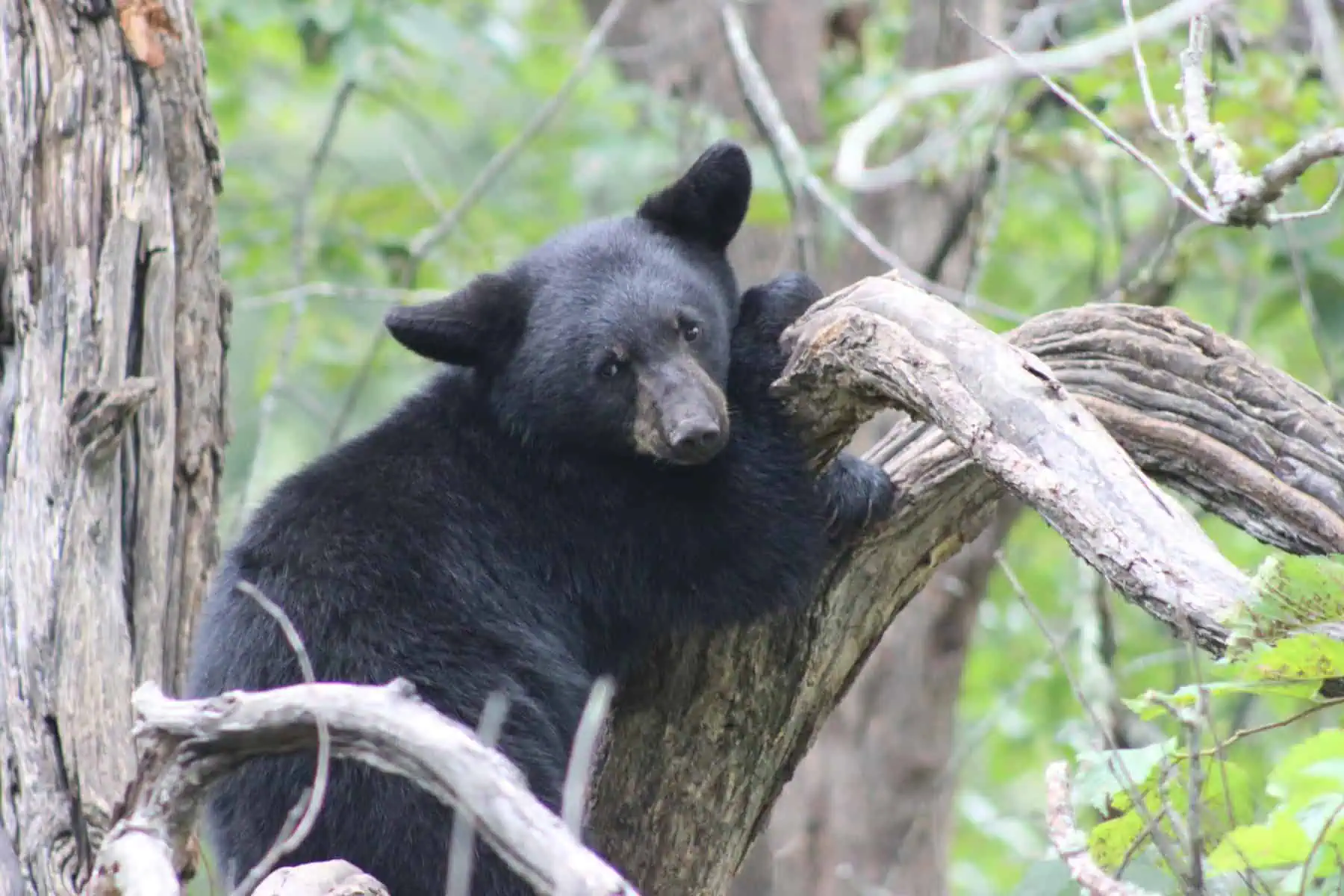
Black bear, U.S. Fish and Wildlife Service Midwest Region file photo (featured image) — U.S. Fish and Wildlife Service, Midwest Region, via Wikimedia Commons
Featured image record. Accessed Sep. 13, 2026. Public domain, U.S. federal government work.
Rights are solid: USFWS Midwest Region black bear photographs on Commons carry USFWS Midwest Region as author and a U.S. federal government public domain tag. The exact file page is not pinned. Our uploaded copy is re-encoded, so a SHA-1 lookup against Commons returned no byte-identical file, and several near-identical USFWS Midwest black bear frames exist. Public domain status does not turn on which of them it is.