Here is an argument that has been running in the Keweenaw for more than a century: everything north of Houghton is an island.
The Keweenaw Waterway cuts clean across the peninsula, from Keweenaw Bay through Portage Lake and out to Lake Superior on the far side. Everything above that cut — Hancock, Calumet, Mohawk, Eagle River, Copper Harbor, the whole top of the copper country — is surrounded by water. Finnish miners who came in the mid-1800s called it Kuparisaari. In English that is Copper Island, and it is still the name people actually use.
What keeps it off the maps is that the water did not finish the job on its own. The Portage Lake Ship Canal opened in 1860, work on the western cut through to Lake Superior began in 1868, and the waterway was completed in 1874. Because that last stretch was dug rather than found, neither the U.S. Geological Survey nor the state of Michigan lists the result as an island, and plenty of people who have lived up there for years have never once called it one. Michigan Tech geographer Don Lafreniere does not accept the distinction, telling Visit Keweenaw that the northern peninsula is “technically, and absolutely, an island.” At roughly 560 square miles it would be the largest one in Michigan, better than double Isle Royale.
And there is exactly one way to drive there. US-41 and M-26 both funnel down to the same crossing, and the Portage Lake Lift Bridge carries all of it. Somewhere north of 20,000 vehicles a day, every ambulance, every propane truck, every kid coming home from Michigan Tech, over one span.

The heaviest of its kind on Earth
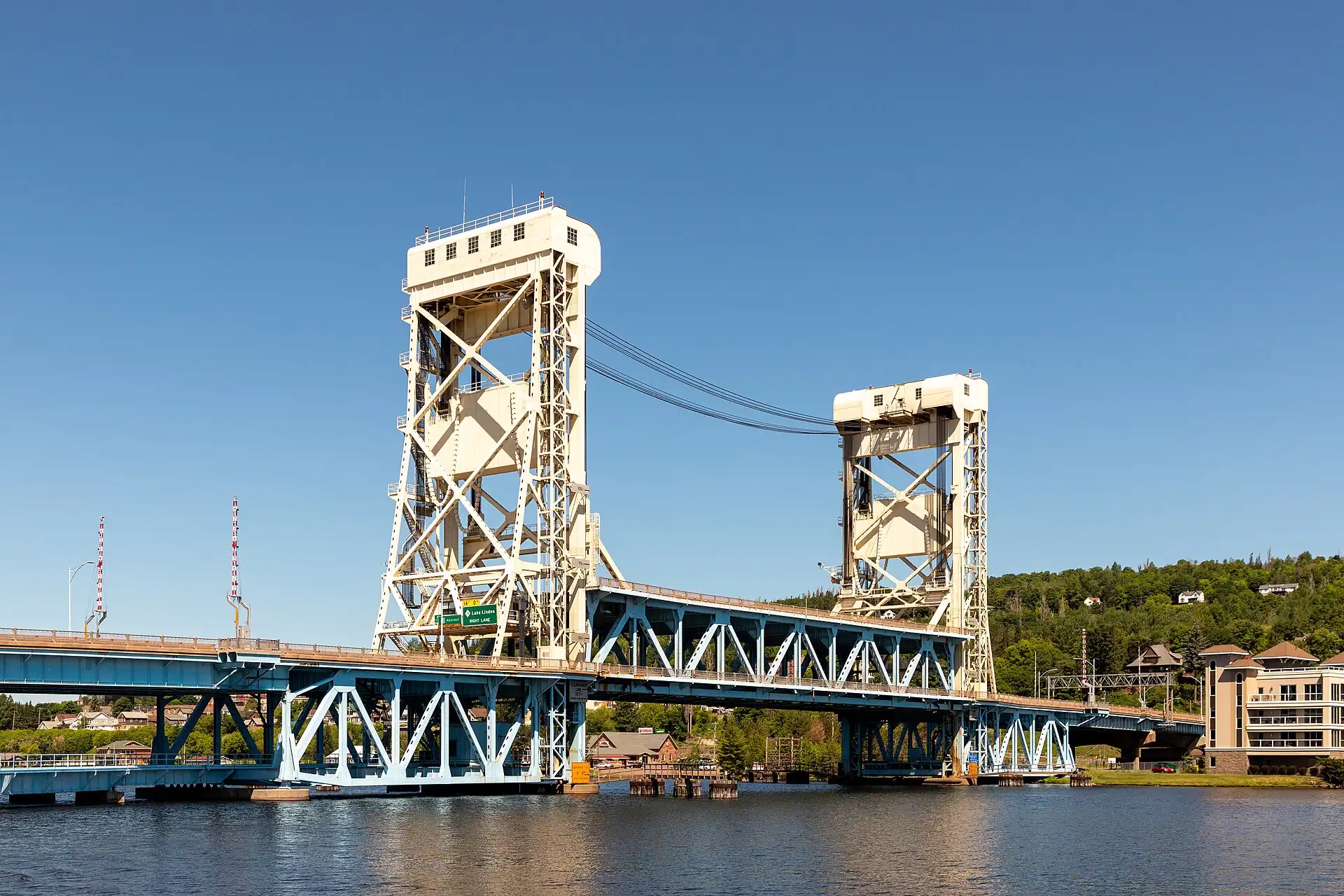
Fortunately, they did not build it small. The bridge that opened in 1959 — officially the Houghton–Hancock Bridge, though nobody calls it that — is the heaviest and widest double-decked vertical-lift bridge in the world. More than 35,000 tons of concrete and 7,000 tons of steel went into it. The lift span alone weighs about 4.58 million pounds. The towers stand 180 feet over the water, and the whole structure runs 1,310 feet across.
It replaced a narrow 54-year-old swing bridge that had been declared an outright menace to navigation on a waterway that was still moving copper. Chicago engineers Hazelet and Erdal drew it up, the American Bridge Company put it together, and construction ran from a frigid start in December 1957 straight through two Keweenaw winters. Michigan’s state transportation director summed up the achievement years later at the landmark ceremony: built in 1959, and “all the calculations were done by hand.”
The clever part nobody notices
Most lift bridges have two settings: down for cars, up for boats, and somebody is always waiting. The Portage Lake bridge was the first in the United States built with a third option — an intermediate position.

Fully lowered, it sits about four feet over the water. Raised all the way, it clears 100 feet, enough for serious lake traffic. But parked in the middle, at roughly 32 to 36 feet, it lets most pleasure boats slip underneath while cars keep rolling across the top deck. One bridge, serving two kinds of traffic at once, on a crossing that cannot afford to close. That design is a large part of why the American Society of Civil Engineers made it a National Historic Civil Engineering Landmark, an honor pushed for by Michigan Tech students and faculty and formally dedicated in 2022.
The night it almost went wrong
The bridge opened to traffic in 1959, but the official ribbon cutting was set for Saturday, June 25, 1960. It nearly did not happen.
The night before the ceremony, a steamer heading west through the waterway signaled for the bridge to open. The signals were not acted on. With a ship of that size closing on a bridge that was not moving, the crew dropped every anchor they had — and in doing so snagged the submarine telephone cables running along the bottom, an almost exact repeat of an incident from twenty years earlier. The city’s own history keeps the story. The dedication went ahead the next morning as though nothing had happened.
What it carries now
The lower deck was built for trains, hauling the copper that built these towns down to the rest of the country. The railroad was abandoned in 1982, and rather than let a whole deck go to waste, the Keweenaw did what the Keweenaw does: in winter, the lower deck becomes a snowmobile crossing. Sleds cross underneath the cars.
Every June since 1987, Houghton and Hancock have thrown Bridgefest — concerts, a parade, fireworks over the water — a two-city party in honor of a piece of infrastructure. It sounds odd until you understand the arithmetic. This is the only road onto Copper Harbor, up to the snow gauge on US-41, out to the end of the pavement where the rockets flew. Cut this bridge and the top of the Keweenaw goes back to being what the canal made it.
An island, whatever the map says. With four and a half million pounds of steel arguing otherwise, twenty-four hours a day.
More worth reading


Sources, credits, and reporting details
Sources & accountability
How this story was reported
Editorial methodArchival synthesis
Last verifiedJul. 23, 2026
Corrections statusNo material correction note is recorded on this article.
AI assistanceResearched and drafted with AI tools. Reviewed and approved by editor Keegan O’Brien.
Verification note: Initial ledger, verified 2026-07-23 during publication prep. Weights, dimensions, clearances, construction dates, the intermediate-position innovation and the 1960 dedication incident were checked against the university, state and municipal sources listed. Daily traffic figures differ between sources, so the article uses a conservative range. The steamer name in the municipal account is not repeated because it could not be confirmed elsewhere. Sole direct quotation is a seven-word fragment via FOX 2 Detroit. Featured image CC BY-SA 4.0, credit Paul R. Burley, resized without cropping. No AI-generated or AI-assisted media.
Primary sources
-
Rich History, Unique Design Make Lift Bridge a National Historic Civil Engineering Landmark — Michigan Technological University
Featured image record. Accessed Jul. 23, 2026. University news release; cited.
-
Portage Lake Bridge history, historical pictorial view — City of Hancock
Featured image record. Accessed Jul. 23, 2026. Municipal historical record; cited.
Municipal source for the night-before-dedication incident; the vessel name given there is not repeated in the article because it could not be confirmed in a second source.
Additional reporting
-
Portage Lake Lift Bridge recognized as historic landmark — FOX 2 Detroit
Featured image record. Published Jun. 21, 2022. Accessed Jul. 23, 2026. Copyright FOX 2 Detroit; brief quotation with attribution.
Sole direct quotation in the article is a seven-word fragment of the transportation director remarks.
-
Portage Lake Lift Bridge — Wikipedia
Featured image record. Accessed Jul. 23, 2026. CC BY-SA text; cited.
-
Houghton Hancock Bridge (Portage Lake Lift Bridge) — HistoricBridges.org
Featured image record. Accessed Jul. 23, 2026. Copyright HistoricBridges.org; cited.
-
Connecting Hancock and Houghton: The Portage Lake Lift Bridge — Northern Michigan History
Featured image record. Accessed Jul. 23, 2026. Copyright northernmichiganhistory.com; cited.
-
Portage Lake Lift Bridge rehabilitation — Modjeski and Masters
Featured image record. Accessed Jul. 23, 2026. Engineering firm project record; cited.
Photo and media credits
-
Portage Lake Lift Bridge 2020-9808.jpg — Paul R. Burley / Wikimedia Commons
Featured image record. Accessed Jul. 23, 2026. CC BY-SA 4.0; credit Paul R. Burley.
