Seven feet long, older than the ice age, and still gliding along the bottom of the water you grew up on.
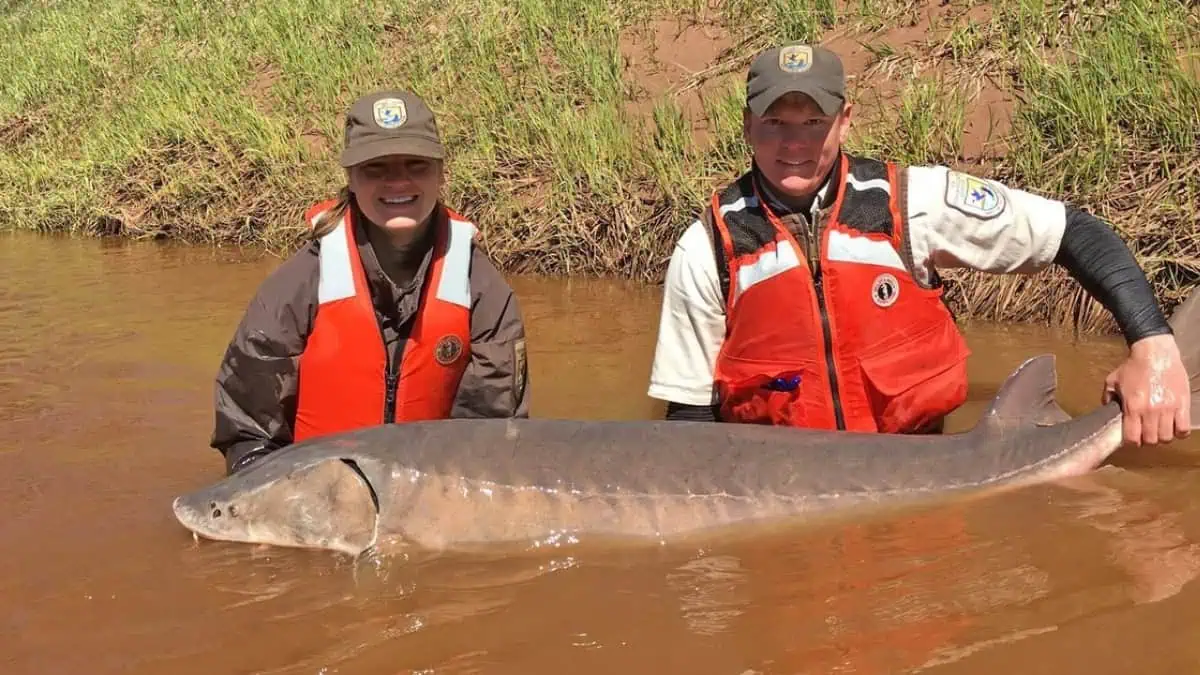
There’s a fish swimming in the U.P. right now whose kind was already gliding through the water when dinosaurs ruled the planet. The lake sturgeon can grow longer than a person is tall, live past 100, and it has barely changed in something like 150 million years. It’s a living dinosaur, and it’s down there in Lake Superior and the rivers you grew up near.
Everything about it looks prehistoric, because it pretty much is. Instead of scales, a sturgeon wears five rows of bony armored plates called scutes. It’s got a shark-like tail, a long snout, four whisker-like barbels, and a toothless, sucker-shaped mouth on the underside that vacuums food right off the bottom. Scientists call it a “living fossil,” a creature whose ancestors were swimming around while dinosaurs stomped overhead.
And they get big. Lake sturgeon are Michigan’s largest freshwater fish, full stop. They can top 7 feet and 200 pounds. The state record, speared back in 1974, was an 88-inch, 193-pound giant. In 2021, biologists in the Detroit River caught and released one that weighed 240 pounds and stretched nearly 7 feet, one of the biggest ever recorded in the country. A female can live to 100, 120, even 150 years, which means a sturgeon cruising a U.P. river today might have hatched before your great-grandparents were born.

For the Anishinaabe, the sturgeon, nmé, has been sacred for thousands of years, a vital food and a centerpiece of ceremony long before Europeans arrived. But once commercial fishing took off in the 1800s, the sturgeon’s luck ran out. Fishermen called it a trash fish because it tore up their nets, and they killed it by the millions. In 1880 alone, more than 4 million pounds were hauled out of Lake Huron and Lake St. Clair. By 1928, the entire Great Lakes catch had collapsed to under 2,000 pounds. The dried bodies were stacked like cordwood and burned for fuel.
Here’s the better news. The sturgeon is clawing its way back. In 1994 Michigan listed it as a threatened species, and ever since, the DNR has teamed up with Anishinaabe tribes and federal partners to rebuild the population. They raise young sturgeon in riverside facilities until the fish “imprint” on their home water, then release them to return and spawn years later. It’s slow, patient work, the same kind of comeback the U.P. pulled off with its moose. And it’s paying off. In 2024, federal officials decided the sturgeon was recovering well enough that it didn’t need endangered-species protection.

You probably won’t reel one in by accident, and you shouldn’t try. Sturgeon are protected, and almost everywhere in Michigan it’s catch-and-release only. But they’re out there, in Lake Superior, in the Menominee River along the Wisconsin line, in the waters that gave the Sturgeon River its name. Every spring they push upriver to spawn, exactly like their ancestors did when the U.P. was buried under ice.
So the next time you’re standing on a U.P. riverbank or looking out at Lake Superior, think about what might be gliding along the bottom beneath you. Not a legend, not a story. A real, living dinosaur, armored and ancient, that has outlasted the ice ages, the asteroid, and just about everything else thrown at it. Still here, in the same cold water it has always called home.
Featured Image Photo: U.S. Fish and Wildlife Service, public domain. Cropped and resized for Yooper.
Explore more: Lake Superior Stories
More worth reading


Yooper Hub community
The conversation
Know something this story missed? Corrections and additions get read by an editor and folded into the article, with credit.
Real neighbors, real names. A Yooper Hub editor reads your first comment before it appears; after that you’re a known neighbor and your comments post right away. No account required. Community guidelines
Nothing here yet. A sentence is plenty: a correction, a name, or what you remember about this place.
Sources, credits, and reporting details
Sources & accountability
How this story was reported
Editorial methodAggregation
Last verifiedJul. 13, 2026
Corrections statusNo material correction identified in the July 13, 2026 source review.
AI assistanceResearched and drafted with AI tools. Reviewed and approved by editor Keegan O’Brien.
Verification note: CEO-directed review checked the central claims against 1 direct public evidence link on July 13, 2026. No material correction was identified. Featured image rights and attribution independently verified against the retained source record on 2026-07-14; attachment 1178 restored under Keegan O'Brien dated approval.
Primary sources
-
Direct evidence for: Meet the Lake Sturgeon: a 150-Million-Year-Old Living Fossil Still Cruising U.P. Rivers and Lake Superior — U.S. Fish and Wildlife Service
Accessed Jul. 13, 2026.
Direct public evidence reviewed against the article on July 13, 2026.
Photo and media credits
-
112-pound lake sturgeon — U.S. Fish and Wildlife Service
Featured image record. Accessed Jul. 14, 2026. U.S. federal work, public domain.
species file photo. Do not imply that the source record places this individual fish in a U.P. river or Lake Superior.