Thirty-one years ago, the U.S. Air Force packed up and left K.I. Sawyer, and took roughly a fifth of Marquette County’s economy with it. On Tuesday night, the county voted to ask whether it can come back.
The Marquette County Board of Commissioners passed a resolution 6 to 0 to open talks with the military about a possible return to the old base south of Marquette. Before anyone pictures fighter jets over Gwinn again, though, here is the part most of the headlines are skipping: the resolution that passed is a lot smaller than the one that was written.
What the county actually voted on
The original wording, drafted by board Chairman Joe Derocha and County Administrator Duane Duray, would have authorized county representatives to take necessary action to recommission the airport, in whole or in part, as a national defense Air Force base. That is a big swing. But commissioners amended it on the floor before the vote, softening it to authorize representatives only to enter into discussions and obtain information about the idea.
In other words, nobody approved a base. They approved a conversation. Derocha called it a starting point for revitalizing the community, and Duray said the county is confident the military is interested in expanding activity at the airport. That is real, but it is a long way from runways full of bombers.
The base that built Marquette County, and the hole it left
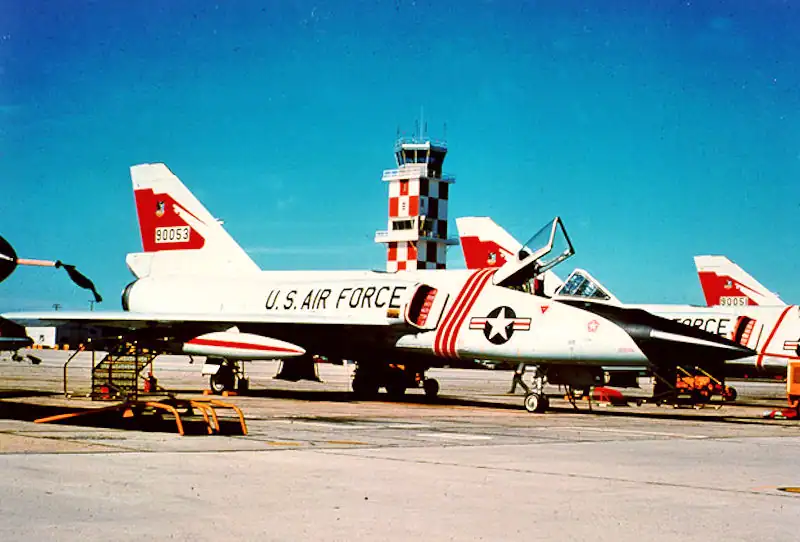
To understand why this lands so hard up here, you have to know what Sawyer was. The Air Force took over the site in 1955 and opened the base in 1959, choosing this stretch of sand plains south of Marquette for a brutally specific Cold War reason: it sat in the path to intercept Soviet bombers flying over the North Pole toward Detroit. It began as a fighter-interceptor base, then in 1963 became something far heavier, home to the 410th Bombardment Wing, its B-52H Stratofortress nuclear bombers, and the KC-135 tankers that kept them flying. Crews poured a runway nearly two and a half miles long just to handle the B-52s.

At its peak, the base and the community around it held around 12,000 people, the second-largest population center in the entire Upper Peninsula. The Air Force spent roughly $157 million a year in the region. Then the Cold War ended, the Pentagon decided it had more heavy-bomber bases than it needed, and in 1995 Sawyer got the axe: a bomber-only base with no missile field to protect it on the closure lists. Its B-52s were sent to Louisiana.

The blow was almost incomprehensible. The closure drilled an estimated $100 million hole in the local economy, erased roughly 5,000 jobs, and cost the county about a fifth of its entire economy. Thousands of people moved away. Gwinn-area schools lost more than 1,600 students. As one local official put it at the time, losing a facility the size of Sawyer was like losing a Fortune 500 company.
The years nobody puts on a postcard
What came next is the part that makes some Sawyer residents uneasy about a repeat. With the neighborhoods suddenly half-empty and barely policed, the shuttered base became a magnet for trouble. Drug dealers and meth cooks moved into the cheap, vacant housing in the late 1990s, and the area picked up a reputation it spent decades trying to shake. By the mid-2010s, the K.I. Sawyer community still carried a poverty rate estimated near 46 percent and unemployment that at times rivaled Detroit’s. It is also split between two townships, with no single local government to fully police or maintain it.
The community has clawed back a lot since: a community center, a clinic, a couple thousand residents, around 60 businesses. But that boom-and-bust whiplash is exactly why the vote was not unanimous in the room, even though it was on the board.
Not everyone wants the jets back
More than a dozen residents spoke against the resolution Tuesday night. Some worried about losing their homes if the military reclaimed housing; commissioners insisted that will not happen. Others said there simply had not been enough public input, especially from the people who actually live at Sawyer. And several named the fear underneath all of it: that the military could build the community back up and then leave again. As resident Grant Combs put it, do you really want to set Gwinn up as a place whose economy is a cycle of success and devastation.
If you live near Sawyer, read this part
Any honest conversation about Sawyer has to include an environmental asterisk, and it doubles as the most useful thing in this story. K.I. Sawyer has a known PFAS problem: decades of Air Force firefighting foam left behind so-called forever chemicals in the groundwater, and the cleanup is still active today, run jointly by the Air Force, the state environmental agency EGLE, and the Michigan Department of Health and Human Services.
If you live in the area, two things are worth knowing:
- MDHHS is offering free drinking-water well retesting to residents near the base whose wells were previously tested for PFAS or who were offered water filters. There is no charge, and you can call MDHHS Environmental Health to schedule a collection appointment.
- The Air Force holds public Restoration Advisory Board meetings on the cleanup, and the county’s discussions about a base return are public too. If you have an opinion either way, there are actual rooms where it counts.
The thing people forget
The military never fully left. That two-and-a-half-mile runway is now Marquette Sawyer Regional Airport, which quietly handles more than half of all the Upper Peninsula’s airline passengers, despite Marquette County making up barely a quarter of the region’s population. The Air Force still uses Sawyer for training, including large multi-state exercises like Northern Strike. And one of the B-52s that once sat nuclear alert here is parked at the K.I. Sawyer Heritage Air Museum, inside a former alert building, kept by the people who refuse to let the place be forgotten.
State Representatives Dave Prestin, Karl Bohnak, and Greg Markkanen have all backed exploring a return, arguing that the strategic value of the Lake Superior region is being noticed again in Washington. Bohnak has been careful to say any new base would not be a K.I. Sawyer 2.0, but something built fresh with local and federal partners. Whether it ever happens is genuinely unknown. What is certain is that, 31 years after the jets left, Marquette County just decided the conversation is worth having.
Explore more: Marquette Stories
More worth reading


Yooper Hub community
The conversation
Know something this story missed? Corrections and additions get read by an editor and folded into the article, with credit.
Real neighbors, real names. A Yooper Hub editor reads your first comment before it appears; after that you’re a known neighbor and your comments post right away. No account required. Community guidelines
Nothing here yet. A sentence is plenty: a correction, a name, or what you remember about this place.
Sources, credits, and reporting details
Sources & accountability
How this story was reported
Editorial methodService and public-interest reporting
Last verifiedJul. 13, 2026
Corrections statusNo material correction identified in the July 13, 2026 source review.
AI assistanceResearched and drafted with AI tools. Reviewed and approved by editor Keegan O’Brien.
Verification note: CEO-directed review checked the central claims against 1 direct public evidence link on July 13, 2026. No material correction was identified. Featured image rights and attribution independently verified against the retained source record on 2026-07-14; attachment 1185 restored under Keegan O'Brien dated approval.
Primary sources
-
Direct evidence for: Could the Air Force Come Back to K.I. Sawyer? Marquette County Just Took the First Step — TV6 / Upper Michigan's Source
Accessed Jul. 13, 2026.
Direct public evidence reviewed against the article on July 13, 2026.
Photo and media credits
-
K.I. Sawyer F-106 flight line — U.S. Air Force
Featured image record. Accessed Jul. 14, 2026. U.S. federal work, public domain.
archival 1976 image. It does not document a current Air Force basing decision or current aircraft.
