Glenn Seaborg grew up to win the Nobel Prize, help discover plutonium, and earn an honor almost no scientist ever gets
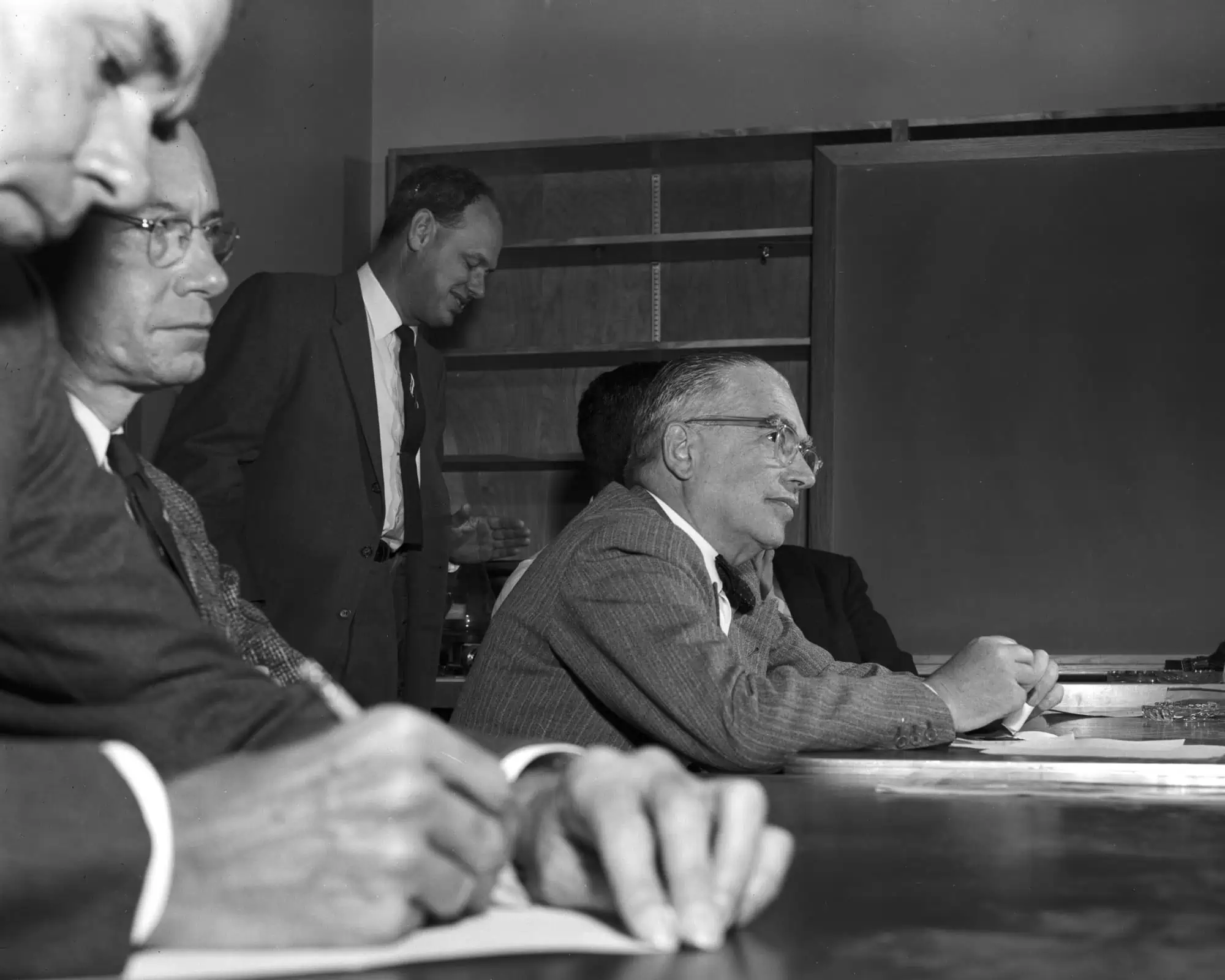
There is an element on the periodic table named seaborgium, after a man born in a little iron-mining town in the U.P. His name was Glenn Seaborg, one of the most important scientists of the 20th century.
And almost nobody outside the U.P. knows he was a Yooper.
Glenn Theodore Seaborg was born in Ishpeming in 1912, the son and grandson of Swedish immigrants. He learned Swedish before he learned English, and Northern Michigan University, just up the road in Marquette, says he was “every bit the normal Yooper.” When he was 10, his family packed up and moved to California.
Glenn T. Seaborg, the Ishpeming-born chemist who helped discover plutonium and later had element 106, Seaborgium, named in his honor. Photo courtesy of Berkeley Lab / Lawrence Berkeley National Laboratory.
He turned out to be a once-in-a-generation mind.
By 28, working at the University of California, Berkeley, he and his team had discovered a brand-new element: plutonium. He went on to help discover nine more, all of them heavier than anything found in nature.
During World War II, that work pulled him into the Manhattan Project, where he was responsible for figuring out how to produce plutonium in huge quantities, the plutonium that would go into the atomic bomb.
In 1951, at 39, Seaborg won the Nobel Prize in Chemistry.
He did something even rarer, too. He figured out where all those heavy new elements belonged, and in doing so, he reorganized the periodic table itself, the chart hanging in every chemistry classroom on earth.
And then came the honor almost no scientist ever gets. In 1997, element number 106 was officially named seaborgium, in his honor. He was the first person in history to have a chemical element named after them while they were still alive.
That was just part of it. Seaborg advised ten different U.S. presidents, ran the Atomic Energy Commission, helped negotiate nuclear test-ban treaties, and even co-discovered the radioactive tracer used in millions of medical scans today.
Through all of it, by the accounts of people who knew him, he never stopped thinking of himself as a kid from Ishpeming.
NMU named its science and math center after him, and the U.P. quietly claims him as one of its own, a boy from the iron country who grew up to change how we understand the building blocks of everything.
It is a reminder that the U.P. has always punched above its weight, the same scrappy corner of Michigan that once tried to become its own state.
And it all started in Ishpeming, the same town that later gave us a 23-foot working chainsaw and Da Yoopers.
So next time someone says nothing big ever comes out of the U.P., you can point them to the periodic table. Element 106. Named for a Yooper.
More worth reading


Yooper Hub community
The conversation
Know something this story missed? Corrections and additions get read by an editor and folded into the article, with credit.
Real neighbors, real names. A Yooper Hub editor reads your first comment before it appears; after that you’re a known neighbor and your comments post right away. No account required. Community guidelines
Nothing here yet. A sentence is plenty: a correction, a name, or what you remember about this place.
Sources, credits, and reporting details
Sources & accountability
How this story was reported
Editorial methodAggregation
Last verifiedJul. 13, 2026
Corrections statusNo material correction identified in the July 13, 2026 source review.
AI assistanceResearched and drafted with AI tools. Reviewed and approved by editor Keegan O’Brien.
Verification note: CEO-directed review checked the central claims against 1 direct public evidence link on July 13, 2026. No material correction was identified.
Primary sources
-
Direct evidence for: There’s a Chemical Element Named After a Yooper From Ishpeming, and Most People Have No Idea — Nobelprize
Accessed Jul. 13, 2026.
Direct public evidence reviewed against the article on July 13, 2026.
Photo and media credits
-
Nobel Prize press conference with Glenn T. Seaborg, Clyde Wiegand, Harold Fidler and Emilio Segre — Donald Cooksey, Lawrence Berkeley National Laboratory / Wikimedia Commons
Featured image record. Published Oct. 26, 1959. Accessed Aug. 15, 2026. Public domain.
Supports: Photo credit for the featured image.
Featured image added 2026-08-15. Resized from 3000×2400 to 2000×1600, no crop. Attribution and licence in the caption.
