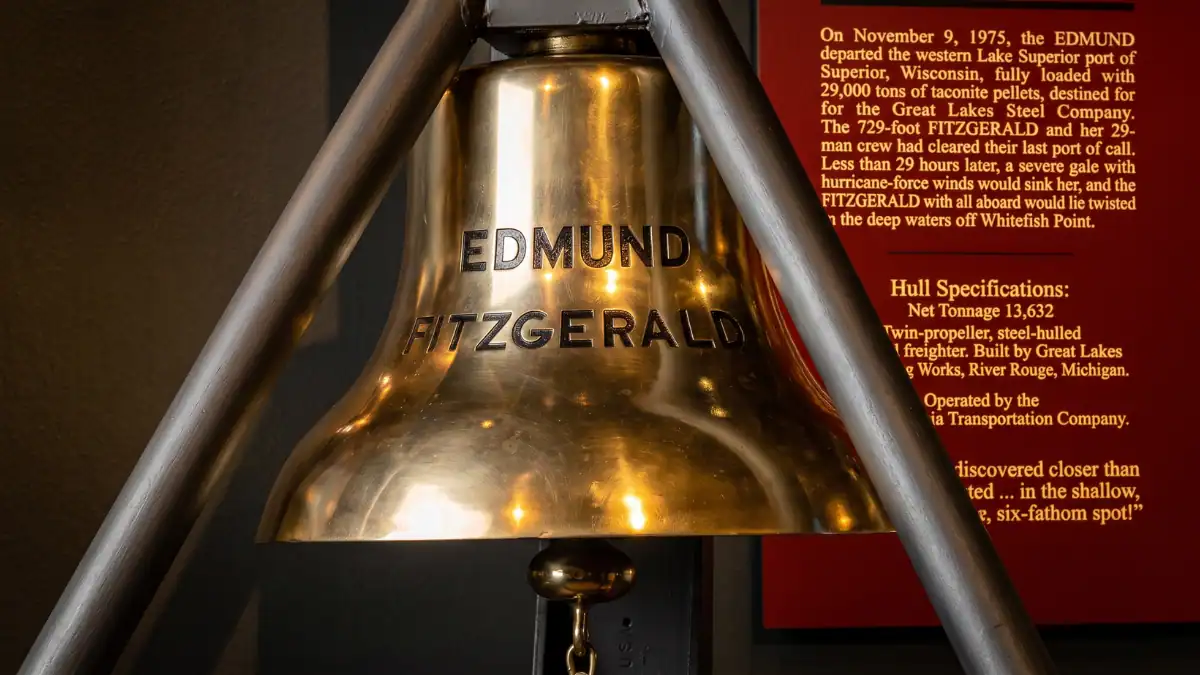
All 29 of her crew were lost on a stormy November night in 1975. At Whitefish Point, her recovered bell still tolls for every one of them.
On a stormy November night in 1975, the largest ship on the Great Lakes slipped beneath the waves of Lake Superior and took all 29 of her crew with her. She was just 17 miles from safety.
That ship was the Edmund Fitzgerald, and half a century later, the U.P. still has not forgotten her.
The Fitzgerald was a 729-foot iron ore freighter, the biggest vessel on the Great Lakes when she launched in 1958. On November 10, 1975, she was hauling a load of taconite pellets from Wisconsin toward Detroit.
Then one of the worst storms ever recorded on Lake Superior caught her.
She went down about 17 miles north-northwest of Whitefish Point, the safe harbor she had been racing for. There were no survivors. None of the 29 men aboard was ever recovered.
To this day, no one knows for certain exactly what sent her to the bottom. The mystery is part of what has kept the story alive.
A year later, Canadian songwriter Gordon Lightfoot turned the tragedy into a haunting ballad, “The Wreck of the Edmund Fitzgerald.” It became a hit, and it made sure the world would never forget the ship or her crew.
Today, that story lives at Whitefish Point, out past the town of Paradise on the wild eastern shore of Lake Superior. It is home to the Great Lakes Shipwreck Museum and a lighthouse that has guided sailors since 1849.
In 1995, divers brought the Fitzgerald’s 200-pound bronze bell up from more than 500 feet down.
In its place on the wreck, they left a replica bell engraved with the names of all 29 men.
The original now sits at the heart of the museum’s memorial. And every November 10, it is rung 29 times. Once for each life lost. A 30th ring honors every mariner the Great Lakes have ever claimed.
This past November marked 50 years. Thousands gathered at Whitefish Point in the cold to remember, the bell tolled again, and the families of the crew came together near the water where their loved ones were lost.
Whitefish Point is a place of stark beauty, a lonely spit of sand and pine on a shore that, on clear nights, glows with the Northern Lights. It is also one of the deadliest stretches of water on the Great Lakes, a graveyard coast where hundreds of ships have gone down.
It sits in the same wild eastern corner of the U.P. that gave us Tahquamenon Falls and beloved pieces of history like the century-old Toonerville Trolley.
Fifty years on, the lake has kept its secret. But it never got to keep their names. Up here, every November, the bell makes sure of that.
Recommended Reads
Why Pictured Rocks was America’s very first National Lakeshore
A U.P. university has been releasing Atlantic salmon into the same river for 40 years
Thousands drive past this tiny U.P. town every day and almost nobody knows its story
Topics: Edmund Fitzgerald, Whitefish Point, Great Lakes Shipwreck Museum, Lake Superior, Paradise Michigan, Chippewa County, Great Lakes, Upper Peninsula, maritime history
More worth reading


Yooper Hub community
The conversation
Know something this story missed? Corrections and additions get read by an editor and folded into the article, with credit.
Real neighbors, real names. A Yooper Hub editor reads your first comment before it appears; after that you’re a known neighbor and your comments post right away. No account required. Community guidelines
Nothing here yet. A sentence is plenty: a correction, a name, or what you remember about this place.
Sources, credits, and reporting details
Sources & accountability
How this story was reported
Editorial methodService and public-interest reporting
Last verifiedJul. 13, 2026
Corrections statusNo material correction identified in the July 13, 2026 source review.
AI assistanceResearched and drafted with AI tools. Reviewed and approved by editor Keegan O’Brien.
Verification note: CEO-directed review checked the central claims against 1 direct public evidence link on July 13, 2026. No material correction was identified.
Primary sources
-
Direct evidence for: Fifty Years Ago, the Edmund Fitzgerald Vanished Into Lake Superior 17 Miles From Safety. The U.P. Has Never Forgotten. — Shipwreckmuseum
Accessed Jul. 13, 2026.
Direct public evidence reviewed against the article on July 13, 2026.
Photo and media credits
-
SS Edmund Fitzgerald Bell at Great Lakes Shipwreck Museum — Creator or rights holder named in the WordPress attachment caption
Featured image record. Accessed Jul. 13, 2026. CC BY-SA 3.0.
Supports: Featured image used by this article.
The bell from the SS Edmund Fitzgerald on display at the Great Lakes Shipwreck Museum. Photo by Duchene9 via Wikimedia Commons, CC BY-SA 3.0. A photo of the bell from the SS Edmund Fitzgerald on display at the Great Lakes Shipwreck Museum. Image by Duchene9 via Wikimedia Commons, licensed under Creative Commons Attribution-ShareAlike 3.0.