In 1988, a retired couple from Ohio came snowmobiling out of the woods of the eastern U.P. and found a lighthouse standing completely alone on the Lake Superior shore, abandoned, crumbling, with the lake eating the ground out from under it. Don and Nellie Ross could have taken a photo and ridden on. Instead they went home, packed up their lives, moved north, and spent the rest of them saving it.
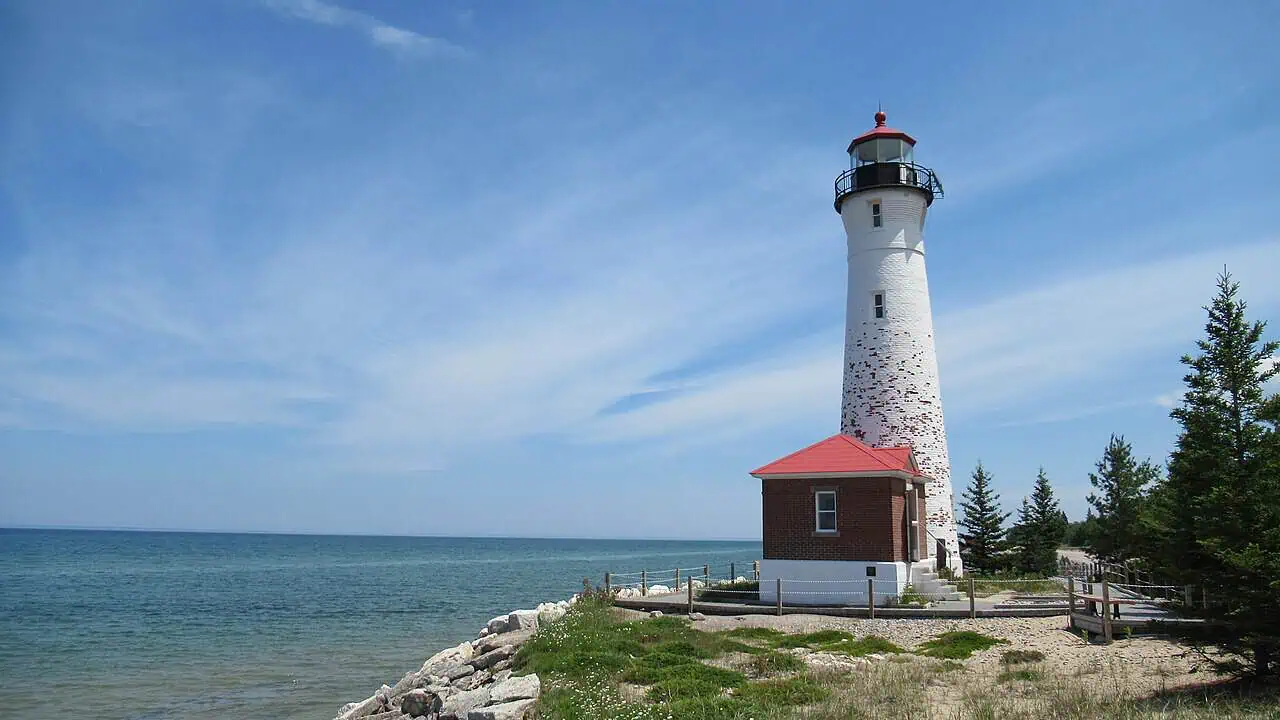
The lonely light on the Shipwreck Coast
Crisp Point sits on the deadliest stretch of Lake Superior, the run between Grand Marais and Whitefish Point that sailors named the Shipwreck Coast. The government put a life-saving station there back in 1876, staffed by surfmen who rowed out into storms after doomed ships, and named the point for one of their keepers, Christopher Crisp, remembered as an iron-willed boatman. The lighthouse came later, after the Lighthouse Board begged for money year after year. The land cost the government exactly thirty dollars. The 58-foot brick tower first lit up in May 1904, with a red lens shipped over from Paris.
For decades it did its job on that empty coast. The water offshore never got safer, though. In November 1975, the Edmund Fitzgerald went down roughly 18 miles northeast of Crisp Point with all 29 men aboard.
Left to die
The machines replaced the keepers in the 1940s, and in 1965 the Coast Guard bulldozed everything at the station except the tower and its little service room. In 1992 the light itself was switched off for good. What remained was a lone brick tower on a shrinking beach, with Lake Superior clawing closer every year. In November 1996 the lake finally collected. A storm tore the service room off the tower and dropped it into the water. The tower was next, and everyone knew it.
Fifty truckloads of stubbornness
Except the Rosses had other plans. They had founded the Crisp Point Light Historical Society in 1991, and in the winter after the collapse, the society hauled roughly a thousand cubic yards of quarry stone, about fifty truckloads, down that terrible dirt road from Newberry and packed it around the tower’s feet. It cost 42,000 donated dollars, and it worked. The lake was stopped. In the years since, volunteers rebuilt the service room brick for brick, put up a visitor center modeled on the old fog signal building, restored the tower, and in 2013 did the thing nobody expected: they turned the light back on. A lighthouse once written off on preservationists’ doomsday lists now shines every season from May through November, and around 15,000 people a year make the trip to see it.
Getting there is the point
Crisp Point is still gloriously hard to reach, about 18 miles of washboard dirt road off M-123 west of Paradise. Two warnings from the people who run it: your GPS will try to send you down the wrong road, so make your turn onto Luce County Road 500, and the last seven miles are seasonal and never plowed, becoming a snowmobile trail in winter, so do not attempt it in a car once the snow flies. The grounds are open year-round, the tower and visitor center roughly Memorial Day through mid-October, and there is no trash service, so pack out what you bring. What you get in exchange is a climbable lighthouse, a beach full of agates, and a horizon with absolutely nothing else on it. Volunteer keepers, one family at a time, live out there all season, and you can apply to be one.
Lake Superior takes what it wants, and it wanted this lighthouse. It lost, to a couple of retirees from Ohio and fifty truckloads of stone. That might be the most U.P. ending there is.
Go See It: Crisp Point Lighthouse — address, hours, cost, season and drive times.
Go See It
Crisp Point Light (Crisp Point Lighthouse)
- Hours
- Generally 10 a.m. to 6 p.m. daily in season, staffed by volunteers and subject to weather/availability — check the Historical Society's calendar before you go. The tower can be climbed (62 interior metal steps) when staffed. Grounds are accessible year-round with posted quiet hours of 11 p.m. to 6 a.m.; the tower and visitor center are closed and unstaffed in winter.
- Cost
- Free to visit the site and climb the tower. The Historical Society runs on donations and an online gift shop/membership program — no posted fixed climb or parking fee.
- Season
- Typically staffed Memorial Day weekend through mid-October (the navigational light itself operates May 1-November 1 under its Coast Guard permit). The final miles of access road are gravel/dirt/sand two-track that gets difficult or impassable outside that window.
- Drive
- From Marquette: 2 hr 53 min, 141 miles via M-28 E (Google Maps route, usual traffic, read Sept. 27, 2026)
From the Bridge: 2 hr 23 min, 104 miles via M-123 N, with the Mackinac Bridge toll (Google Maps route, usual traffic, read Sept. 27, 2026) - Contact
- info@crisppointlighthouse.org, visitor center (906) 658-4600, or PO Box 28, Newberry, MI 49868.
More worth reading


Yooper Hub community
The conversation
Know something this story missed? Corrections and additions get read by an editor and folded into the article, with credit.
Real neighbors, real names. A Yooper Hub editor reads your first comment before it appears; after that you’re a known neighbor and your comments post right away. No account required. Community guidelines
Nothing here yet. A sentence is plenty: a correction, a name, or what you remember about this place.
Golden 25 trust review · #14
Verified context for this Yooper Hub story
- Evidence refreshed
- July 13, 2026
- Source readiness
- Live source review complete.
- Corrections status
- No material correction note is recorded on this article.
- Image rights
- Featured and in-story images have documented rights records.
Sources, credits, and reporting details
Sources & accountability
How this story was reported
Editorial methodService and public-interest reporting
Accountable editor:Keegan O’Brien, publisher and editor.
Last verifiedJul. 13, 2026
Corrections statusNo material correction note is recorded on this article.
AI assistanceResearched and drafted with AI tools. Reviewed and approved by editor Keegan O’Brien. Tool: Claude Max.
Verification note: Lighthouse history and visitor conditions were checked against the preservation society and U.S. Coast Guard history. Featured image rights and attribution independently verified against the retained source record on 2026-07-14; attachment 1539 restored under Keegan O'Brien dated approval.
Primary sources
-
Crisp Point Lighthouse — Crisp Point Light Historical Society
Accessed Jul. 13, 2026.
Supports: Primary operational source for visitor access, preservation, and current notices.
-
Crisp Point Lighthouse history — U.S. Coast Guard Historian's Office
Accessed Jul. 13, 2026.
Supports: Supports the federal light-station history and historical context.
Photo and media credits
-
Crisp Point, June 2021 — Notorious4life
Featured image record. Accessed Jul. 14, 2026. CC0 1.0 public-domain dedication.
exact Crisp Point image; retain the June 2021 file-photo date.
.jpg)