If you’ve ever driven US-41 between Escanaba and Iron Mountain, you’ve passed right through it. A bend in the highway, a railroad crossing, a scatter of houses, and then it’s behind you. Most people never even catch the name on the sign.
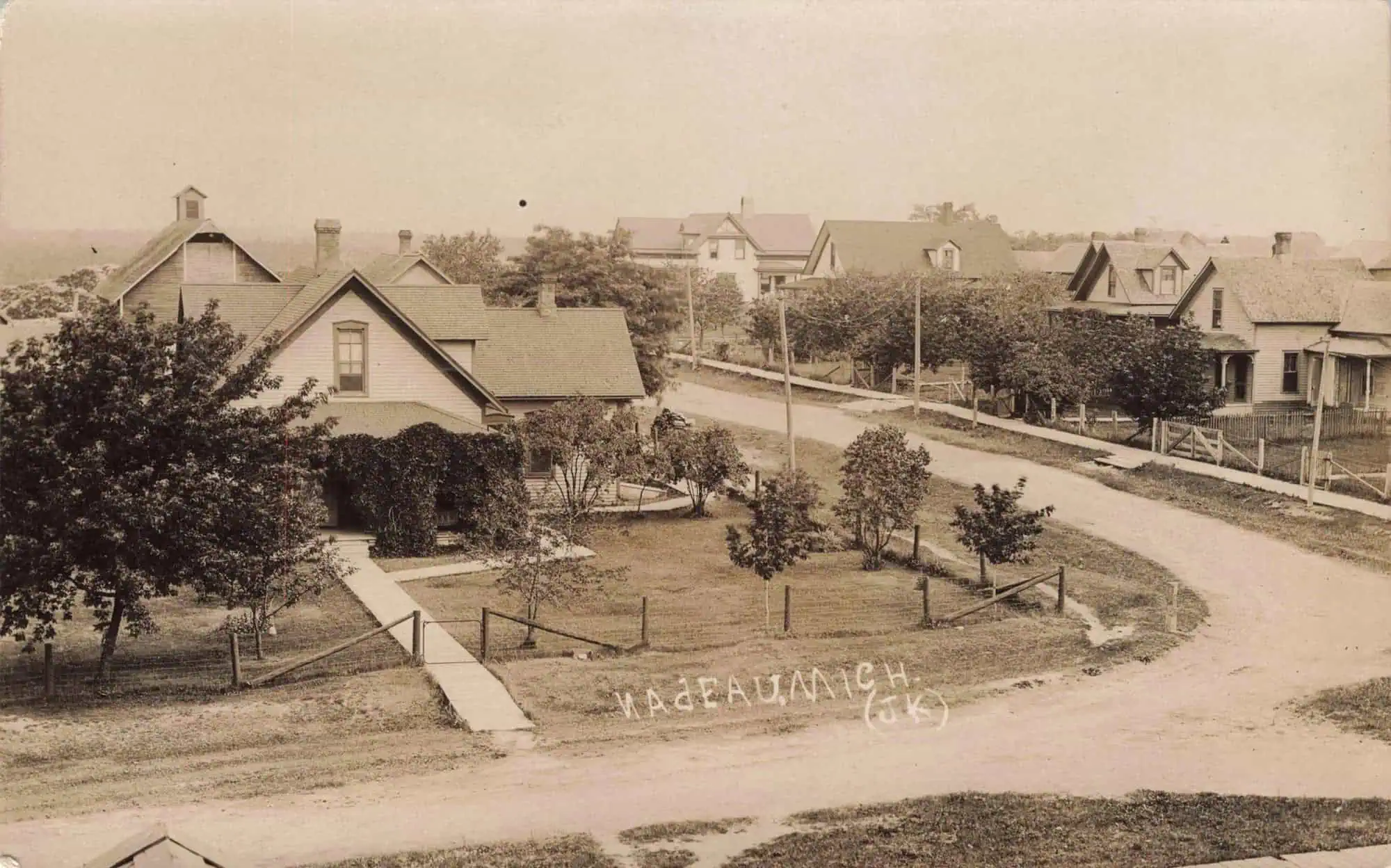
But Nadeau, Michigan has a story — one that goes back to a Civil War veteran, a wilderness full of hardwood, and the French-Canadian families who carved a town out of nothing. And it’s the kind of story you’d never guess just blowing past at 55 miles an hour.
Someone who explores America’s forgotten small towns recently drove through Nadeau and filmed it. Take a look below — then keep reading for the story behind the place.
Video via SightseeingSally (YouTube)
A town most people never notice
Nadeau sits in Menominee County, in Nadeau Township, just a mile and a half north of Carney along US-41 and the rail line. It’s an unincorporated community — meaning it’s not even its own city, just a small dot on the map in the rolling hardwood country of the southern U.P. The whole surrounding township counts only about 1,090 people, and the community of Nadeau itself is a good deal smaller than that.
In other words: easy to miss. Which is exactly what makes it worth a second look.
It started with a Civil War veteran
The town takes its name from Bruno “Barney” Nadeau, born in New Brunswick, Canada, in 1826. As a young man he made his way to Wisconsin, settling around Green Bay and later Marinette, just across the river from Menominee.
When the Civil War came, Nadeau volunteered for the Union Army — and served under General Ulysses S. Grant himself. After the war, he came back north and saw an opportunity in the wild, unsettled country of the U.P.
In 1872, Nadeau’s sons landed a contract to supply railroad ties for the railroad extension being pushed through from Marinette to Escanaba. Two years later, in 1874, Barney took up a homestead claim, built a house for his family in the wilderness, and started clearing a farm. A town slowly grew up around that effort — and it kept his name.
Carved out of the hardwood
The land itself had only been surveyed starting in 1848, opened up to logging, mining, and farming after the Menominee people lost claim to it through a series of treaties. When the first settlers arrived, there were no roads — just thick hardwood forest and swamp.
A lot of those early settlers were French-Canadian. Oliver Perras and his wife Victorine arrived in 1880, when, as one old account put it, the area was still “a heavy hardwood forest.” The pioneers, the Escanaba Daily Press wrote decades later, “blazed their own trails and later made roads.” They built the place by hand, tree by tree.
That French-Canadian heritage ran so deep that early accounts of the area summed up the settlers simply as a few familiar names — “and the rest all French.”
Why it’s worth remembering
Nadeau isn’t a ghost town exactly — people still live there, the township is still going. But it’s the kind of place that’s faded into the background of everyday U.P. life. A town founded by a Grant veteran and a community of French-Canadian homesteaders, now just a name on a highway sign that thousands pass without a thought.
That’s the thing about the U.P. — there’s history tucked into damn near every bend in the road. You just have to know it’s there. The little places we overlook usually have far more behind them than we’d ever guess.
Drive past Nadeau all the time? Tag someone from that stretch of US-41 who never knew the story. 🛤️
More worth reading


Yooper Hub community
The conversation
Know something this story missed? Corrections and additions get read by an editor and folded into the article, with credit.
Real neighbors, real names. A Yooper Hub editor reads your first comment before it appears; after that you’re a known neighbor and your comments post right away. No account required. Community guidelines
Nothing here yet. A sentence is plenty: a correction, a name, or what you remember about this place.
Golden 25 trust review · #25
Verified context for this Yooper Hub story
- Evidence refreshed
- July 13, 2026
- Source readiness
- Live source review complete.
- Corrections status
- No material correction note is recorded on this article.
- Image rights
- Featured and in-story images have documented rights records.
Sources, credits, and reporting details
Sources & accountability
How this story was reported
Editorial methodArchival synthesis
Accountable editor:Keegan O’Brien, publisher and editor.
Last verifiedJul. 13, 2026
Corrections statusNo material correction note is recorded on this article.
AI assistanceResearched and drafted with AI tools. Reviewed and approved by editor Keegan O’Brien. Tool: Claude Max.
Verification note: Nadeau Township geography and the 2020 population were checked against the Census. Local-history claims remain attributed to the community history source.
Primary sources
-
2020 Census county subdivisions in Michigan — U.S. Census Bureau
Accessed Jul. 13, 2026.
Supports: Official geography table listing Nadeau Township and its 2020 population.
Additional reporting
-
Leaves of Menominee — Menominee County local history project
Accessed Jul. 13, 2026.
Supports: Local historical context for communities and families in Menominee County.
Local-history source; demographic claims are checked against the Census.
Photo and media credits
-
Nadeau, Michigan, 1909 — Unknown photographer / Wikimedia Commons
Featured image record. Accessed Aug. 15, 2026. Public domain.
Supports: Photo credit for the featured image.
Featured image added 2026-08-15. Resized from 3296×2057 to 2000×1248, no crop. Attribution and licence in the caption.
