Drive M-26 along the Keweenaw’s north shore and you cross a timber arch bridge over the Eagle River, look down at a waterfall, and pass a handful of houses and a couple of businesses. That is Eagle River. Sixty-five people lived there at the last census. It is the seat of Keweenaw County, and it is not close: it is by far the least populated county seat in Michigan, in a county that is itself the least populated in the state, with a little over 2,000 people.
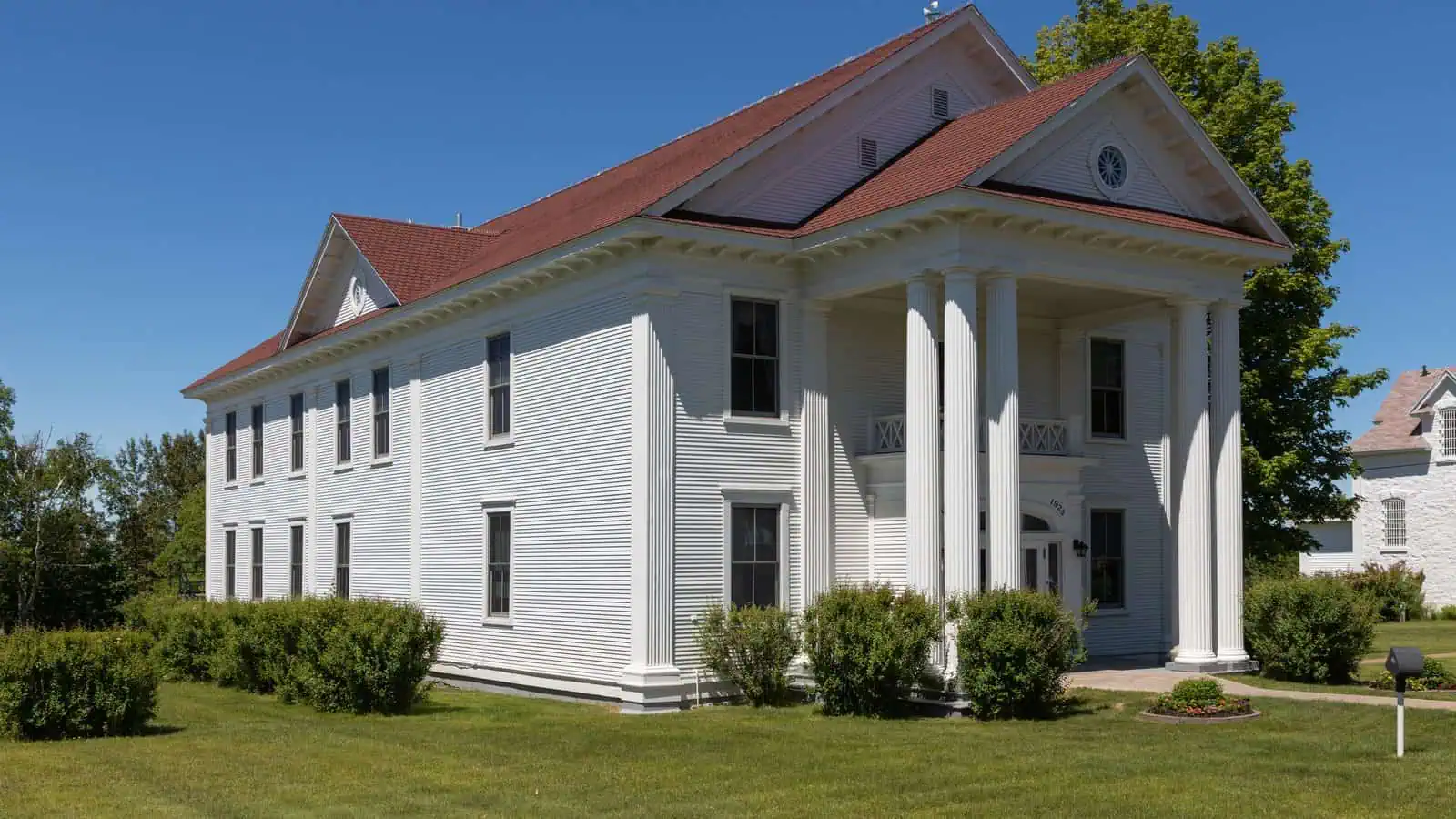
The government of that county sits in a white wooden building with a red roof and six tall columns across the front. From the road it looks like a New England meetinghouse that decided to become a Greek temple. That is more or less what happened.
Keweenaw County was cut off from Houghton County in 1861. Eagle River was the obvious seat because in 1861 it was the obvious town. Copper had been found at the Cliff, a few miles inland, in 1845, and the Cliff Mine was the first copper mine in the district to pay its investors real money. Eagle River was its port. Ore went out through it and everything else came in.
Five years after the county was organized, in 1866, a builder named John Sweatt put up a courthouse in the middle of the village. It was a plain two-story clapboard box, and it cost $6,578. Sweatt also built the sheriff’s residence and jail beside it. Court has been held in that building ever since.
What it did not have, for its first sixty years, was the temple front. That came in 1925, when the county hired Hampson Gregory to remodel it and he added the pediment and the six Doric columns that make it look the way it does now. By then the reason for the building was long gone. The Cliff had played out around 1870, the mining money had moved south to Calumet and Houghton, and Eagle River had already become what it is today, a very small place with a very large courthouse.
The columns are the interesting decision. In 1925 the county could have moved its seat to somewhere with people in it. Instead it dressed up the building it had. Whatever the reasoning was at the time, the effect a century later is that a county of 2,000 has one of the more handsome courthouses in the Upper Peninsula, and it is a wooden one, which is rarer still.
It is also a working one, with a working building’s problems. In April 2023 the county board approved new windows and refinished hardwood floors for the courthouse and the sheriff’s office, a repair to a basement leak after snowmelt forced water into an electrical panel, and an elevator to the second-floor courtroom. The sheriff told the board there had been complaints over the years from defendants who could not get up the stairs to their own hearings. The money came from a millage voters passed in 2012.
So the 1866 building is getting an elevator, which is about the most Keweenaw County sentence there is. The county is small enough that its whole government fits in one wooden building, old enough that the building went up the year after the Civil War ended, and stubborn enough to keep it. Sixty-five people, six columns, and court on the second floor.
More worth reading


Yooper Hub community
The conversation
Know something this story missed? Corrections and additions get read by an editor and folded into the article, with credit.
Real neighbors, real names. A Yooper Hub editor reads your first comment before it appears; after that you’re a known neighbor and your comments post right away. No account required. Community guidelines
Nothing here yet. A sentence is plenty: a correction, a name, or what you remember about this place.
Sources, credits, and reporting details
Sources & accountability
How this story was reported
Editorial methodArchival synthesis
Last verifiedAug. 15, 2026
Corrections statusNo material correction note is recorded on this article.
AI assistanceResearched and drafted with AI tools. Reviewed and approved by editor Keegan O’Brien. Tool: Claude.
Verification note: Drafted 2026-08-15. Population figures are the 2020 census (Eagle River 65, Keweenaw County 2,046). The 2023 repairs are reported as approved by the county board, not as completed; the Cliff Mine 'first to pay' clause is general knowledge, flagged in the draft.
Primary sources
-
Courting Favor: Courthouse Buildings Play an Important Role in the Upper Peninsula's History — Michigan Architectural Foundation
Published Dec. 20, 2022. Accessed Aug. 15, 2026.
-
Keweenaw County board approves courthouse, sheriff's office repairs, additions — WLUC TV6
Published Apr. 21, 2023. Accessed Aug. 15, 2026.
Additional reporting
-
Keweenaw County Courthouse Eagle River Michigan 2021-4249 (Commons file description quoting the National Register record) — Wikimedia Commons / National Register of Historic Places
Accessed Aug. 15, 2026.
-
Eagle River, Michigan and Keweenaw County, Michigan (Wikipedia) — Wikipedia contributors
Accessed Aug. 15, 2026.
Census figures and pointers.

Photo and media credits
-
Keweenaw County Courthouse Eagle River Michigan 2021-4249.jpg (featured image) — Paul R. Burley, via Wikimedia Commons
Featured image record. Published Jun. 19, 2021. Accessed Aug. 15, 2026. CC BY-SA 4.0.
Original 6240×4160, cropped 16:9 (box 0,358,6240,3868), resized to 1600×900 q85. Attachment 2424.