There is a hill on the south side of Sault Ste. Marie where the streets are laid out a little too straight and the brick buildings sit a little too evenly spaced, with wide porches facing a long open lawn. It reads as a campus, and it is one. Lake Superior State University has been there since 1946. But the lawn was a parade ground first, and the porches were built for soldiers.
The Army arrived at the Sault in the summer of 1822. A battalion of the Second Infantry came up from Sackets Harbor, New York, under a colonel named Hugh Brady, and built a cedar stockade with two blockhouses on the bank of the St. Marys River. The point of it was to put an American flag at the top of the lakes, a few years after a war in which the British had taken Fort Mackinac without firing a shot, and to remind everyone on both sides of the river whose country this now was. That first Fort Brady covered a little over 26 acres and ran 550 feet along the water.
It was never a busy post. Troops were pulled out for the Mexican War and replaced by Michigan volunteers, came back, and were withdrawn again in 1857. The Army only returned for good in 1866, and by then the mission had changed: the state locks and canal had opened in 1855, and somebody had to guard them.
That is also what eventually pushed the fort off the riverbank. As the canal was widened the old site stopped making sense, and General Philip Sheridan picked higher ground to the south. Work on the new post began in 1886 and the garrison moved up the hill in 1893. The old fort was auctioned off the same year, 62 building lots’ worth, and the town grew over it. Old Fort Brady is a marker now. New Fort Brady is a university.
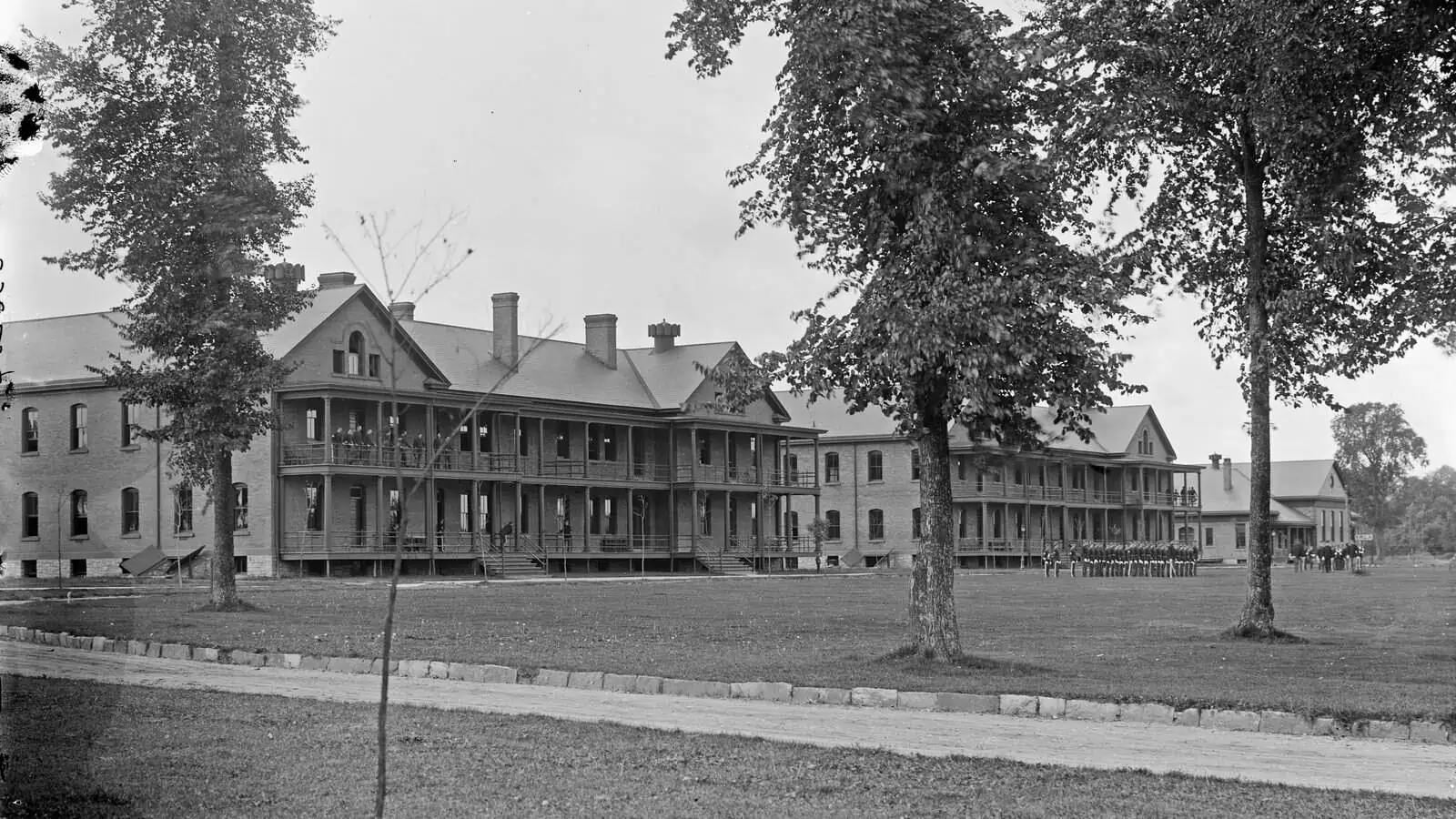
The new post was built the way the Army built things at the end of the nineteenth century: brick barracks with two-story porches, a row of officers’ houses, a guardhouse, a post headquarters, a fire house, a gymnasium. In 1898, with the Spanish-American War coming, about 2,000 troops were stationed there. It kept going through the First World War, and in the Second the Soo Locks became one of the most heavily defended places in the country, because a bomb in the right lock would have stopped every ton of iron ore moving from the Mesabi Range to the steel mills. Fort Brady was the post behind that defense.
Then the war ended and the reason for the post ended with it. The Army declared Fort Brady surplus in April 1944, put it on inactive status that November, and had the last troops out in late 1945. It left behind 64 buildings on 73 acres.
What happened next happened fast. Grover Dillman, the president of the Michigan College of Mining and Technology in Houghton, heard at the end of 1945 that the fort was available and that people in the Sault wanted it turned into a school. He said yes immediately. Inspections and renovations started in January 1946. Registration opened on November 1. Classes began November 5.
The first class was 260 students, and it tells you exactly what the place was for. Two hundred fifteen of them were in engineering. One hundred sixty-seven were veterans. One was a woman. They were housed in the barracks, barely touched. Only three of the 64 buildings had been fitted out as offices and classrooms. The post theater and the post exchange became auditoriums. The library and the gym were kept as they were. A retired Navy captain, H. W. Risteen, was made a full professor and put in charge of the branch.
The Sault branch of Michigan Tech became Lake Superior State College in 1970 and a university in 1987. Fourteen of the fort’s buildings are still in use. The 1903 infantry barracks became South Hall, and one of them is now Considine Hall, the business school. The post headquarters is Brown Hall. The post office, built in 1920, is the administration building. The barracks put up in the 1930s for the Women’s Army Corps is Brady Hall. The gymnasium is the Fletcher Center.
Walk that campus and you are walking a plan drawn by the War Department in the 1880s. The photograph above is the barracks around 1908, with a company drawn up on the lawn. Students eat lunch on that grass now. It is one of the few places in the Upper Peninsula where you can stand on the same ground and see, without much effort, both of the things it was for.
More worth reading


Yooper Hub community
The conversation
Know something this story missed? Corrections and additions get read by an editor and folded into the article, with credit.
Real neighbors, real names. A Yooper Hub editor reads your first comment before it appears; after that you’re a known neighbor and your comments post right away. No account required. Community guidelines
1 comment
So where is old fort Brady? Do the buildings still exist?
Sources, credits, and reporting details
Sources & accountability
How this story was reported
Editorial methodArchival synthesis
Last verifiedAug. 15, 2026
Corrections statusNo material correction note is recorded on this article.
AI assistanceResearched and drafted with AI tools. Reviewed and approved by editor Keegan O’Brien. Tool: Claude.
Verification note: Drafted 2026-08-15 from Lake Superior State University's Fort Brady page, Michigan Tech's Military History of the Upper Great Lakes article (citing the 1947 catalog and the Sault Evening News of 1946-10-26) and the River of History Museum. Enrollment 260 follows the MTU/catalog figure over River of History's 272; the 20,000-troop WWII figure and the sold-vs-given question are left out of the copy.
Primary sources
-
Fort Brady (Lake Superior State University resource page) — Lake Superior State University
Accessed Aug. 15, 2026.
-
Michigan College of Mining and Technology, Sault Ste. Marie Branch (Military History of the Upper Great Lakes) — Michigan Technological University
Published Oct. 19, 2016. Accessed Aug. 15, 2026.
Cites the 1947 course catalog and the Sault Evening News, 1946-10-26.
Additional reporting
-
Lake Superior State University (1946-Present) — River of History Museum, Sault Ste. Marie
Accessed Aug. 15, 2026.
Gives first class as 272; the copy uses the catalog-traced 260.
-
Fort Brady (Wikipedia) — Wikipedia contributors
Accessed Aug. 15, 2026.
Used as a pointer to the Michigan State Historic Sites records it cites.
Photo and media credits
-
Fort Brady Barracks c 1908.jpg (featured image) — Detroit Publishing Co., Library of Congress Prints and Photographs Division, via Wikimedia Commons
Featured image record. Published Jan. 1, 1908. Accessed Aug. 15, 2026. Public domain.
Original 4658×3306, cropped 16:9 (box 0,412,4658,3032), resized to 1600×900 q85. Attachment 2418.
