Most public land exists because somebody decided in advance that it should. Bewabic exists partly because a county road manager kept buying more than he needed.
Around 1918, Herbert Larson, manager of the Iron County Road Commission, bought up a substantial amount of land in order to lay out wide rights of way, and dedicated that land to public use. Wide roadsides are a practical thing for a road man to want. Handing the surplus to the public is a choice.
In 1923 he went further and bought a farmstead down the road on Fortune Lake, and made it Bewabic Park.
Then the Depression built the rest of it
The park as visitors experience it today is largely a product of the 1930s federal work programs, and the numbers are specific: between 1933 and 1937, 170 Civil Works Administration workers and 108 Civilian Conservation Corps workers improved the site.
They were not working freehand. A local architect, Abraham Anderson, designed the buildings, and Glenn Case Gregg of Michigan State College planned the landscaping. That combination, federal labour with trained design direction, is the reason CCC-era parks across the country share a recognisable look: heavy local stone, low horizontal lines, buildings that sit down into the site instead of announcing themselves.
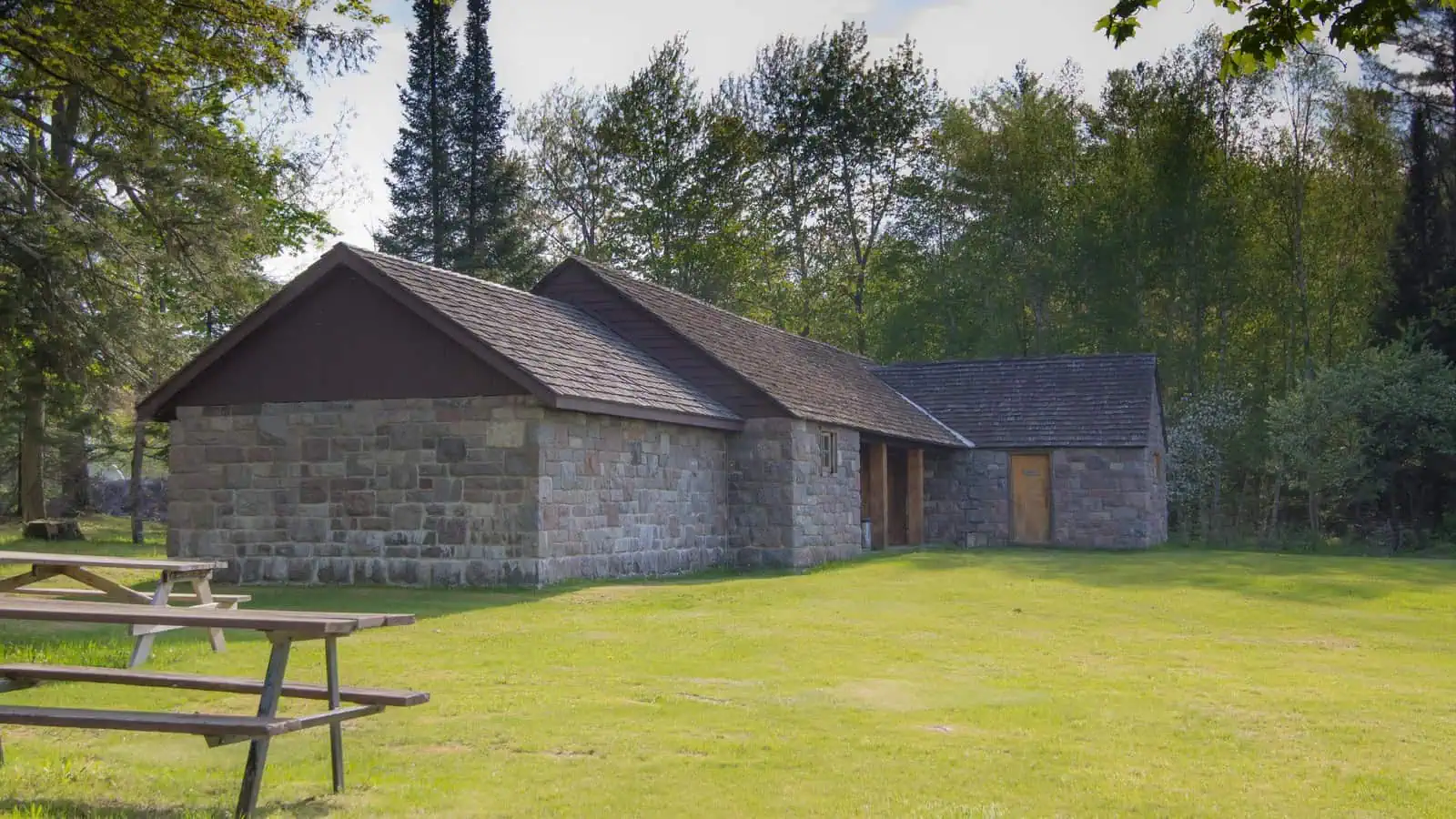
At Bewabic that means fieldstone shelters with shingled roofs, and several of those structures are still in use, which is close to a century of service from buildings put up by young men on a federal relief wage.
The park was listed on the National Register of Historic Places in 2016, specifically for its CCC-related architecture. Not for the lake, not for the recreation. For the buildings the relief workers made.
What it is now
Bewabic covers 315 acres on Fortune Lake, four miles west of Crystal Falls in Iron County. It is a working state park: camping, water, day use.
That is the part worth ending on. This is not a preserved site or an interpretive exhibit. People book a campsite, eat lunch under a stone shelter built in 1935, and mostly never think about who stacked it or why. The buildings are still doing exactly the job they were designed for, which is a rarer outcome in the Upper Peninsula than the ruins would suggest.
More worth reading


Sources, credits, and reporting details
Sources & accountability
How this story was reported
Editorial methodArchival synthesis
Last verifiedAug. 15, 2026
Corrections statusNo material correction note is recorded on this article.
AI assistanceResearched and drafted with AI tools. Reviewed and approved by editor Keegan O’Brien. Tool: Claude.
Verification note: CLAIM DELIBERATELY NOT MADE: Bewabic is sometimes called one of Michigan's OLDEST STATE PARKS. That is not in the copy. No source read states it, the 1923 date is for its creation as a county-level park rather than a state park, and "oldest" claims depend on which founding date is counted. It needs a source that says it plainly plus a defined date before it can run. CATEGORY: filed outdoors-travel (473) deliberately and not history-culture, because this is a working campground and day-use park people visit, not a building study. ATTRIBUTION: the paragraph explaining why CCC-era parks share a look is general architectural context, not a Register claim about Bewabic specifically, and is phrased to read that way; if tightening to only what the record supports, cut the sentence beginning "That combination" and nothing else breaks. IMAGE CAUTION: the Commons file named "Oldest Building at Bewabic State Park" is an uploader caption, not a sourced dating; do not let that filename become a caption claim.
Primary sources
-
Bewabic State Park, National Register of Historic Places record — National Register of Historic Places, via Wikipedia
Accessed Aug. 15, 2026.
-
Bewabic State Park — Michigan Department of Natural Resources
Accessed Aug. 15, 2026.
Photo and media credits
-
Fieldstone shelter at Bewabic State Park, by rossograph — rossograph, via Wikimedia Commons
Featured image record. Accessed Aug. 15, 2026. CC BY-SA 4.0.
16:9 crop box (0,200,5184,3116) from the 5184×3456 original to 1600×900, a comfortable 3.24x margin. Chosen because it shows the CCC architecture the Register listing is actually for AND shows it in use, with picnic tables beside it, which is the article closing point. Three more large CC BY-SA 4.0 files by the same photographer are available for inline use.
