Most people know Whitefish Point for what happened offshore. The Edmund Fitzgerald went down not far from here, the shipwreck museum is on the point, and the water is the reason anybody built anything at this address.
The birds are there for the same reason, and almost nobody comes for them.
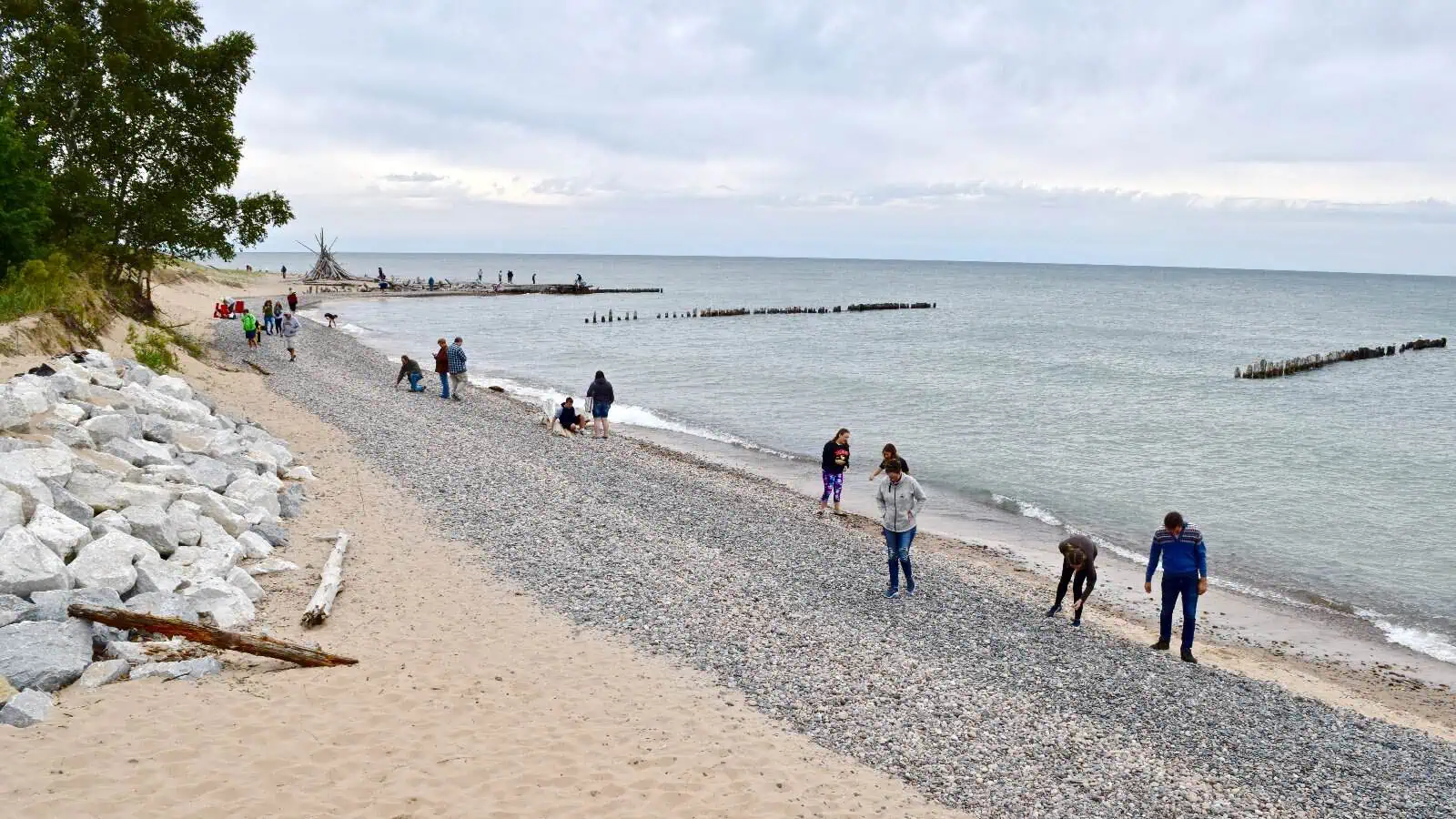
Here is the mechanism. A hawk migrating north in spring does not want to cross Lake Superior. Soaring birds ride columns of warm rising air, and open cold water produces none, so a big lake is not merely a long flight, it is a flight with the engine off. So they follow the shoreline instead, working north and east along the south shore looking for the shortest way across. Whitefish Point is where that shoreline runs out. It is a narrow spit of sand and pine sticking up into the lake, and everything that has been tracing the coast arrives at the tip of it at once.
The result is a funnel. The Hawk Migration Association of North America regards this as the most important spring corridor for birds of prey on the continent. Not one of several. The most important.
People noticed early. In 1966 members of the Ontario Bird Banding Association and the Cranbrook Institute of Science, who already knew about the spring hawk flight, set up a banding project on the point. It ran until 1971 and expanded along the way from hawks into owls. That project is the direct ancestor of what is there now: in 1979 Michigan Audubon formally established the Whitefish Point Bird Observatory.
The counts are the unglamorous heart of it. Raptor counting runs from March 15 to May 31, nine in the morning until five in the afternoon, every day, all season. Somebody sits at the point and identifies and tallies birds for eight hours. Waterbirds are counted in both spring and fall. It is monotonous in the way that all real data collection is monotonous, and it is the reason anyone can say anything at all about whether raptor populations in the eastern half of the continent are rising or falling, because a number from one spring means nothing and sixty springs of numbers from the same spot mean a great deal.
Then there is the night shift. Spring owl banding has run since 1988, fall banding since 1993, and summer banding since 2006, focused on Northern Saw-whet and Boreal Owls. A Northern Saw-whet Owl is about the size of a pint glass and migrates in the dark, which is why almost nobody has ever seen one and why the only practical way to study them is to catch them at night, weigh and band them, and let them go. The birds pass over the point in numbers most visitors would find hard to believe, entirely invisibly, while the parking lot is empty.

What makes the point worth a visit in spring, if you are not a birder, is the scale of the thing you cannot see from anywhere else. Stand at the tip in April with a north wind and the sky has hawks in it, moving in a direction, with a reason. It is one of the few places where migration stops being an abstraction and becomes traffic.
The observatory is open to visitors, the counters are generally happy to tell you what is overhead, and it costs nothing to stand there and look up. Bring more clothing than you think a spring day requires. The lake is right there, and in April it is still winter over the water.
Go See It
Whitefish Point Bird Observatory, Paradise
- Hours
- WPBO’s outdoor spaces are open from dawn to dusk year-round. WPBO’s visit page lists no visitor center or gift shop hours.
- Cost
- WPBO’s visit page lists no fee and says nothing about parking charges. The Great Lakes Shipwreck Museum next door is a separate attraction and is not covered here.
- Season
- Open year-round. Count seasons per WPBO: hawk count and owl banding start March 15; spring research ends May 31; waterbird count April 15 to May 31 and August 15 to mid-November; Northern Saw-whet Owl summer program July 1 to August 25; fall owl banding September 15 to October 31. During count seasons the hawk deck and waterbird shack are open to visitors.
- Drive
- From Marquette: 2 hr 43 min (158 mi) via M-28 E
From the Bridge: 1 hr 25 min (77.7 mi) via M-123 N (Google Maps flags tolls on this route)
More worth reading


Sources, credits, and reporting details
Sources & accountability
How this story was reported
Editorial methodArchival synthesis
Last verifiedAug. 12, 2026
Corrections statusNo material correction note is recorded on this article.
AI assistanceResearched and drafted with AI tools. Reviewed and approved by editor Keegan O’Brien.
Verification note: HMANA characterization confirmed directly against hawkmigration.org (not just WPBO quoting itself); public-access claim confirmed against wpbo.org/visit/; thermal-soaring water-avoidance mechanism confirmed against migration ecology literature. Edmund Fitzgerald distance already softened to "not far from here" per the credit file, an unchecked figure was not restored.
Primary sources
-
Whitefish Point Bird Observatory: Program History — Whitefish Point Bird Observatory
Accessed Aug. 12, 2026.
WPBO's own institutional history page.
-
Whitefish Point Bird Observatory: About / Research — Whitefish Point Bird Observatory
Accessed Aug. 12, 2026.
Companion research page: https://wpbo.org/research/
Additional reporting
-
Hawk Migration Association of North America — Hawk Migration Association of North America
Accessed Aug. 12, 2026.
Verified 2026-08-12 against HMANA’s own domain, resolving the draft’s flag that the quote came second-hand through WPBO.
-
Whitefish Point Bird Observatory: Visit — Whitefish Point Bird Observatory
Accessed Aug. 12, 2026.
Confirms the piece's invitation for readers to visit and talk to counters.
Photo and media credits
-
Whitefish Point Shore, Lake Superior, Michigan — Deb Nystrom
Featured image record. Published Sep. 2, 2017. Accessed Aug. 12, 2026. CC BY 2.0.
Featured image, attachment 2211, cropped from a 6000×4000 source. Shows the shoreline running out into open water, the article's central mechanism.
-
Northern Saw-Whet Owl (Aegolius acadicus) — Flickr user *Sage*
Published Jul. 30, 2006. Accessed Aug. 12, 2026. CC BY 2.0.
Inline image, attachment 2212, portrait, no crop. Captioned as a species portrait only — photographed at an event against colored fabric, not a wild bird and not a Whitefish Point banding shot. Caption does not claim it was taken at the point or during banding.
.jpg)
.jpg)