John Terry was appointed the first keeper of the Sand Point Lighthouse in Escanaba. He never lit it. He died of consumption in April 1868, before the building was finished.
Two weeks after his death, the Lighthouse Board gave the job to his widow. Mary Terry lit the lamp for the first time on May 13, 1868, and then kept it alone for eighteen years.

Why there was a light here at all
Congress authorized the lighthouse in 1864, and the timing was not a coincidence. The first railroad had just started hauling iron ore down from the mines to the docks at Escanaba, which meant loaded boats were suddenly working a harbor with a low spit of sand running out into Little Bay de Noc.
That spit is the whole problem. It is flat, it sits right at the harbor entrance, and in the dark it is invisible. The light ran continuously from 1868 to 1939.
Eighteen years alone
Mary L. Thurston Terry was born in 1816 and came to Escanaba with her husband in 1867. She had no children. After John died she ran the station by herself — hauling oil, trimming wicks, keeping the lamp lit every night of the shipping season for nearly two decades.
She was one of the first women to hold a lighthouse keeper’s post in the United States, and one of the first on the Great Lakes. It is worth being clear about what that meant in 1868: not a ceremonial title, but the actual job, performed alone, in a building she also lived in.
The night of March 4, 1886
A fire started in the dwelling. The Lighthouse Board’s 1886 report records the keeper burned to death and the station damaged.
The details that survive are grim and strange. The fire department did not get inside until the following morning. Her body was found in the oil room. Her cause of death was ruled unknown, and it has been called a mysterious fire ever since — a word that appears on the state historical marker itself.
Nobody has ever established what happened. The building was repaired and the light was back in service seven weeks later.
The local paper, the Iron Port, noted that the scramble for her vacant post began before the embers were cold.

What happened to the building
Families lived in the lighthouse after Terry’s death, and keepers stayed on until 1939, when a new crib light took over the harbor and the Coast Guard assumed ownership.
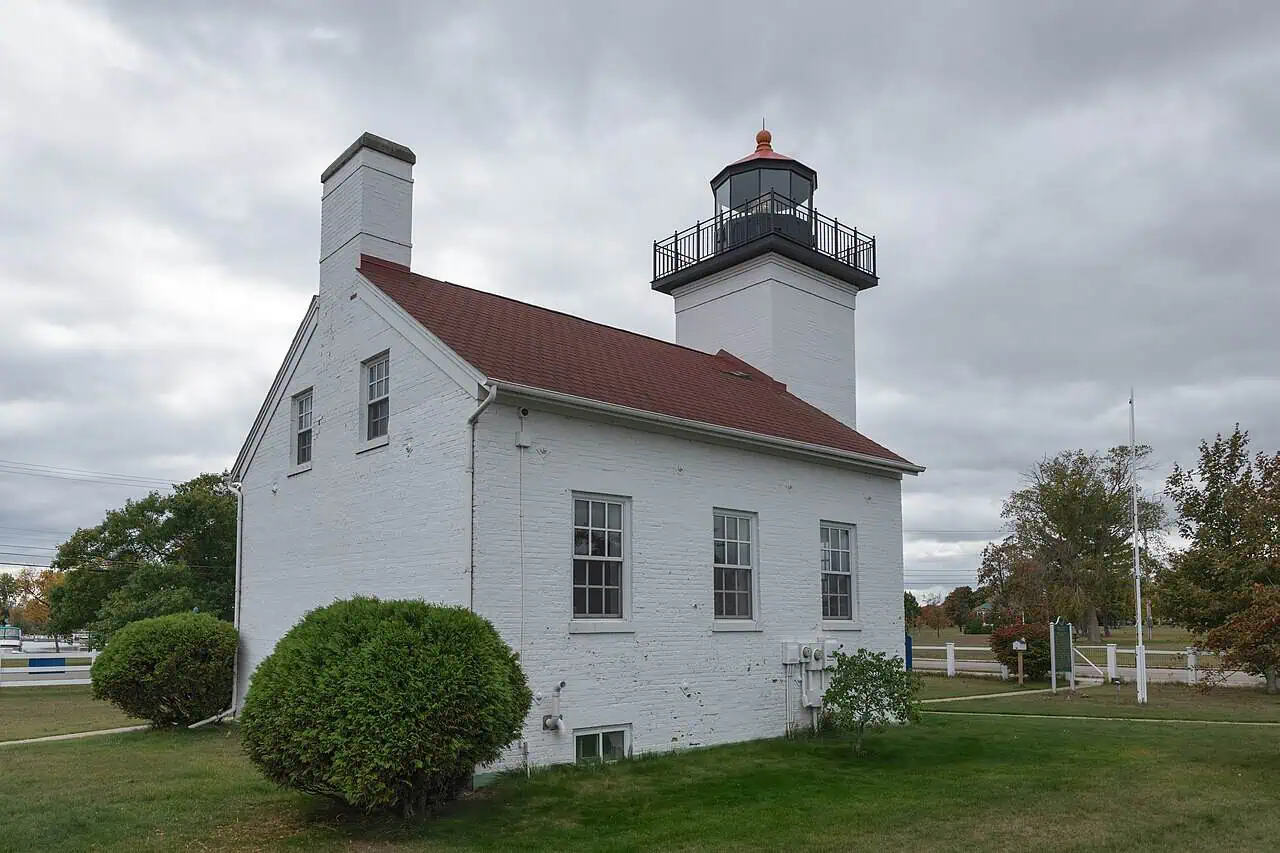
What came next nearly erased it. The building was converted for Coast Guard use, and the tower and the pitched roof were taken off — leaving a plain flat-roofed brick house that gave no sign of what it had been.
Between 1985 and 1990 the Delta County Historical Society put it back. They had a copy of the original 1867 plan in their own archives, filled the gaps with National Archives records, and rebuilt the exterior to match. A duplicate cast iron lantern room came from Poverty Island. Ownership transferred to the society in 1998, and a replica fourth-order Fresnel lens went into the lantern in 2014, with the historic lens moved to the museum.
Visiting the light
The lighthouse stands at the far west end of Escanaba, where Ludington Street and Loren W. Jenkins Memorial Drive meet Water Plant Drive, next to the Delta County Historical Society museum in Ludington Park.
The season runs roughly Memorial Day through Labor Day, afternoons, and admission has been a few dollars for a pass covering both the lighthouse and the museum. Hours have varied, so calling ahead is sensible. You can climb to the lantern room, and the interior is furnished the way it would have looked during its working years.
If you are working through the U.P.’s lights, we keep a broader list of our roundup of U.P. lights, and Fayette is an easy pairing across the bay on the Garden Peninsula.
More worth reading


Yooper Hub community
The conversation
Know something this story missed? Corrections and additions get read by an editor and folded into the article, with credit.
Real neighbors, real names. A Yooper Hub editor reads your first comment before it appears; after that you’re a known neighbor and your comments post right away. No account required. Community guidelines
Nothing here yet. A sentence is plenty: a correction, a name, or what you remember about this place.
Sources, credits, and reporting details
Sources & accountability
How this story was reported
Editorial methodArchival synthesis
Last verifiedAug. 15, 2026
Corrections statusNo material correction note is recorded on this article.
AI assistanceResearched and drafted with AI tools. Reviewed and approved by editor Keegan O’Brien. Tool: Claude Opus 5.
Verification note: Ledger reconstructed 2026-08-15 from Lighthousefriends' station history (which quotes the Lighthouse Board's 1886 report), the Delta County Historical Society's page and the state marker. Visiting hours and admission change year to year; the copy says so.
Primary sources
-
Sand Point (Escanaba) Lighthouse — Lighthousefriends.com
Accessed Aug. 15, 2026.
Compiles Lighthouse Board annual reports and the Escanaba Iron Port.
-
Sand Point Lighthouse — Delta County Historical Society
Accessed Aug. 15, 2026.
Additional reporting
-
Sand Point Lighthouse / Squaw Point Boathouse historical marker — Michigan Historical Marker, via HMdb
Accessed Aug. 15, 2026.
Supports: Marker text, including the description of the 1886 fire as mysterious.
-
Sand Point Lighthouse: A shoreline sentinel of history — Escanaba Daily Press
Published Jun. 1, 2026. Accessed Aug. 15, 2026.
Supports: Recent local coverage of the lighthouse's history and season.
Photo and media credits
-
Sand Point Lighthouse, Escanaba (featured image) — Giorgio Galeotti, via Wikimedia Commons
Featured image record. Accessed Aug. 2, 2026. CC BY-SA 4.0.
Creator and license from the attachment caption. Attachment 2112, 1280×853.