There is a town in Houghton County named after a Boston stockbroker, and a town next to it named after his daughter.
William Alfred Paine ran the brokerage that became Paine Webber. In 1899 he put money into the Copper Range Consolidated Company, arranged its financing, and ended up its president. The company built a town around its mine and called it Painesdale. Eleven miles northwest, the mill town got named Freda, after Paine’s daughter.

A company town, planned on purpose
Painesdale did not grow the way most Copper Country settlements did, which was haphazardly and fast. Copper Range laid it out deliberately, following what the company considered efficient planning, and built it up between roughly 1899 and 1917. It started as a tent town and turned into streets of company housing, churches, and a school.
Paine also put up a library and named it for his mother, Sarah Sargent Paine.
The arrangement worked, for a while. Copper Range acquired controlling interests in the Baltic, Trimountain, and Champion mines and became the third largest copper producer on the peninsula. Paine died on September 24, 1929, a few weeks before the Wall Street crash, leaving an estate estimated at $13.7 million.
What the mine actually did
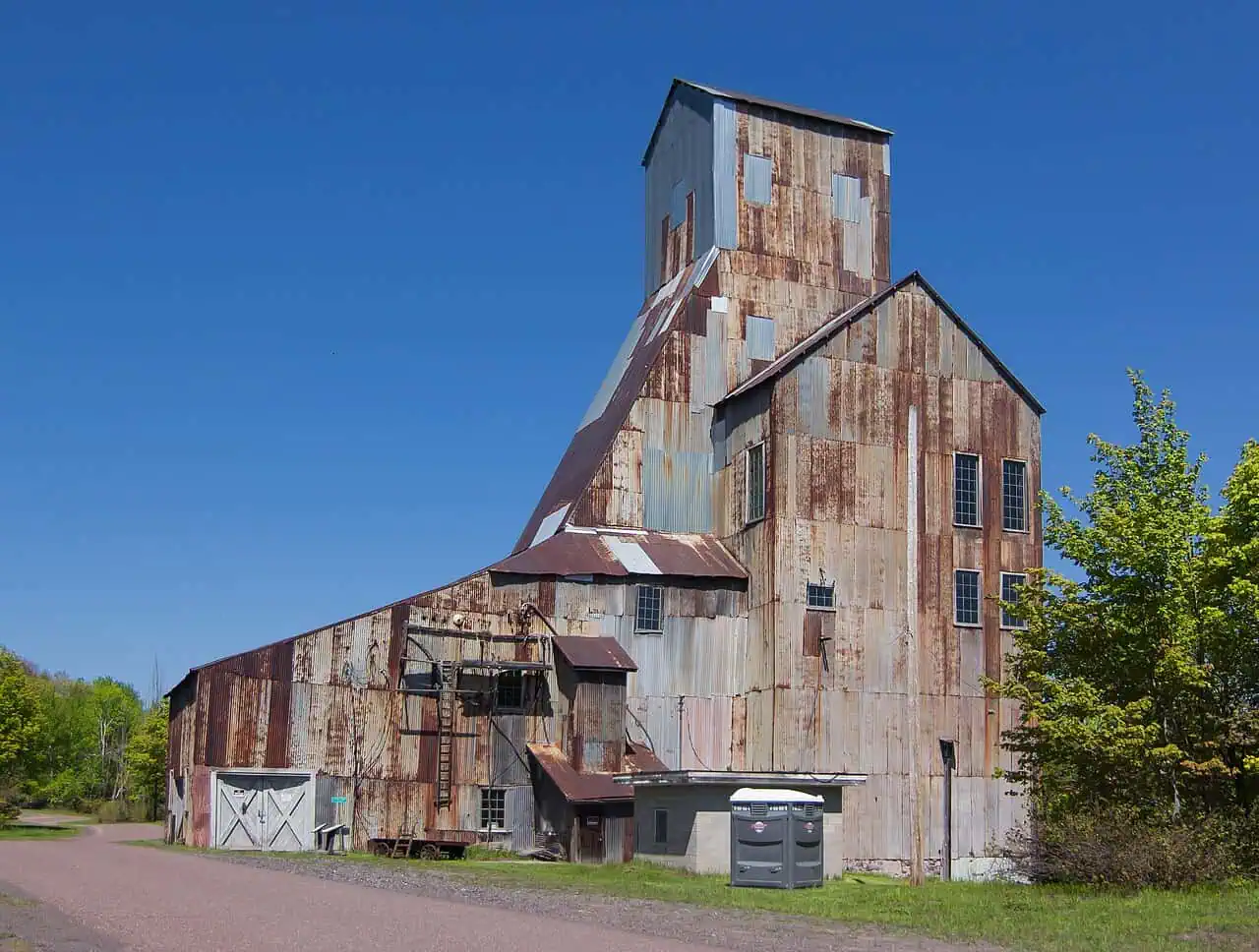
The Champion No. 4 shaft-rock house went up in 1902 and ran until 1967 — close to 65 years of continuous work.
The shaft did not go straight down; it followed the lode on an incline. By the 1930s crews were working the 48th level, about 4,800 feet from the surface along that incline, and the shaft eventually reached down around 5,600 feet.
Rock came up the shaft, got sorted and crushed in the rock house, dropped into ground-level ore bins, and went out by rail to the mill at Freda. It was not a glamorous operation. It was a machine for moving stone, and it ran for two-thirds of a century.
Painesdale also lived through the labor fights that defined the district — strikes in 1904 and again in 1913, the second one remembered for how violent it got, and for how it ended in Calumet.

Why this one is still standing
When Champion closed in 1967, Copper Range handed the site to the Adams Township Water Department, which used the structures for regional water service. That accident of utility is the only reason the buildings survived the decades when every other shaft house in the district was being torn down for scrap.
By the mid-1990s the water department did not need them anymore, and a volunteer nonprofit — Painesdale Mine & Shaft, Inc. — took over keeping them up.
The result is that Champion No. 4 is now the oldest shaft-rock house left standing anywhere on the Keweenaw, and the only place in the district where a visitor can climb up inside one.
Turned off, not cleared out
The thing that makes people go quiet on the tour is that the machinery is still there. Sorting mechanisms, rock crushers, the steam engine, the hoist engine in the hoist house — most of the original equipment sits where it was installed. It was shut off, not stripped.
The captain’s office still holds business records, blueprints, and photographs. Volunteers have done enough restoration to keep the buildings from failing and deliberately stopped there. They have said outright that they do not have money to make the place look new, and would not want to if they did.
Visitors keep describing the same impression: that the whistle blew at the end of a shift in 1967, everybody walked out, and nothing was touched again.
Getting inside
The site is at 42634 2nd Street, on Shaft House Road in Painesdale, in Adams Township along M-26 southwest of South Range. It is a Keweenaw Heritage Site and a partner of Keweenaw National Historical Park, though it is privately held and volunteer-run.
You can walk the surface grounds free during daylight hours, no appointment needed. Getting inside the rock house, the hoist house, and the captain’s office takes an arranged tour — email painesdalemine@gmail.com, which the volunteers say is faster than calling 906-369-5358.
If you are already making a Copper Country run, the Quincy hoist in Hancock is about half an hour north.
More worth reading


Yooper Hub community
The conversation
Know something this story missed? Corrections and additions get read by an editor and folded into the article, with credit.
Real neighbors, real names. A Yooper Hub editor reads your first comment before it appears; after that you’re a known neighbor and your comments post right away. No account required. Community guidelines
Nothing here yet. A sentence is plenty: a correction, a name, or what you remember about this place.
Sources, credits, and reporting details
Sources & accountability
How this story was reported
Editorial methodArchival synthesis
Last verifiedAug. 15, 2026
Corrections statusNo material correction note is recorded on this article.
AI assistanceResearched and drafted with AI tools. Reviewed and approved by editor Keegan O’Brien. Tool: Claude Opus 5.
Verification note: Ledger reconstructed 2026-08-15 from the National Park Service heritage-site page, Painesdale Mine & Shaft Inc.'s own history, and the Copper Beacon report of the site's Keweenaw Heritage Site recognition.
Primary sources
-
Painesdale Mine and Shaft (Keweenaw National Historical Park heritage site) — National Park Service
Accessed Aug. 15, 2026.
-
Champion Mine History — Painesdale Mine and Shaft Inc.
Accessed Aug. 15, 2026.
Additional reporting
-
Painesdale Mine & Shaft officially recognized as Keweenaw Heritage Site — Copper Beacon
Accessed Aug. 15, 2026.
Supports: The site's recognition as a Keweenaw Heritage Site.
-
Champion Mining Company — Wikipedia contributors
Accessed Aug. 15, 2026.
Supports: Company history and pointers to the National Register record.
Pointer.
Photo and media credits
-
Champion No. 4 shaft-rock house (featured image) — Rossograph, via Wikimedia Commons
Featured image record. Accessed Aug. 4, 2026. CC BY-SA 4.0.
Creator and license from the attachment caption. Attachment 2081, 1280×968.