Almost every dam ever built is made of earth, concrete, or masonry. Steel dams are so rare that the United States built only three of them, ever.
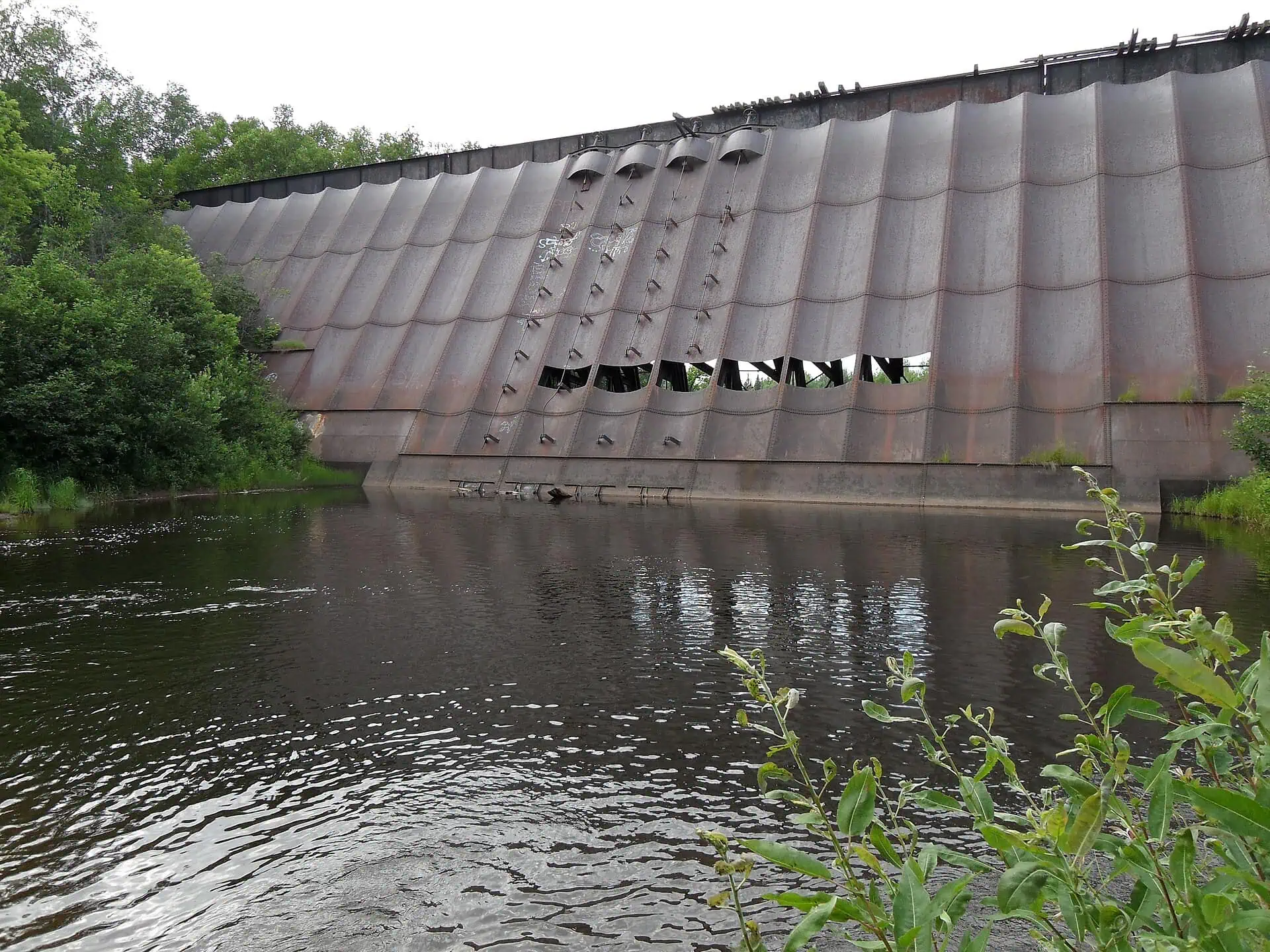
One is in Arizona. One was in Montana, and it failed within a year of going up. The third is standing in the woods west of Houghton, 1,006 feet of riveted steel across the Salmon Trout River — and it has not held back water since 1979, because somebody deliberately cut holes in it.
What happened when they did is the best part of the story.
Two mills, one river
Redridge exists because of copper. In the early 1890s the Atlantic Mining Company put a stamp mill here, on the Lake Superior shore southwest of Houghton, to crush the ore coming out of its inland mines. A stamp mill runs on water, so Atlantic threw a timber crib dam across the Salmon Trout River — a wooden box filled with loose rock and dirt, 50 feet high, 53 feet wide at its base, built of hewn timbers 14 inches thick.
It worked fine until the neighbors showed up. The Baltic Mining Company — which shared a board of directors with Atlantic — opened its own mine and by 1901 had a second stamp mill running at Redridge. Two mills meant roughly double the water, and the wooden dam and its reservoir could not keep up.
So they built one out of steel
The answer was a flat slab buttress dam of structural steel, designed by engineer J. F. Jackson and erected by the Wisconsin Bridge and Iron Company. It was finished in November 1901: about 74 feet high at the center and 1,006 feet long, with a rail line running across the top of it.
They built it immediately upstream of the old timber dam, which stayed right where it was, submerged in the enlarged reservoir behind the new steel wall.
Steel was a strange choice, and the industry never really took to it. The Ashfork-Bainbridge dam went up in Arizona in 1898. Hauser Lake Dam followed in Montana in 1907 and collapsed inside of a year. After that, essentially nobody built another one. Redridge is the survivor of a three-item experiment that the engineering world quietly abandoned.
The mines leave, the dam stays
The Atlantic mill ran until about 1912. Atlantic itself was absorbed into the Copper Range Company, the mills were eventually dismantled, and the reason for the dam simply evaporated. Nobody maintained it.
On Easter morning in 1941, the spillway let go and flooded the ground below. The steel barely noticed — it came through with little damage — but with no mills left to supply, the owners opened the valves and left them open. Water kept overtopping the structure anyway.
So in 1979 the Copper Range Company had large holes cut straight through the steel, specifically so the thing could never impound a reservoir again.

What the water was hiding
The reservoir dropped. And as it fell, the 1890s timber crib dam rose back out of the water — still standing, still intact, still holding.
It is still holding today. The rare steel marvel that was built to replace it has been deliberately disabled for nearly fifty years, while the obsolete wooden box it was supposed to supersede quietly went back to doing the job.
That reversal created the problem Stanton Township now owns. The steel dam picked up its honors — a Michigan Historic Civil Engineering Landmark in 1985, the National Register of Historic Places in 1992 — and the township took possession of the site that same year. But by 2001 the state was treating the aging timber dam as a significant hazard, and the fixes on offer ran from roughly $311,000 to over a million dollars. Stanton Township has about 1,590 residents. It could not afford any of them.
The compromise came in 2004: crews cut the top 13 feet off the wooden dam to drop the water level and take pressure off the structure. More recent assessments suggest it is not likely to fail soon.
Go stand on it
Redridge is usually called a ghost town, though a handful of people still live there. The mills are gone. What remains is a rusting steel wall in the trees that you can walk out onto, a pool below it where people fish, and behind it a 130-year-old wooden dam still doing quiet work no one asks it to do.
The Keweenaw is full of monuments to the copper boom that built it, and most of them are ruins in the ordinary sense — things that stopped. This one is stranger. Head up across the lift bridge and go look at the only surviving steel dam of three, punched full of holes on purpose, standing guard over the wooden one that outlived it.
Go See It
Redridge Steel Dam, Houghton County
- Hours
- No hours posted. It is an outdoor site owned by Stanton Township.
- Cost
- No admission fee listed.
- Season
- Water runs year-round; the falls at the dam are strongest in the spring melt. Access is by a sandy track, so wet or snowy conditions change the trip.
- Drive
- From Marquette: 2 hr 4 min (110 mi) via US-41 N
From the Bridge: 4 hr 43 min (273 mi) via M-28 W and US-41 N (toll on the Bridge)
More worth reading


Sources, credits, and reporting details
Sources & accountability
How this story was reported
Editorial methodArchival synthesis
Last verifiedJul. 23, 2026
Corrections statusNo material correction note is recorded on this article.
AI assistanceResearched and drafted with AI tools. Reviewed and approved by editor Keegan O’Brien.
Verification note: Initial ledger, verified 2026-07-23 during publication prep. Construction dates, dimensions, the three-steel-dams claim, the 1941 spillway failure, the 1979 holes, the revealed timber dam, designations and township cost figures were checked against the municipal archive document and supporting engineering and history sources. Sources date the original timber dam variously to 1891-92, 1892 and 1894, so the article says early 1890s rather than picking one. The three-steel-dams point is attributed as what most sources indicate rather than asserted as certain. No direct quotations. Featured image CC BY-SA 3.0, credit Donovan Squires, resized without cropping. No AI-generated or AI-assisted media.
Primary sources
-
Redridge description, Stanton Township archives — Stanton Township, Houghton County
Featured image record. Accessed Jul. 23, 2026. Municipal historical document; cited.
Original URL https://www.stantontownship.com/wp-content/uploads/2016/05/1.-Redridge-description.pdf returned 404 on 2026-08-15; link points to the Internet Archive capture of 2026-02-10, which the archive reports as a 200. Primary municipal source for the timber dam, the hazard designation, cost options and the 2004 remedy.
Additional reporting
-
Redridge Steel Dam — Wikipedia
Featured image record. Accessed Jul. 23, 2026. CC BY-SA text; cited.
Source of the three-steel-dams framing, which is attributed as what most sources indicate rather than asserted absolutely.
-
Redridge Steel Dam (Redridge, 1901) — Structurae
Featured image record. Accessed Jul. 23, 2026. Copyright Structurae; cited.
Source of dimensions, the 1941 spillway failure, the 1979 holes and the revealing of the timber dam.
-
Redridge, MI – Redridge Dam — michiganrailroads.com
Featured image record. Accessed Jul. 23, 2026. Copyright michiganrailroads.com; cited.
Source of the 1985 engineering landmark designation and the built-above-the-timber-dam detail.
-
Redridge Steel Dam — Mi Roadtrip
Featured image record. Published Feb. 16, 2024. Accessed Jul. 23, 2026. Copyright Mi Roadtrip; cited.
Source of the designer name and the present-day visitor description.
-
History of Redridge Michigan: From Copper Boom to Bust — Michigan4You
Featured image record. Published Oct. 30, 2025. Accessed Jul. 23, 2026. Copyright Michigan4You; cited.
Source of the two-mills water-demand rationale and the November 1901 completion.
Photo and media credits
-
Redridge Steel Dam.JPG — Donovan Squires / Wikimedia Commons
Featured image record. Accessed Jul. 23, 2026. CC BY-SA 3.0; credit Donovan Squires.
