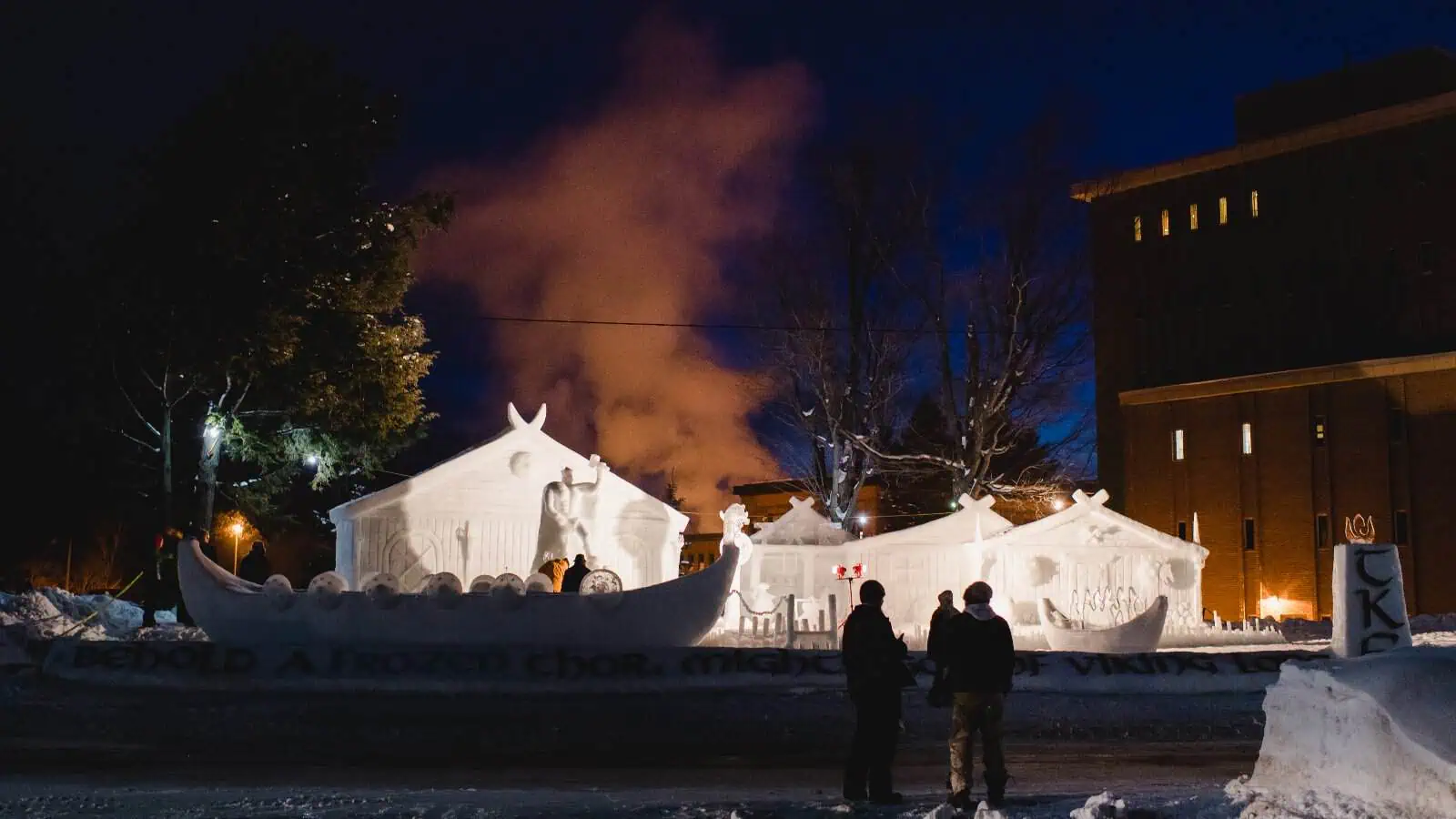
Somewhere around two in the morning in early February, in a town where the snow gets measured in feet, a few hundred college students are outside in the dark packing snow into wooden forms with their hands. They started at four in the afternoon. They have until eight the next morning. Whatever is standing when the judges come by is what they get scored on, and there is no version of this where anybody gets to sleep first.
That is the All-Nighter, and it is the most Michigan Tech thing that happens all year.
Winter Carnival began in 1922, and it did not begin with snow. The first one was a single-night Ice Carnival run by the Student Organization, closer to a circus than a festival, with students performing acts in animal costumes. It ran for a few years and then stopped, caught by the stock market crash of 1929, and the campus went four winters without one.
What brought it back was a fraternity of sorts. The Blue Key National Honor Society took over sponsorship in 1934 and has organized the Carnival ever since, which makes this one of the longer unbroken student-run traditions anywhere in the country. Two years into that stewardship, in 1936, students and local school children built the first snow statues, and the thing that had been an ice show became something else entirely.
The statues are the reason people drive up for it now. Campus groups spend weeks on the month-long entries, working a theme that changes every year, and the results are not lumpy snowmen. They are archways you can walk under, animals two stories tall, scenes with moving parts, all of it carved out of snow that has been packed, watered, and frozen into something closer to soft stone. The groups build what they are about, so a robotics club and a ski club produce very different objects out of the same material.
The Carnival has been moved and interrupted more than once. It settled permanently into February in 1940, for the least surprising reason imaginable: January had stopped reliably delivering enough snow. The Second World War shut it down after a last attempt in 1943, and it did not return until 1946, when it came back with enough energy that nobody has managed to stop it since. The Torchlight Parade, now one of the signatures of the week, was added in 1962.
The All-Nighter is the part that sounds made up. It is a separate competition from the month-long statues, built entirely inside one night, and the constraint is the whole point. Teams get their site at four in the afternoon and the clock runs out at eight the next morning, when judging begins. Everything about a snow statue that is normally solved with time has to be solved instead with planning, bodies, and a tolerance for standing in a Keweenaw February at three in the morning. Some years it is snowing on them the entire time. Some years it is too warm, which is worse, because a statue that will not hold its edges is a statue that slumps into a shape nobody recognizes an hour before judging.
If you have never seen a Keweenaw winter, the setting explains a lot. Houghton sits in the snowbelt, on the Portage Waterway, in a part of Michigan that routinely takes more than 200 inches in a season. A festival built around snow is not a novelty there. It is a reasonable use of the one resource guaranteed to show up.
What keeps the Carnival interesting more than a century in is that it never became a spectator event. The statues are not built by a hired crew. They are built by nineteen-year-olds who have class the next day, in the cold, on a deadline they set for themselves, and then they melt in April and everybody does it again. There is no permanent version of any of it. That is arguably the point.
It runs in early February in Houghton, and the statues are free to walk through. Go on the Thursday morning if you want to see the All-Nighter entries while they are still crisp.
More worth reading


Sources, credits, and reporting details
Sources & accountability
How this story was reported
Editorial methodArchival synthesis
Last verifiedAug. 12, 2026
Corrections statusNo material correction note is recorded on this article.
AI assistanceResearched and drafted with AI tools. Reviewed and approved by editor Keegan O’Brien.
Primary sources
-
Michigan Tech Winter Carnival: History — Michigan Technological University
Accessed Aug. 12, 2026.
Official MTU institutional history page for Winter Carnival.
Additional reporting
-
MTU News: T-Minus Seven Days to Winter Carnival Liftoff — Michigan Technological University News Office
Accessed Aug. 12, 2026.
Published January 2026; exact day not recorded, publication date left blank rather than guessed.
-
Snow statues are the heart of Winter Carnival — Daily Mining Gazette
Accessed Aug. 12, 2026.
Published February 2025; exact day not recorded, publication date left blank rather than guessed.
Photo and media credits
-
Michigan Tech Winter Carnival Snow Statue (Thor), 2018 — Jcvertin
Featured image record. Published Feb. 8, 2018. Accessed Aug. 12, 2026. CC BY-SA 4.0.
Featured image, attachment 2206, cropped from a 5077×3385 source. Same CC BY-SA licence family as the M-185 featured image already in use on the site.
-
Michigan Tech Winter Carnival, 1968 — Michigan Technological University Archives and Copper Country Historical Collections
Accessed Aug. 12, 2026. Public domain.
Inline historic image, attachment 616×599 native, used unresampled. Publication year 1968 known from the Commons record; exact date not recorded, publication date field left blank rather than guessed.

