In the late summer of 1983, two men from Detroit drove north until the road nearly ran out. They were looking for somewhere remote enough to become monks. What they found, on a wild stretch of M-26 along the Lake Superior shore near Jacobs Falls, was an abandoned roadside hamburger shack sitting next to a tiny resort and three cabins.
They bought it. Then winter came.
The shack had been built for summer tourists. No insulation. No plumbing. No heat, except a wood-burning stove. That was the first Keweenaw winter for the men who would become Father Basil and Father Nicholas, in a building designed to sell hamburgers in July, in a county where twenty feet of snow a year is ordinary.
They stayed.

Ora et labora
What they founded was Holy Transfiguration Skete, a Byzantine Rite community known as the Society of St. John. A skete is a monastic form that splits the difference between hermitage and monastery — solitude and silence, but shared prayer and shared work. They follow the Rule of St. Benedict, and its formula is only two words long: ora et labora, prayer and work.
Prayer was covered. Work needed a business plan, because a monastery has to feed itself.
The answer was already growing all around them. In the 1980s it was ordinary for Keweenaw families to pick wild berries and put up jam to sell. As Father Ambrose later described the logic to Bridge Michigan, “it looked like something we could do.” So they went into the woods with buckets, learned the craft from neighbors, and taught themselves the rest.
They already had a storefront. It was the burger shack. They called it the Jampot, and in 1986 — three years after arriving — they sold their first jars.
Thimbleberry
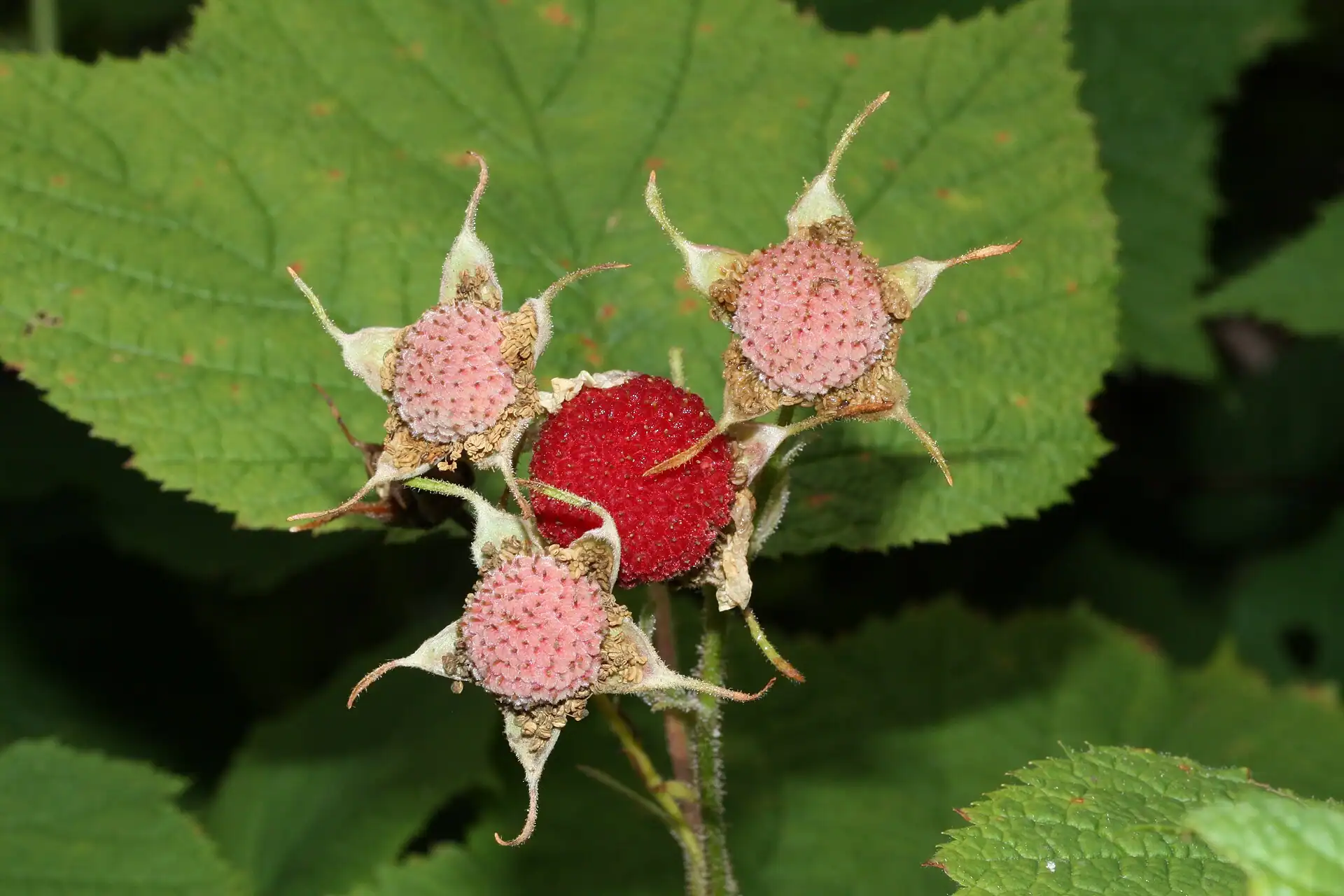
The berry that made them famous is one most visitors have never heard of. The thimbleberry grows wild across the Keweenaw: a soft red fruit that looks like a raspberry someone gently sat on, too delicate to ship far, which is exactly why you have to come here to taste it. It remains the monks’ best seller by something like four to one over everything else.
And there is a lot of everything else now. Roughly 60 varieties of jams, jellies, and preserves move through that little building — wild blueberry, chokecherry, golden raspberry, spiced peach, pear-cinnamon, brandied peach — sold under the label Poorrock Abbey. Then the baking: muffins the size of a fist, oatmeal cookies, caramels, hand-rolled truffles, and dense rum- and bourbon-soaked fruitcakes wrapped in cheesecloth that the monks cheerfully claim will improve for years. Ingredients are organic, non-GMO, and sourced regionally, so what is on the shelf depends on what the season actually produced.

The problem with being good at it
Here is the tension nobody plans for. The monks took vows that include poverty and silence. They also, accidentally, built one of the most beloved food businesses in the Upper Peninsula, one that draws thousands of people up M-26 every summer.
So the kitchen runs quiet — talking kept to a minimum while the jam is stirred. The day starts hours before daylight with prayer, moves to berries and baking, and closes with vespers. And when the business has grown past what the devotions can absorb, they have simply scaled it back. Success is not the point. Winter is what they call the desert season: the tourists gone, the lakeshore empty, cross-country skis on, back to contemplation.
They have also quietly built up the place around them, cutting walking trails along Jacobs Creek and the falls and planting an orchard of more than a hundred apple, pear, plum, and peach trees. Father Basil put the civic case for the bakery plainly to Hour Detroit: the Jampot has been “important part in revitalizing the tourist economy” in that corner of the peninsula.
Both founders are gone now — Father Nicholas in 2017, Father Basil in 2021. Three monks remain, with Father Ambrose as superior, and the shop still opens seasonally from roughly May into October, hours depending on the day and the harvest.
Go if you are up that way, somewhere between Copper Harbor and the bridge. Buy the thimbleberry. But understand what you are actually looking at: a hamburger stand that two men moved into in 1983 with a wood stove and no plumbing, still standing, still open, because they never once treated it as temporary.
Go See It
The Jampot (Poorrock Abbey), Eagle Harbor
- Hours
- Wednesday to Friday 11 a.m. to 4 p.m.; Saturday 10 a.m. to 4 p.m. No other days are listed. Hours as updated August 13, 2026 on the Jampot's own site.
- Cost
- No admission listed. It is a shop and items are priced individually. The Jampot's site does not say what payment the shop takes.
- Season
- The in-person store is open through Saturday, October 17, 2026.
- Drive
- From Marquette: 2 hr 28 min (130 mi) via US-41 N
From the Bridge: 5 hr 10 min (294 mi) via US-41 N (toll on the Bridge)
More worth reading


Sources, credits, and reporting details
Sources & accountability
How this story was reported
Editorial methodArchival synthesis
Last verifiedJul. 23, 2026
Corrections statusNo material correction note is recorded on this article.
AI assistanceResearched and drafted with AI tools. Reviewed and approved by editor Keegan O’Brien.
Verification note: Initial ledger, verified 2026-07-23 during publication prep. Founding year, the burger-shack origin, the 1986 first sales, product range, the deaths of both founders and current community size were checked against the sources listed. Opening days and hours vary between sources and change seasonally, so the article gives only a general season and advises checking. Two short quotations, each under fifteen words and from different sources, both attributed and linked. Featured image is a representative thimbleberry photograph, CC BY-SA 3.0, credit Walter Siegmund, identified as such in the caption because no openly licensed image of the bakery exists. No AI-generated or AI-assisted media.
Primary sources
-
Michigan Dreaming Bucket List: UP bakery run by monks offers pastries, prayers — Bridge Michigan
Featured image record. Published Aug. 20, 2025. Accessed Jul. 23, 2026. Copyright Bridge Michigan; brief quotation with attribution.
Sole quotation from this source is a seven-word Father Ambrose fragment.
Additional reporting
-
Jam-Packed Piety — Hour Detroit Magazine
Featured image record. Accessed Jul. 23, 2026. Copyright Hour Detroit; brief quotation with attribution.
Sole quotation from this source is a nine-word Father Basil fragment.
-
Superior Sanctuary: A Band of Monks Makes Jam on the Keweenaw Peninsula — MyNorth / Traverse Magazine
Featured image record. Accessed Jul. 23, 2026. Copyright MyNorth; cited.
-
The Jampot Monks of Keweenaw — UP Connect
Featured image record. Published Jul. 28, 2025. Accessed Jul. 23, 2026. Copyright UP Connect; cited.
-
The Jam Pot, an Unsuspected Secret Pleasure — 99WFMK (Townsquare Media)
Featured image record. Published Nov. 22, 2024. Accessed Jul. 23, 2026. Copyright Townsquare Media; cited.
Primary source for the burger-shack origin and first-winter conditions.
-
Monk-made jams from Michigan, with a Byzantine twist — Aleteia
Featured image record. Published May. 13, 2022. Accessed Jul. 23, 2026. Copyright Aleteia; cited.
-
The Jampot — University of Michigan personal pages, Ann Arbor Agenda archive
Featured image record. Accessed Jul. 23, 2026. Archived magazine column; cited.
Photo and media credits
-
Rubus parviflorus 9481.JPG — Walter Siegmund / Wikimedia Commons
Featured image record. Accessed Jul. 23, 2026. CC BY-SA 3.0; credit Walter Siegmund.
No openly licensed photograph of the bakery or monastery was available.
