The most important compass malfunction in Michigan history happened on September 19, 1844, in the woods about a mile south of Teal Lake. William A. Burt, a deputy government surveyor running section lines through country his contemporaries wrote off as barren wasteland, watched his magnetic needle swing wildly and sent his men into the brush to find out why. They came back carrying chunks of iron ore.
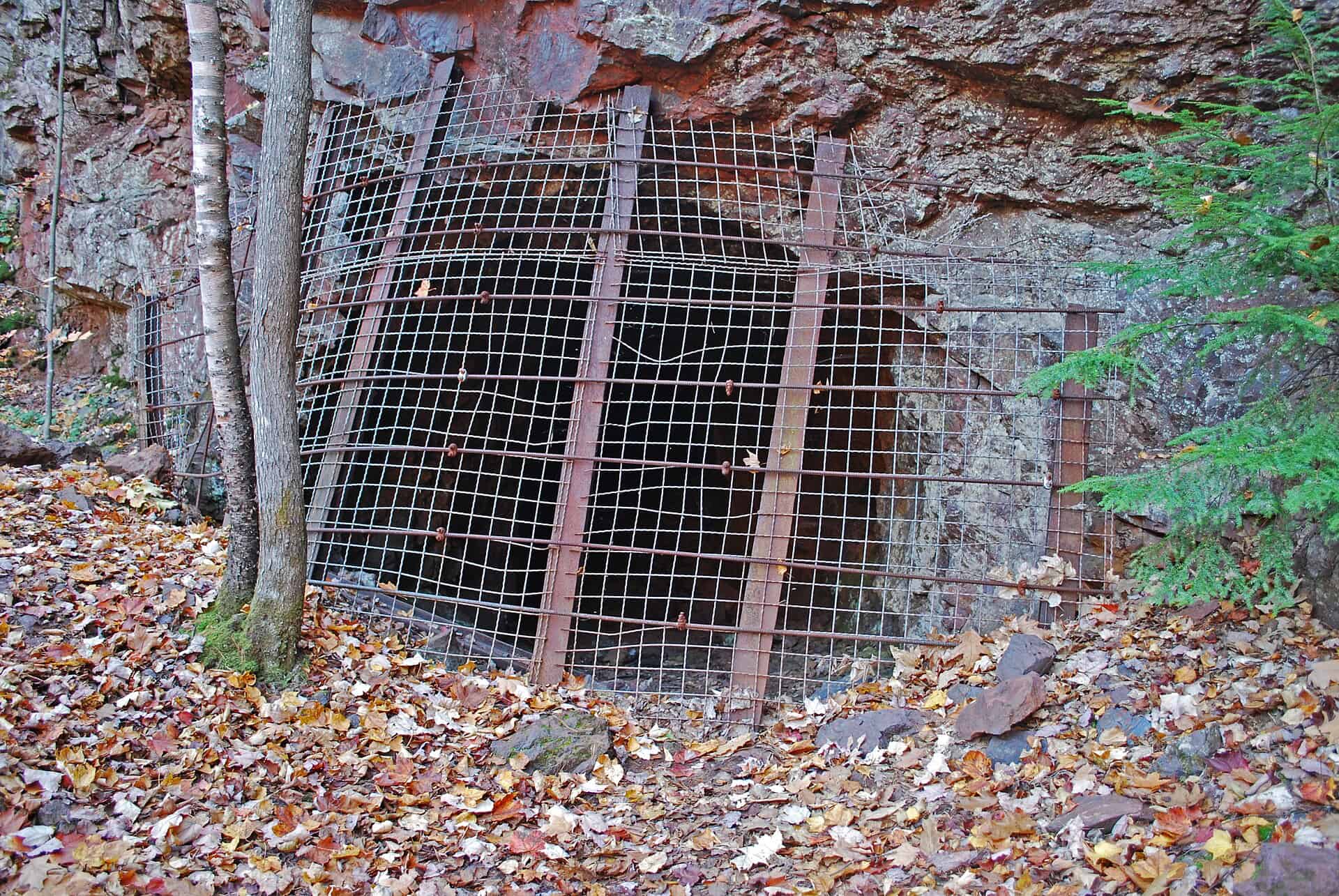
A year later a party of prospectors out of Jackson, Michigan, led by Philo M. Everett, came north bound for the copper country and ended up with something better. An Ojibwa chief named Marji-Gesick guided the party to a spot where iron ore lay tangled in the roots of a fallen pine tree, and by 1847 the Jackson Mining Company was taking ore out of the ground — the first iron mine in the entire Lake Superior region, the strike that gave birth to one of the great mining industries on Earth. The town that grew up around the diggings took its name from the Anishinaabemowin word “nigani” — foremost, in advance, leading — and became Negaunee.
The catch
The catch was that the richest ore didn’t sit politely outside of town. It ran directly beneath it. So Negaunee did what iron towns do: it followed the ore down — under its own streets, houses, churches, and schoolyards. Some of the underground methods of the era, like block caving, worked by deliberately collapsing the rock above the ore body. As researchers who have combed the old mine reports have documented, companies took that ore knowing the surface would eventually come down after it.
Eventually arrived on schedule. Through the early twentieth century the ground over the old workings began to fail, and neighborhood by neighborhood, the oldest part of the city was condemned. In all, some 900 acres of Negaunee — by the city’s own master plan — were ruled off-limits because underground mining had left the ground unsafe.
Take the house with you
What do you do when the ground under your house is hollow? In Negaunee, you take the house. Families in the condemned zone jacked their homes off their foundations and hauled them to solid ground; in the words of the city’s master plan, residents “had to take all belongings including their homes.” Churches were moved. Even cemeteries were moved. What couldn’t be relocated was dismantled, and by the middle of the century the original heart of Negaunee — Old Town, the streets closest to the Jackson — stood empty. The mining company ringed it with fence and hung signs reading “Danger: Caving Grounds,” and for decades that was that: the city’s birthplace sat behind wire, going quietly back to forest while sidewalks cracked and staircases climbed toward houses that no longer existed.
Getting the ground back
The fences stood for roughly half a century. Then, in 2003, Negaunee bought the abandoned land back from the mining company, and by 2007 sections of it were judged stable enough to reopen — the county mine inspector’s rule of thumb being that if undermined ground is going to sink and settle, it almost always does so within the first fifteen or twenty years. The old forbidden zone began a third life as one of the U.P.’s most unusual playgrounds. The 47-mile Iron Ore Heritage Trail now threads straight through the caving grounds; ORV and fat-tire bike routes loop past water-filled pits and rusting relics; and in Old Town you can walk the ghost streets themselves, where the foundations, steps, and sidewalks of the vanished neighborhood still sit among the trees, with markers telling you whose front porch you’re standing on.
It isn’t a theme park, and nobody pretends otherwise. Plenty of ground remains fenced, and the fences mean it: Marquette County’s mine inspector checks nearly a hundred abandoned mine properties every year, and as recently as 2021 city crews were installing another 3,000 feet of new fencing around Old Town hazards. Negaunee schoolkids get an annual visit from the mine inspector and a sticker that puts it plainly: “Caving Grounds are Not Playgrounds.”
Negaunee’s name means the one who goes first, and no town in the U.P. has earned it harder. First ore. First mine. First to learn what a century of hollowing out the bedrock does to the streets standing on top of it — and among the first anywhere to figure out how to take that broken ground back. Burt’s compass never could point straight here. The town it led to still does.
More worth reading


Sources, credits, and reporting details
Sources & accountability
How this story was reported
Editorial methodArchival synthesis
Last verifiedJul. 17, 2026
Corrections statusNo material correction note is recorded on this article.
AI assistanceResearched and drafted with AI tools. Reviewed and approved by editor Keegan O’Brien.
Verification note: Initial ledger, verified 2026-07-17 during publication prep. All named facts checked against the records listed here. Direct quotations limited to one master-plan phrase and the county sticker slogan. Featured image CC BY-SA 3.0, credit Andrew Jameson, resized without cropping. No AI-generated or AI-assisted media.
Primary sources
-
Jackson Mine historical marker (erected 1957) — Michigan Historical Commission / Historical Marker Database
Featured image record. Accessed Jul. 17, 2026. Public historical marker text.
Monument relocated 1974 by Cleveland-Cliffs; text reproduced at HMdb.
-
Michigan Iron Ore — Michigan History Center, State of Michigan
Featured image record. Accessed Jul. 17, 2026. State of Michigan educational content.
-
Old Town Abandoned Mines Fencing Update — City of Negaunee
Featured image record. Published Sep. 3, 2021. Accessed Jul. 17, 2026. Municipal public notice.
Additional reporting
-
Digging for answers — The Mining Journal (Marquette)
Featured image record. Published Jul. 9, 2020. Accessed Jul. 17, 2026. Copyright Ogden Newspapers; brief quotation with attribution.
Sole direct quotation in the article is one master-plan phrase.
-
Answers about abandoned mines — The Mining Journal (Marquette)
Featured image record. Published Jul. 10, 2020. Accessed Jul. 17, 2026. Copyright Ogden Newspapers; cited without quotation.
-
Pioneering spirit — The Mining Journal (Marquette)
Featured image record. Published Jul. 14, 2018. Accessed Jul. 17, 2026. Copyright Ogden Newspapers; cited.
-
Healing the U.P. scars: The reuse of former mining operations — UPword (Northern Michigan University)
Featured image record. Published Sep. 26, 2012. Accessed Jul. 17, 2026. Copyright UPword; cited.
Publication date taken from the article URL date code.
-
Author unearths lost environmental histories of Upper Michigan: The Caving Grounds — Modern History Press
Featured image record. Published Mar. 17, 2025. Accessed Jul. 17, 2026. Copyright Modern History Press; cited.
Interview with researcher and poet Kathleen Heideman.
-
Marquette County Hazard Mitigation Plan, Unstable Ground chapter (excerpt) — Marquette County / The Orebody
Featured image record. Published Feb. 19, 2025. Accessed Jul. 17, 2026. Public county planning document, excerpted.
-
Marquette Range of Iron Ore Discovered — Northern Michigan History
Featured image record. Published Sep. 19, 2025. Accessed Jul. 17, 2026. Copyright northernmichiganhistory.com; cited.
Photo and media credits
-
Jackson Mine Negaunee MI F.jpg — Andrew Jameson / Wikimedia Commons
Featured image record. Published Oct. 8, 2010. Accessed Jul. 17, 2026. CC BY-SA 3.0; credit Andrew Jameson.
