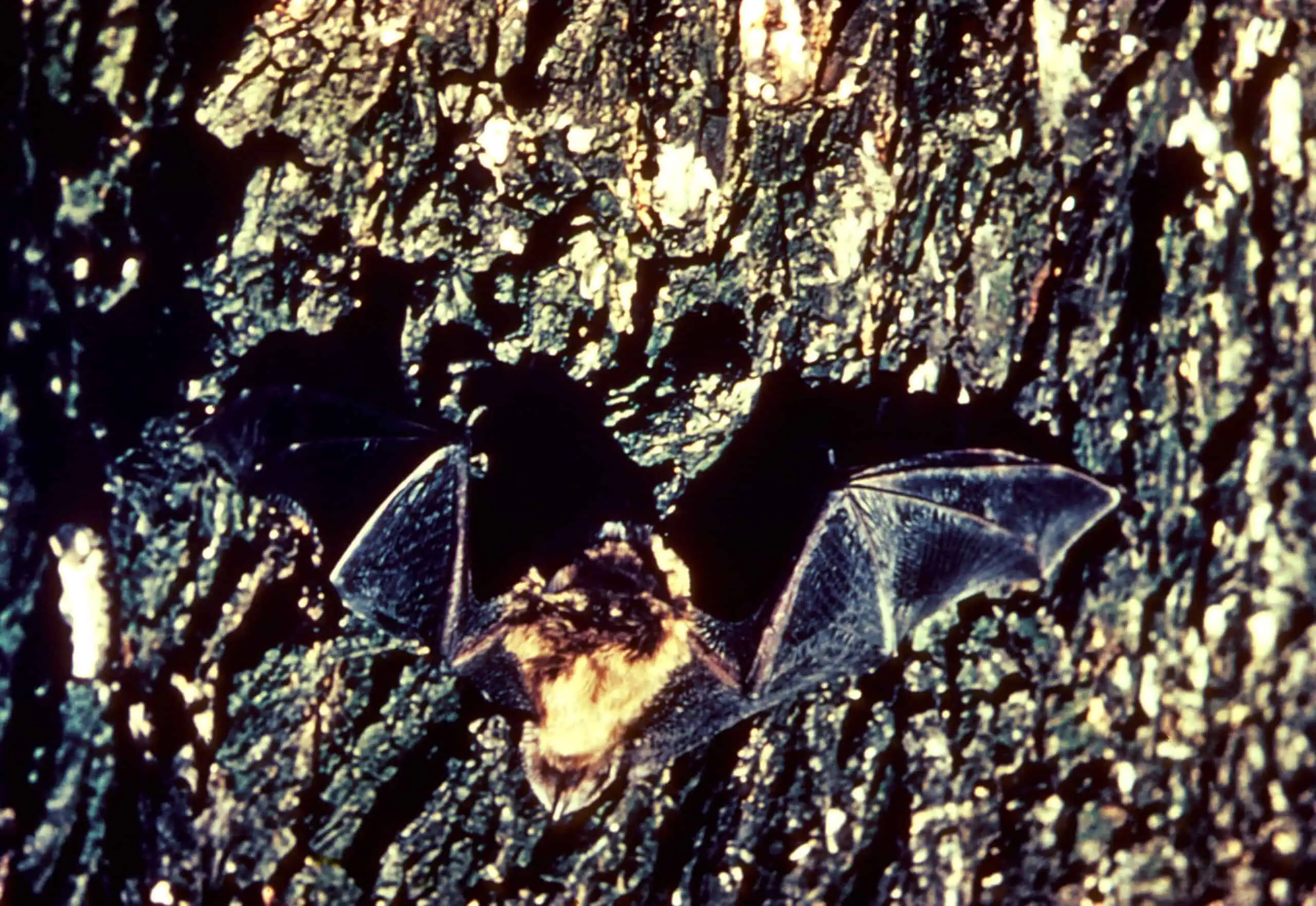

Under a hill in Iron Mountain there is an abandoned iron-mine shaft that drops about a hundred feet straight down. For years it was rumored to be bottomless. When a local caver finally rappelled to the bottom in 1992, something in the dark hissed at him. It was a quarter of a million bats.
The caver was Steve Smith, who had been slipping into old mines since he was a kid, usually illegally. He went down the Millie Mine with 200 feet of rope and a couple of flashlights strapped to motorcycle helmets, found the bottom, and found it packed with hibernating bats, most of them little brown bats.

The city wanted to fill it in
In the spring of 1993, the city of Iron Mountain planned to fill the shaft in, bats and all. Smith called Bat Conservation International, and together they got the mine saved. Rather than pouring the shaft full, crews capped it and covered the opening with an eight-foot steel cage, its bars spaced wide enough for bats to fly in and out but far too narrow for a person to follow.
The payoff for Smith was a career. The Michigan DNR hired the man who used to break into mines as an official mine inspector, a job he held for 26 years. The site is now an official Michigan Wildlife Viewing Area, with benches set around the fence and hiking trails nearby. The bats are easiest to see at dusk in spring and again in autumn as they swarm before and after hibernation.

The number nobody updates
Here is what most write-ups and a lot of the old signage will not tell you. That quarter-million figure is history, not the present tense. From 2014 to 2020, white-nose syndrome swept the Upper Peninsula and killed roughly 90 percent of its bats.
The disease is a cold-loving fungus that grows on bats while they hibernate. It does not poison them so much as wake them up, over and over, until they burn through the fat reserves meant to last the winter and starve. The little brown bat that made up about 85 percent of Millie’s colony was hit hardest of all, down more than 90 percent across the region. The swarm you would see today is a fraction of the one Smith counted.
Why it still matters
A single little brown bat can eat close to its body weight in insects in a night, which is a quiet favor to every farmer and backyard in the region. That is a big part of why the shaft is sealed the way it is. White-nose syndrome spreads on human clothing and gear, so keeping people out of the roost is not about trespassing, it is about not carrying the fungus in. The rule of thumb everywhere is simple: never wear cave gear from one site into another, and never enter a mine or cave where bats are wintering.
More worth reading


Yooper Hub community
The conversation
Know something this story missed? Corrections and additions get read by an editor and folded into the article, with credit.
Real neighbors, real names. A Yooper Hub editor reads your first comment before it appears; after that you’re a known neighbor and your comments post right away. No account required. Community guidelines
Nothing here yet. A sentence is plenty: a correction, a name, or what you remember about this place.
Sources, credits, and reporting details
Sources & accountability
How this story was reported
Editorial methodArchival synthesis
Last verifiedJul. 13, 2026
Corrections statusNo material correction identified in the July 13, 2026 source review.
AI assistanceResearched and drafted with AI tools. Reviewed and approved by editor Keegan O’Brien.
Verification note: CEO-directed review checked the central claims against 1 direct public evidence link on July 13, 2026. No material correction was identified. Exact remote featured image imported from the approved source on 2026-07-14; new attachment 2558 created under Keegan O'Brien dated approval.
Primary sources
-
Direct evidence for: Iron Mountain Almost Buried This Mine in 1993. One Caver Saved a Quarter-Million Bats. — State of Michigan
Accessed Jul. 13, 2026.
Direct public evidence reviewed against the article on July 13, 2026.
Photo and media credits
-
Little brown bat in cave (Myotis lucifugus) — Marvin Moriarty, U.S. Fish and Wildlife Service / Wikimedia Commons
Accessed Aug. 15, 2026. Public domain.
Supports: Photo credit for the image used in the article body.
Rights record for the in-body image, added 2026-08-15. The attachment is reuse-blocked by media clearance and is not the featured image. Species illustration, not photographed at Millie Mine, as the caption says. Public domain U.S. government work. Attribution in the caption.
-
A little brown bat (*Myotis lucifugus*), used as a representative species file photo. Photo: W. D. Fitzwater / U.S. Fish and Wildlife Service (public domain). — W. D. Fitzwater / U.S. Fish and Wildlife Service
Featured image record. Accessed Jul. 14, 2026. U.S. federal public domain; 3193 x 2199.
visibly disclose that it is representative and was not photographed at Millie Mine.

