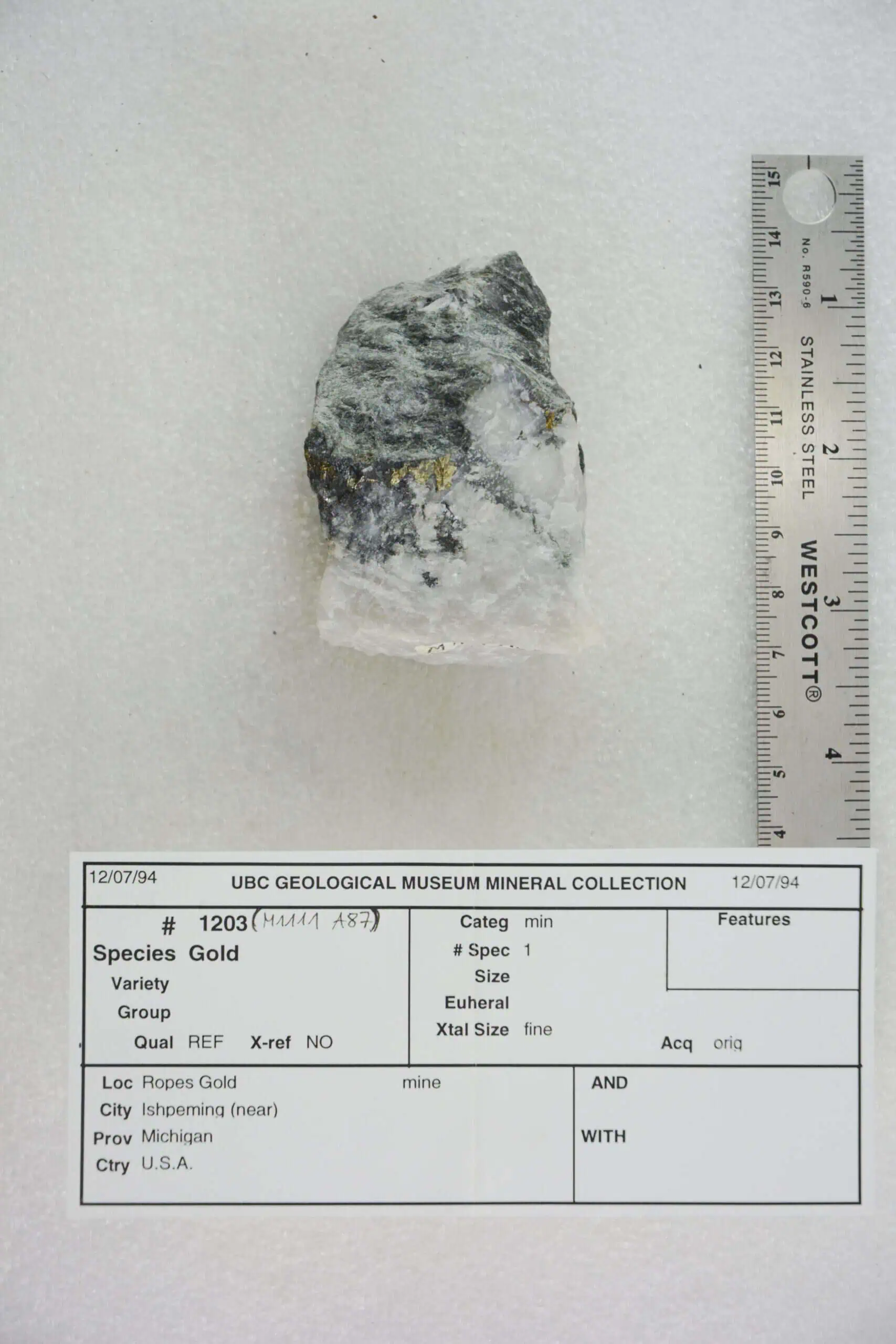

The Upper Peninsula is copper country and iron country. Almost nobody remembers that for a couple of decades it was also gold country. In 1880, a former druggist named Julius Ropes found gold-bearing quartz about five miles northwest of Ishpeming. Within two years he had the only commercially successful gold mine in Michigan history up and running.
Ropes was not a prospector by trade. Before the gold, he had been Ishpeming’s postmaster, a druggist, and a school board member. After the strike he moved fast, forming the Ropes Gold and Silver Company in 1881 and putting 35 men to work sinking the Curry shaft. The crews pulled gold from milky quartz veins using mercury amalgamation and gravity separation, and the operation ran for roughly fifteen years.

How much gold actually came out
By the time financial trouble forced the mine to close in 1897, it had shipped about $645,792 worth of gold and silver in period dollars. The U.S. Geological Survey puts that closer to $24 million in today’s money. The first load even went out on what was billed as the first bullion train ever run in Michigan.
The gold was real enough that stealing it became a problem. Pilfering got so bad the company threw up a high fence and searched every worker on the way out. In one now-famous incident, two miners were caught with a trunk of stolen gold worth about $3,000, roughly $100,000 today, just as they were about to sail for Europe.

The myth worth correcting
You will see it written almost everywhere that the Ropes Mine was the only gold mine east of the Mississippi River. That one is a stretch. North Carolina’s Reed Gold Mine produced the first documented gold in the United States back in 1799, and Georgia’s Dahlonega gold rush drew thousands of miners in 1828 and 1829, decades before Ropes ever picked up a rock.
What is accurate is narrower and still remarkable. The Ropes Mine was the only gold mine in Michigan that ever actually turned a commercial profit. Everything else the state tried came up with pretty rock and very little payable ore.
Still there, still fenced off
The mine changed hands for decades. Corrigan, McKinney and Company bought it around 1900 and cyanide-leached nearly $200,000 in gold from the leftover tailings. Callahan Mining reopened it in 1985 when gold prices spiked, sinking a modern shaft, until the ground gave way and low prices shut it for good in 1991. The shafts were capped, and erosion forced a final refill in 2001. It sits fenced off today.
You can still pan for U.P. gold, legally
Here is the useful part. According to the Michigan Department of Natural Resources, recreational gold panning is allowed on state-owned land as long as the state also owns the mineral rights. Most of what you would find is glacial placer gold, tiny flakes carried in by ice and scattered through streams rather than locked in veins, so bring patience. But the gold in the U.P. is real, and Julius Ropes proved it.
More worth reading


Yooper Hub community
The conversation
Know something this story missed? Corrections and additions get read by an editor and folded into the article, with credit.
Real neighbors, real names. A Yooper Hub editor reads your first comment before it appears; after that you’re a known neighbor and your comments post right away. No account required. Community guidelines
Nothing here yet. A sentence is plenty: a correction, a name, or what you remember about this place.
Sources, credits, and reporting details
Sources & accountability
How this story was reported
Editorial methodAggregation
Last verifiedAug. 21, 2026
Corrections statusNo material correction identified in the July 13, 2026 source review.
AI assistanceResearched and drafted with AI tools. Reviewed and approved by editor Keegan O’Brien.
Verification note: Aug 21 recheck: no credible news; only SEO-farm pages mention the mine in 2026. Closed since 1991; nothing to move. Exact remote featured image imported from the approved source on 2026-07-14; new attachment 2557 created under Keegan O'Brien dated approval.
Primary sources
-
Direct evidence for: Everyone Thinks the U.P. Is Copper and Iron. In 1880 a Druggist Found Gold. — State of Michigan
Accessed Jul. 13, 2026.
Direct public evidence reviewed against the article on July 13, 2026.
Photo and media credits
-
CSIRO ScienceImage 10458, an 8 kg nugget from Victoria cut in two — CSIRO / Wikimedia Commons
Accessed Aug. 15, 2026. CC BY 3.0.
Supports: Photo credit for the image used in the article body.
Rights record for the in-body image, added 2026-08-15. The attachment is reuse-blocked by media clearance and is not the featured image. Illustrative example of native gold in quartz, not from the Ropes Mine, as the caption says. Uploaded at the Commons size, 2288×1712. Attribution and licence in the caption.
-
Native gold specimen from the Ropes Gold Mine near Ishpeming, Michigan. Photo: Pacific Museum of Earth / Wikimedia Commons (CC BY-SA 2.0). — Pacific Museum of Earth
Featured image record. Accessed Jul. 14, 2026. CC BY-SA 2.0; 4000 x 6000.
use only the exact Ropes Gold Mine specimen; disclose any crop or adaptation and preserve CC BY-SA 2.0.

.jpg)