On the morning of November 3, 1926, fifty-two men were underground at the Barnes-Hecker iron mine west of Ishpeming. At about 11:20 the ground above the workings gave way. Within about fifteen minutes the entire mine, more than a thousand feet deep, was full of water, mud, and quicksand. Fifty-one men died. One man outran it, straight up.

A mine under waterlogged ground
The Barnes-Hecker worked a rich arm of the Marquette Iron Range near North Lake, and everyone knew it was a wet mine. Part of the ore body ran beneath waterlogged ground, where the cover above the workings was soft, water-soaked glacial drift rather than solid rock. Cleveland-Cliffs had engineered it to be as safe as the era allowed.
What set it off has never been fully settled. The Engineering and Mining Journal called the cause “a mystery” that November. The U.S. Bureau of Mines found that the back of a stope had caved into the glacial drift above it and the mine filled with water and quicksand. Historian Robert M. Neil later wrote that the 11:20 blast had broken into a large void running up into the soft overburden. On the surface, onlookers watched a pit 300 feet long open up and swallow the landscape as the water-soaked ground above drained into the mine like a pulled bathtub plug.
Fifteen minutes
Down on the second level, a 22-year-old tram motorman named Rutherford J. Wills, known as Wilfred (historian Robert M. Neil spells it Wilford), felt a blast of air snuff out his light and heard the rumble every miner dreaded. He shouted a warning and ran for the shaft with three other men, Jack Hanna, Joseph Mankee, and Thomas Kirby Jr. The hoist was already gone. They started up the ladders.
Wills climbed roughly 800 feet with the flood rising under him. The three men climbing below him were overtaken and never made it out. He came out of the shaft collar into the daylight alone. The water stopped rising about 185 feet below the surface. Of the fifty-one men still down there, among them the mine captain and County Mine Inspector William E. Hill, who had been re-elected to his job only the day before, none came up alive.

The mine became the grave
Rescue was impossible almost immediately. That afternoon, company supervisors working in through the connecting Morris-Lloyd mine found seven bodies in waist-deep water, and three more were found in the shaft on November 9. Only ten of the dead were ever brought out. The remaining forty-one men were left where they lay, and the flooded shaft was permanently sealed above them. The Barnes-Hecker never operated again. It is still described as Michigan’s worst mine disaster.
The human arithmetic was staggering for a community the size of Ishpeming. Thirty-one of the dead were born outside the United States, most of them in Finland. Historian Robert M. Neil counted 42 widows and 132 children left without fathers. Cleveland-Cliffs president William G. Mather raised the families’ weekly compensation to $28, double the required rate. Wills, the only survivor, carried the day with him for the remaining 46 years of his life, in an era before anyone had a name for that kind of wound. Members of his own extended family were among the men who never came up.
Remembering them
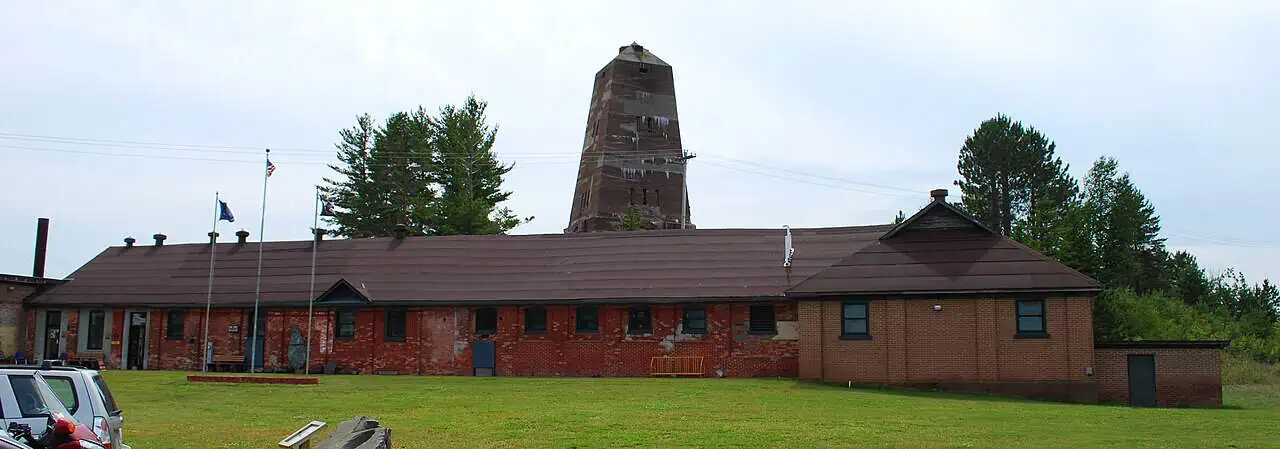
The site of the Barnes-Hecker is on County Road CL in Ely Township, just west of Ishpeming, a short way north of where County Road CL meets County Road 496. Ely Township bought the property in 2025, and a memorial park there is dedicated on October 17, 2026. The township also raised a memorial stone in 1971. A plaque at the Cliffs Shaft Mine Museum in Ishpeming carries all fifty-one names, and the museum’s great headframes are the best place to stand and understand the world these men worked in.
The U.P. was built on iron, and iron had a price. The Barnes-Hecker is where the Marquette Range paid the most of it in a single morning, and one young man’s climb up 800 feet of ladder is the only reason anyone lived to describe it.
Update, October 7, 2026: We replaced “the worst industrial disaster in Michigan history” with the claim our sources support: Michigan’s worst mine disaster. We corrected the recovery account. The first seven bodies came out through the connecting Morris-Lloyd mine, not the North Lake mine, and the waist-deep water was where that recovery party found them, not on Wills’s climb. We credited the widow and child counts to historian Robert M. Neil, gave his figures for the dead born abroad and for the company’s compensation, and removed a line we could not source.
Update, September 26, 2026: We corrected Rutherford Wills’s age to 22 (he was born May 5, 1904) and now give the name he is remembered by, Wilfred, alongside the Wilford spelling historian Robert M. Neil uses. We replaced a sentence that stated a routine blast as the cause with what the 1926 record, the U.S. Bureau of Mines and Neil each say. We also corrected the site’s location: it is on County Road CL, off County Road 496.
Correction: An earlier version of this article said the mine ran beneath a lake and that divers took part in the recovery. Neither is right. The flood came from the water-saturated glacial ground above the workings, not a lake, and no divers were involved. Our description of the ground above the mine follows the wording of the U.S. Bureau of Mines report. We have also corrected the number of men underground and the count of families left behind. Our thanks to the readers and the Barnes-Hecker remembrance community who set the record straight. For the definitive account, see Mary V. Tippett’s book Enduring Legacies: People of the 1926 Barnes-Hecker Mine Disaster.
More worth reading


Sources, credits, and reporting details
Sources & accountability
How this story was reported
Editorial methodArchival synthesis
Last verifiedOct. 7, 2026
Corrections statusA correction or update note dated October 7, 2026 is published in this article.
AI assistanceResearched and drafted with AI tools. Reviewed and approved by editor Keegan O’Brien.
Verification note: Rechecked on September 26, 2026. Wills was 22: his birth date (May 5, 1904) and Robert M. Neil's account agree. He is remembered as Wilfred by the memorial committee's coverage and his grave record; Neil spells it Wilford, so the article gives both. On the cause, the 1926 Engineering and Mining Journal called it a mystery, the U.S. Bureau of Mines found a stope had caved into the glacial drift above, and Neil wrote that the 11:20 blast broke into a void running up into the overburden; the article now says all three rather than stating one as fact. The site is on County Road CL, off County Road 496. Earlier: rechecked August 22, 2026 against Neil's Mining History Journal article (the 800-foot climb, the 185-foot water line, the 42 widows and 132 children, and the ten bodies recovered all check out).
Primary sources
-
Accessed Jul. 13, 2026.
Direct public evidence reviewed against the article on July 13, 2026.
-
The Barnes-Hecker Mine Disaster, Engineering and Mining Journal vol. 122 no. 20, p. 781 — Engineering and Mining Journal (McGraw-Hill), via Internet Archive
Published Nov. 13, 1926. Accessed Sep. 26, 2026.
Supports: The cause was called a mystery in 1926
"What caused the ground to give way is a mystery, but it is possible that the jasper ledge (cap rock) hung up as the back was being brought down and finally let go with terrific force."
-
Statement by Superintendent Elliott, Engineering and Mining Journal, p. 782 — Engineering and Mining Journal (McGraw-Hill), via Internet Archive
Published Nov. 13, 1926. Accessed Sep. 26, 2026.
Supports: The ground gave way at about 11:20 a.m.
S. R. Elliott, general superintendent, Cleveland-Cliffs Iron Co.: "At about 11:20 a.m. Wednesday, Nov. 3, a cave occurred at a point above the first level, Barnes-Hecker mine".
-
EMJ Nov. 13, 1926, p. 781: first recovery — Engineering and Mining Journal (McGraw-Hill), via Internet Archive
Published Nov. 13, 1926. Accessed Sep. 26, 2026.
Supports: Seven bodies carried out through a connecting mine that night
"On Wednesday night seven bodies were removed from the tunnel which connects with the Morris-Lloyd mine, about a mile away."
-
Reclamation Work at the Barnes-Hecker Mine, EMJ vol. 122 no. 21, p. 826 — Engineering and Mining Journal (McGraw-Hill), via Internet Archive
Published Nov. 20, 1926. Accessed Sep. 26, 2026.
Supports: Three more found in the shaft Nov. 9; the remaining 41 unlikely to be reached
"Seven bodies were removed from the workings on the day of the accident and three more were found in the shaft on Nov. 9. It is unlikely that any of the remaining 41 can be reached for some time."
Additional reporting
-
Accessed Sep. 26, 2026.
"Wilford Wills, twenty-two and in excellent physical condition, was the sole survivor" / "the blast at 11:20 had broken into a large void, or vug, which ran steeply up through the stable rock into the soft overburden above" / "widowed 42 women and left 132 minor children fatherless". Re-read Sep. 26, 2026.
-
Barnes-Hecker Mine Disaster (U.S. Bureau of Mines summary) — U.S. Mine Disasters (miningquiz.com)
Accessed Sep. 26, 2026.
Supports: Bureau of Mines finding on the cause
"The back of one of the stopes in this iron mine caved to the overlying glacial drift material and the mine was filled with water and quicksand."
-
Rutherford John "Wilfred" Wills (1904-1973) — Find a Grave
Accessed Sep. 26, 2026.
Supports: Rutherford J. "Wilfred" Wills; born May 5, 1904, so 22 on Nov. 3, 1926
"Rutherford John "Wilfred" Wills"; born "5 May 1904"; "the lone survivor of the Barnes-Hecker mining disaster". Age 22 is calculated from the birth date and matches Neil.
-
Ground broken at Barnes-Hecker Memorial Park — The Mining Journal
Published May. 23, 2026. Accessed Sep. 26, 2026.
Supports: The memorial park is at the mine site; the name Wilfred
"The park is at the site of the old Barnes-Hecker mine" / "Rutherford "Wilfred" Wills, the only survivor".
-
Barnes-Hecker Memorial Park dedication rescheduled to complete landscaping — WLUC TV6 / Upper Michigan's Source
Published Aug. 6, 2026. Accessed Sep. 26, 2026.
Supports: The park is on County Road CL; dedication Oct. 17, 2026
"The Barnes-Hecker Memorial Park is located on County Road CL in Ely Township, just west of Ishpeming." / "rescheduled from Saturday, Sept. 5 to Saturday, Oct. 17 at 11 a.m."
-
Barnes-Hecker Mine Disaster (Wikipedia): mine coordinates — Wikipedia
Accessed Sep. 26, 2026.
Supports: Mine coordinates, used to place the site against the road map
Coordinates given: 46°30′11″N 87°46′44″W. Read against Google Maps on Sep. 26, 2026: the point sits on County Road CL, a short way north of where County Road CL meets County Road 496 (Diorite Road). That placement is our reading of the map.
-
Ely Township buys site of Barnes Hecker Mine tragedy — Daily Press (Antonio Anderson)
Published Nov. 21, 2025. Accessed Sep. 26, 2026.
Supports: Ely Township bought the site in 2025
"Ely Township has purchased nearly 20 acres of the Barnes Hecker Mine property and surrounding lands"
-
Robert M. Neil, "The Barnes-Hecker, 1926: Michigan's Worst Mine Disaster," Mining History Journal v.15 (2008), pp. 84 to 90 — Mining History Association
Accessed Oct. 7, 2026.
p.85: "a large new surface crater, 300 feet long, 150 feet wide, and 100 feet deep" / p.85: "within fifteen minutes had flooded the mine to 185 feet below the surface" / p.87: "As the men pushed on in waist-deep water, they discovered seven severely battered bodies" (Stakel, Conibear and four supervisors, Morris sixth level, about 4 p.m.) / p.88: "Thirty-one of the victims, 61 percent, were born in other countries, predominantly Finland" / p.88: "William G. Mather, president of Cleveland-Cliffs, personally authorized raising the weekly compensation to twenty-eight dollars, double the required rate" / p.90: "worst mining disaster in Michigan's history". Read Oct. 7, 2026.
-
Barnes-Hecker Mine Disaster 100th anniversary events announced — The Mining Journal
Published Feb. 12, 2026. Accessed Sep. 26, 2026.
Supports: Michigan's worst mine disaster; 41 still entombed; centennial events Oct. 21 to Nov. 3
"The tragedy remains Michigan's worst mine disaster, claiming the lives of 51 men." / "Forty-one of those miners are still entombed in the collapsed mine." Lists the Oct. 21 talk, the Nov. 1 interfaith service at Bethany Lutheran, the Nov. 2 candlelight vigil at the shaft site and the Nov. 3 church bells at 11:20 a.m.
-
Rutherford John "Wilfred" Wills: death date — Find a Grave
Accessed Oct. 7, 2026.
Supports: Wills died May 7, 1973: 46 years after Nov. 3, 1926 (our calculation)
Born "5 May 1904", died "7 May 1973". Nov. 3, 1926 to May 7, 1973 is 46 years and 6 months, calculated by Yooper Hub.
Photo and media credits
-
cliffs-shaft-mine-ishpeming — Creator or rights holder named in the WordPress attachment caption
Featured image record. Accessed Jul. 13, 2026. CC BY-SA 3.0.
Supports: Featured image used by this article.
The Cliffs Shaft Mine headframes in Ishpeming. A memorial plaque at the mine museum here carries the names of the Barnes-Hecker dead. Photo: Andrew Jameson / Wikimedia Commons (CC BY-SA 3.0).