In the summer of 1908, a federal gunboat steamed up the Lake Michigan coast, stopping in every port and backwater, hunting one man. The newspapers said he was a pirate, and for once the newspapers were barely exaggerating. His name was Dan Seavey, Roaring Dan to everyone who had met him, and the ship he was accused of stealing ended up hidden in a river while he slipped away on his own schooner. Seavey is widely remembered as the only man ever arrested for piracy on the Great Lakes, and he ran his whole operation out of Escanaba.

The pirate of Ludington Street
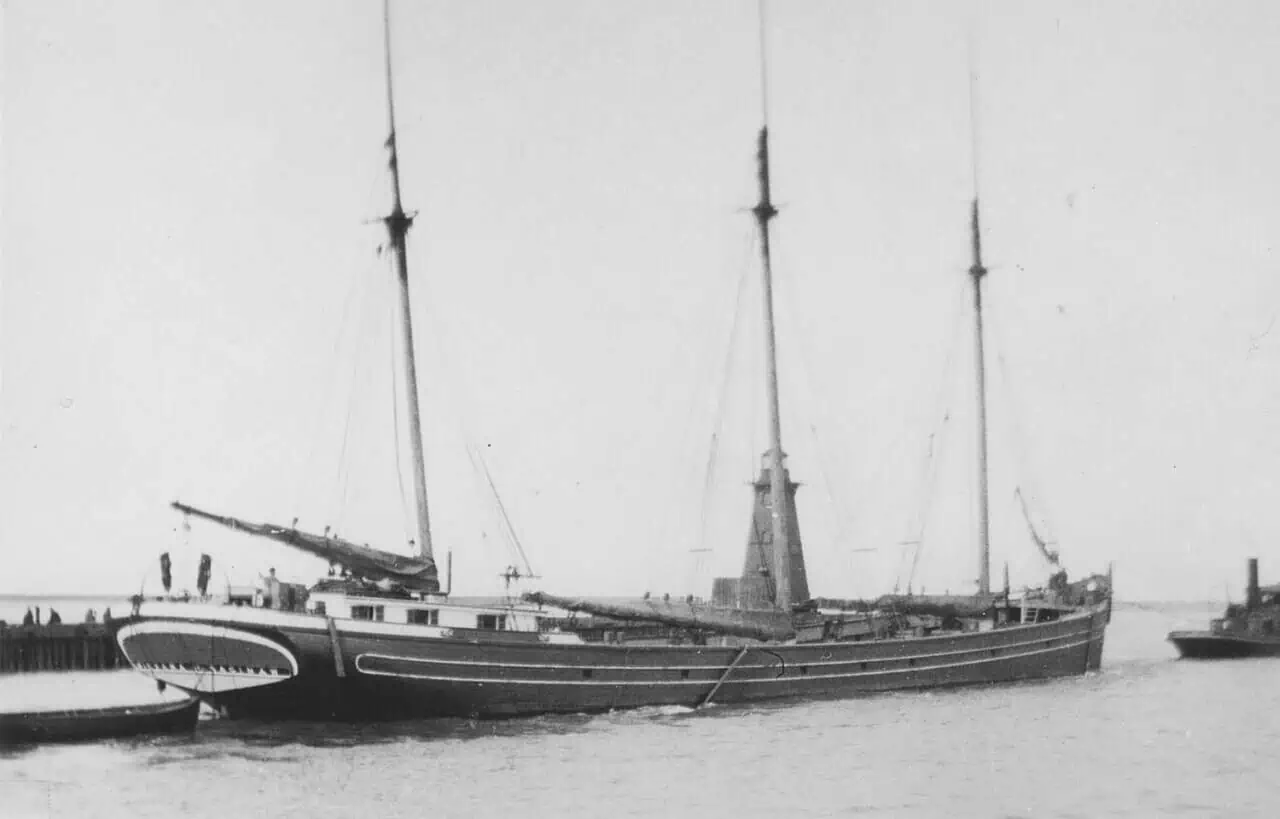
Seavey was born in Portland, Maine, in 1865, went to sea at 13, did a stretch in the Navy, and lost everything chasing the Klondike Gold Rush. Around 1900 he washed up in Escanaba, got hold of a two-masted schooner he named the Wanderer, and started a freight business that was real just often enough to be a good cover. By night, the stories go, the Wanderer would ghost into a port with her lights out, and by morning anything not nailed down on the docks would be gone, sold later in Escanaba as legitimate cargo.
He poached venison at industrial scale, ran liquor, ferried women for waterfront brothels, and was accused of the old wreckers’ trick called moon cussing, moving or faking navigation lights so ships piled onto the rocks where their cargo could be collected. He stood over six feet and around 250 pounds, and by every account was the last man in any saloon you wanted to swing at.
The Nellie Johnson affair
The stunt that made him famous came on June 11, 1908, in Grand Haven. Seavey boarded the schooner Nellie Johnson with a generous supply of liquor and drank sparingly while her crew did not. When they were passed out, he put them ashore and sailed off with the ship and her cargo of cedar posts. Word of the theft got to Chicago before he did, nobody would touch the hot cargo, and Seavey stashed the Nellie Johnson in a river near Frankfort and went back to sailing the Wanderer as if nothing had happened.
The government sent the Tuscarora, a 178-foot steel revenue cutter reputed to be the fastest thing on the lakes, with the Nellie Johnson’s captain and a deputy U.S. marshal aboard. After more than a week of searching port to port, they ran the Wanderer down off Frankfort on June 27 and took Seavey to Chicago in irons.

The part the legend gets wrong
The story everyone repeats says the Tuscarora fired a cannon shot across his bow to make him heave to, and that Seavey was charged with piracy, a hanging offense. The paperwork tells it differently. A biographer who examined the Tuscarora’s own logbook found no shot recorded, just a pirate who pulled over when hailed.
And the formal charge was not piracy at all but the unauthorized removal of a vessel he had once crewed on, since Seavey had conveniently once worked aboard the Nellie Johnson. Then the case simply evaporated. The schooner’s owner never showed up in court, the charges were dropped, and Seavey spent the rest of his life insisting he had won the Nellie Johnson in a poker game and everybody was too embarrassed to admit it.
They gave the pirate a badge
Here is the ending nobody would believe in a movie. Later in life, the federal government hired Dan Seavey as a deputy U.S. marshal and set him to work stopping poaching, smuggling, and piracy on Lake Michigan, on the theory, presumably, that nobody alive knew the business better. Whether he ever fully retired from the other side of the law is an open question, since his beloved Wanderer burned in 1918 and he replaced her with a fast motor launch just as Prohibition made fast motor launches very profitable.
He grew old telling tall tales around the Escanaba waterfront, retired to Peshtigo, Wisconsin, and died in a nursing home there in 1949 at 83. A Wisconsin distillery sells a maple rum with his name on it to this day.
Every harbor town on the lakes has a Roaring Dan story, and half of them are probably even true. But the heart of it is real: the Great Lakes had exactly one arrested pirate, and he tied up his schooner in Escanaba.
More worth reading


Yooper Hub community
The conversation
Know something this story missed? Corrections and additions get read by an editor and folded into the article, with credit.
Real neighbors, real names. A Yooper Hub editor reads your first comment before it appears; after that you’re a known neighbor and your comments post right away. No account required. Community guidelines
Nothing here yet. A sentence is plenty: a correction, a name, or what you remember about this place.
Sources, credits, and reporting details
Sources & accountability
How this story was reported
Editorial methodAggregation
Last verifiedJul. 13, 2026
Corrections statusNo material correction identified in the July 13, 2026 source review.
AI assistanceResearched and drafted with AI tools. Reviewed and approved by editor Keegan O’Brien.
Verification note: CEO-directed review checked the central claims against 1 direct public evidence link on July 13, 2026. No material correction was identified.
Primary sources
-
Direct evidence for: Escanaba Had an Actual Pirate. The Feds Chased Him Down With a Gunboat in 1908. — Escanaba
Accessed Jul. 13, 2026.
Direct public evidence reviewed against the article on July 13, 2026.
Photo and media credits
-
great-lakes-schooner-seavey-era — Creator or rights holder named in the WordPress attachment caption
Featured image record. Accessed Jul. 13, 2026. public domain.
Supports: Featured image used by this article.
A Great Lakes schooner of Seavey's era. His own two-masted Wanderer worked these same waters out of Escanaba. Photo: public domain, via Wikimedia Commons.