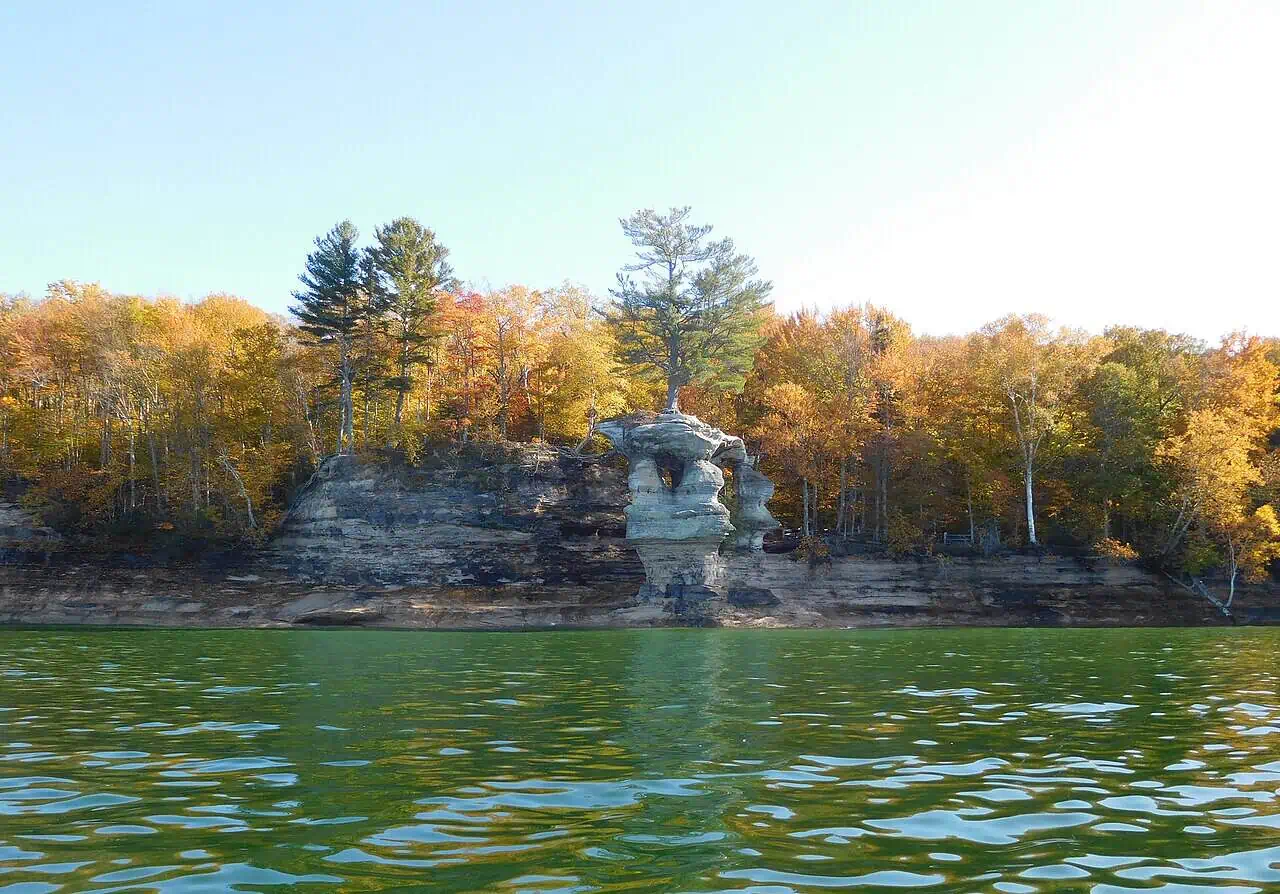
Dig a Michigan quarter out of your pocket, the 2018 one with the rocky shoreline, and look at the little pine standing on the stone pillar. That tree is real. It grows on top of Chapel Rock at Pictured Rocks National Lakeshore, it is roughly 250 years old, about the age of the United States, and by every rule of botany it should be dead. It survives because of one impossible lifeline: a bundle of roots stretched through open air, reaching all the way back to the mainland.

It used to have a bridge
Chapel Rock is a leftover of Cambrian sandstone, carved into a freestanding pillar by the high waters of ancient Lake Nipissing close to 4,000 years ago. When French explorers saw it they called it La Chappelle, the chapel, and when Henry Schoolcraft came through with the 1820 Cass expedition he described a natural arch springing from it like classical architecture and named it Doric Rock.
That arch is the key to the whole story. For centuries it connected the top of the pillar to the mainland cliff, and the pine growing on the rock quietly ran its roots across the top of the arch to reach real soil on the other side, since the bare rock it stands on has essentially none.
Then the bridge fell down
Sometime in the 1940s, the arch finally collapsed into Lake Superior. The stone bridge dropped away, and by any reasonable expectation the roots crossing it should have gone with it, dooming the tree. Instead they held. The roots stayed anchored on both sides and simply kept doing their job with nothing underneath them, a living cable strung across the gap.
In the decades since, they have thickened into a woody bridge that carries every drop of water and every nutrient the tree gets from the mainland forest to the bare rock where it stands. Visitors who make the hike routinely stop dead when they realize what they are looking at, a full-grown white pine being kept alive through thin air.

Seeing it for yourself
Chapel Rock sits in the Chapel Basin area of Pictured Rocks, about 15 miles east of Munising off County Road H-58, then five slow miles up rough Chapel Road to the trailhead. From there it is a three mile hike each way through the woods, past Chapel Falls, to the beach and the rock. Fair warning for summer: the parking lot regularly fills by nine in the morning, so go early or go in the off season, and the road itself demands patience.
You can also see the rock the easy way, from the water, on the Munising boat cruises and kayak tours that run the cliffs all season. However you get there, do not try to climb it or walk the roots. The tree has survived storms, winters, and a collapsing arch. It does not need help from us.
Pictured Rocks is full of grand things, waterfalls, cliffs, caves, whole castles of sandstone. But the most famous resident of the entire lakeshore is one stubborn tree that lost its bridge eighty years ago and decided to stay anyway. It made it onto the back of a quarter. It earned it.
More worth reading


Yooper Hub community
The conversation
Know something this story missed? Corrections and additions get read by an editor and folded into the article, with credit.
Real neighbors, real names. A Yooper Hub editor reads your first comment before it appears; after that you’re a known neighbor and your comments post right away. No account required. Community guidelines
Nothing here yet. A sentence is plenty: a correction, a name, or what you remember about this place.
Sources, credits, and reporting details
Sources & accountability
How this story was reported
Editorial methodAggregation
Last verifiedJul. 13, 2026
Corrections statusNo material correction identified in the July 13, 2026 source review.
AI assistanceResearched and drafted with AI tools. Reviewed and approved by editor Keegan O’Brien.
Verification note: CEO-directed review checked the central claims against 1 direct public evidence link on July 13, 2026. No material correction was identified.
Primary sources
-
Direct evidence for: The Tree on Michigan’s Quarter Is Alive Because Its Roots Refuse to Let Go — National Park Service
Accessed Jul. 13, 2026.
Direct public evidence reviewed against the article on July 13, 2026.
Photo and media credits
-
chapel-rock-lone-pine-fall — Creator or rights holder named in the WordPress attachment caption
Featured image record. Accessed Jul. 13, 2026. public domain.
Supports: Featured image used by this article.
Chapel Rock and its lone white pine in fall, roots stretched across the gap where the arch once stood. Photo: National Park Service / public domain.