Updated Sept. 10, 2026: Clark Township’s board adopted its data-center zoning ordinance, No. 2026-02, on Aug. 19 (details below). Delta County commissioners approved a 12-month moratorium on data centers and cryptocurrency mining in late July. Forsyth Township in Marquette County (12 months, late June) and the City of Houghton (one year, July 8) have also passed moratoriums; neither had an application in hand. In Forsyth Township, Aeris Energy has publicly pitched a data center at the former K.I. Sawyer base but has filed no application or permit. This version also corrects the name of the Dafter defendant.
Correction and records review – July 12, 2026: An earlier version incorrectly said the Lake Superior Academy lawsuit had moved into federal court; the federal court remanded it to state court on July 21, 2025. It also overstated who was pursuing Upper Peninsula sites, misstated Switch’s jobs record and Michigan law, and published unsupported claims about Cloverland Electric, mining operations, a Dafter permit, noise levels and local opposition. Those claims have been corrected or removed.
Public records reviewed by Yooper Hub do not identify a hyperscale developer, an approved Upper Peninsula data-center project, a final site, a utility interconnection request or a construction permit. What the records do show is an unnamed data-center intermediary’s preliminary inquiry to InvestUP, an unfinished regional energy study, a Dafter computing-facility dispute, and documented local and tribal planning actions.
The confirmed inquiry is preliminary
InvestUP CEO Marty Fittante told TV6 in a report published February 24, 2026, that an unnamed “data center aggregator” had contacted the regional economic-development organization about two months earlier. InvestUP and partners then assembled information about possible properties. Fittante described the contact as very early and only a first step.
TV6 also reported that public-record requests to Upper Peninsula counties had found no evidence of data-center projects in the vast majority of responses received by that point. Responses from Gogebic, Houghton, Luce and Schoolcraft counties were still pending when the report was published. That snapshot does not establish that no later proposal exists.
InvestUP was also studying how a large project could affect the eastern U.P. energy system. Yooper Hub has not found published results from that study in the records reviewed for this correction. The available record therefore supports an early inquiry, not a claim that a named technology company is selecting or developing a U.P. site.

What the Dafter court record says
Dafter Township had 1,327 residents in the 2020 Census. A dispute there involves Lake Superior Academy and Odessa Partners, LLC. In its complaint, the school alleged that Odessa placed six shipping-container-size structures nearby, operated data-processing equipment around the clock and produced noise above 50 decibels at the school’s property. Those are allegations, not findings by Yooper Hub or a final court judgment.
The Chippewa County Circuit Court initially issued a temporary restraining order. Odessa then removed case 25-18269-CZ to the U.S. District Court for the Western District of Michigan as case 2:25-cv-00160. On July 21, 2025, U.S. District Judge Paul L. Maloney remanded the case because Odessa had not established federal subject-matter jurisdiction. The federal order did not decide the merits of the school’s allegations.
Yooper Hub has not obtained a current state-court register of actions after the remand and is not stating whether the parties later resolved the dispute or whether a later injunction remains in effect.
Documented government responses
Clark Township records trace the township from a moratorium to an adopted data-center zoning ordinance. September 17, 2025 board minutes say a moratorium was then preventing cryptocurrency-mining permit applications while an ordinance was drafted. Draft April 22, 2026 minutes say the planning commission was working toward a final ordinance before the moratorium’s expected June expiration. A June 9 planning commission agenda listed approval of a revised crypto ordinance under old business, though the commission’s minutes record no vote on it. The commission recommended a data-center ordinance July 14 and held a public hearing Aug. 11. On Aug. 19 the township board adopted it as Ordinance No. 2026-02, which allows data centers, AI data centers and cryptocurrency mining only as special land uses in industrial districts, with a 1,000-foot buffer from Lake Huron.
The Sault Ste. Marie Tribe of Chippewa Indians took a separate action. Its May 19, 2026 board packet confirms adoption of Resolution 2026-107, establishing a moratorium on data centers on Tribal land. The resolution text in the April 7 board packet prohibits approval, permitting, development, construction, leasing, operation and negotiation for AI data centers on Tribal and trust lands. It is indefinite unless lifted by a later resolution after specified impact, environmental, cultural, infrastructure, energy and community reviews.
Michigan’s tax rules and the Switch jobs record
Michigan’s data-center equipment tax exemptions came from 2024 Public Acts 181 and 207, effective April 2 and April 17, 2025, respectively. For an enterprise data center to receive certification, the law includes at least $250 million in aggregate capital investment, at least 30 qualifying jobs paid at 150% of the regional median wage, green-building certification and clean-energy procurement equal to at least 90% of forecast annual electricity use. Other definitions and deadlines also apply.
Switch’s Grand Rapids-area project is useful only as a carefully bounded comparison. A July 2016 Michigan Strategic Fund packet projected 103 jobs at Switch by December 31, 2021. It separately anticipated at least 100 jobs from colocated tenants; it did not promise 1,000 Switch jobs. The state’s 2023 Renaissance Zone report lists 43 current Switch employees, including 17 transferred positions, and 26 actual jobs created above the report’s zero-job baseline. The 26 figure is not the site’s total employment.
What remains unverified
The reviewed records do not identify the intermediary, a developer, a final parcel, an approved project, a permit application, a utility interconnection request or the results of InvestUP’s energy study. Yooper Hub also found no reliable support in those records for the previous article’s claims that Cloverland Electric had the region’s lowest rates or was recruiting data centers, that three mining operations were running in the U.P., that a Dafter storage-facility permit covered the disputed operation, or that all AI computing loads can be curtailed in the same way.
How to verify a future proposal
- Check the relevant township, city and county planning agendas, minutes, zoning files and permit records.
- Look for a Michigan Strategic Fund or Michigan Economic Development Corporation certification tied to the state tax exemption.
- Request the utility-service or interconnection record and distinguish a preliminary inquiry from an executed agreement.
- For the Dafter dispute, consult the Chippewa County Circuit Court register for case 25-18269-CZ rather than relying on the ended federal docket.
This article was rebuilt from the records listed below. Yooper Hub will update it when a named project, application, court filing, energy study, ordinance or other controlling record becomes available.
More worth reading


Golden 25 trust review · #5
Verified context for this Yooper Hub story
- Evidence refreshed
- July 13, 2026
- Source readiness
- Live source review complete.
- Corrections status
- A material correction or update note is published in this article.
- Image rights
- Featured and in-story images have documented rights records.
Sources, credits, and reporting details
Sources & accountability
How this story was reported
Editorial methodService and public-interest reporting
Accountable editor:Keegan O’Brien, publisher and editor.
Last verifiedSep. 10, 2026
Corrections statusA material correction or update note is published in this article.
AI assistanceResearched and drafted with AI tools. Reviewed and approved by editor Keegan O’Brien. Tool: Claude Max.
Verification note: Rechecked Sept. 10, 2026. Clark Township adopted its data-center zoning ordinance Aug. 19. Forsyth Township and the City of Houghton passed moratoriums this summer, and Aeris Energy has pitched a K.I. Sawyer data center without filing an application. The Sault Tribe's moratorium is unchanged, InvestUP's energy study has not been published, and Michigan's data-center tax exemption is unchanged. The Dafter defendant's name was corrected to Odessa Partners, LLC, as captioned in the federal order.
Primary sources
-
Order remanding Lake Superior Academy v. Odessa Partners, LLC — U.S. District Court for the Western District of Michigan / GovInfo
Published Jul. 21, 2025. Accessed Sep. 10, 2026.
The order does not decide the merits and does not establish the current state-court posture.
-
2020 Census county subdivision record for Dafter Township — U.S. Census Bureau
Accessed Jul. 12, 2026.
Supports: Reports Dafter Township's 2020 Census population as 1,327.
-
Revenue Administrative Bulletin 2025-18 — Michigan Department of Treasury
Published Sep. 16, 2025. Accessed Jul. 12, 2026.
-
Michigan Strategic Fund July 2016 meeting packet — Michigan Strategic Fund
Published Jul. 26, 2016. Accessed Jul. 12, 2026.
-
CY2023 Renaissance Zone Annual Report — Michigan Economic Development Corporation
Accessed Jul. 12, 2026.
The 26 actual-created figure is not total site employment.
-
Sault Tribe Board of Directors April 7, 2026 packet — Sault Ste. Marie Tribe of Chippewa Indians
Published Apr. 7, 2026. Accessed Jul. 12, 2026.
-
Sault Tribe Board of Directors May 19, 2026 packet — Sault Ste. Marie Tribe of Chippewa Indians
Published May. 19, 2026. Accessed Jul. 12, 2026.
-
Clark Township Board minutes, September 17, 2025 — Clark Township
Published Sep. 17, 2025. Accessed Jul. 12, 2026.
-
Clark Township draft minutes, April 22, 2026 — Clark Township
Published Apr. 22, 2026. Accessed Jul. 12, 2026.
Draft minutes; used only for the status they report, not as proof of later adoption.
-
Clark Township Planning Commission agenda, June 9, 2026 — Clark Township
Published Jun. 9, 2026. Accessed Sep. 10, 2026.
Supports: Lists approval of a revised crypto ordinance under the planning commission's old business.
An agenda is not proof that the item passed; current final status remains unverified.
-
Notice of Ordinance Amendment Adoption, Clark Township Ordinance No. 2026-02 — Clark Township (Mackinac County)
Accessed Sep. 10, 2026.
-
Clark Township Board of Trustees regular meeting agenda, Aug. 19, 2026 — Clark Township
Published Aug. 19, 2026. Accessed Sep. 10, 2026.
-
Clark Township Planning Commission minutes, June 9, 2026 — Clark Township Planning Commission
Published Jun. 9, 2026. Accessed Sep. 10, 2026.
-
Sault Tribe Board of Directors meeting packet, Sept. 1, 2026 — Sault Ste. Marie Tribe of Chippewa Indians
Published Sep. 1, 2026. Accessed Sep. 10, 2026.
-
Enterprise Data Center Sales & Use Tax Exemption — Michigan Economic Development Corp.
Accessed Sep. 10, 2026.
Additional reporting
-
TV6 Investigates: Data centers in the U.P. — WLUC-TV6
Published Feb. 24, 2026. Accessed Jul. 12, 2026.
-
Clark Township Planning Commission minutes, July 14, 2026
Published Jul. 14, 2026. Accessed Aug. 21, 2026.
Delta County moratorium: Daily Press, July 23, 2026, and Mining Journal, July 24, 2026.
-
Delta County Board passes moratorium on data centers — Daily Press (Escanaba)
Published Jul. 23, 2026. Accessed Sep. 10, 2026.
-
Forsyth Township Board passes moratorium regarding data centers at crowded meeting — WLUC TV6
Published Jun. 25, 2026. Accessed Sep. 10, 2026.
-
He wants to bring a data center to the Upper Peninsula. He also says don't panic. — WJMN / MyUPNow
Published Jun. 19, 2026. Accessed Sep. 10, 2026.
-
Houghton city council approves temporary data center moratorium — WLUC TV6
Published Jul. 9, 2026. Accessed Sep. 10, 2026.
Photo and media credits
-
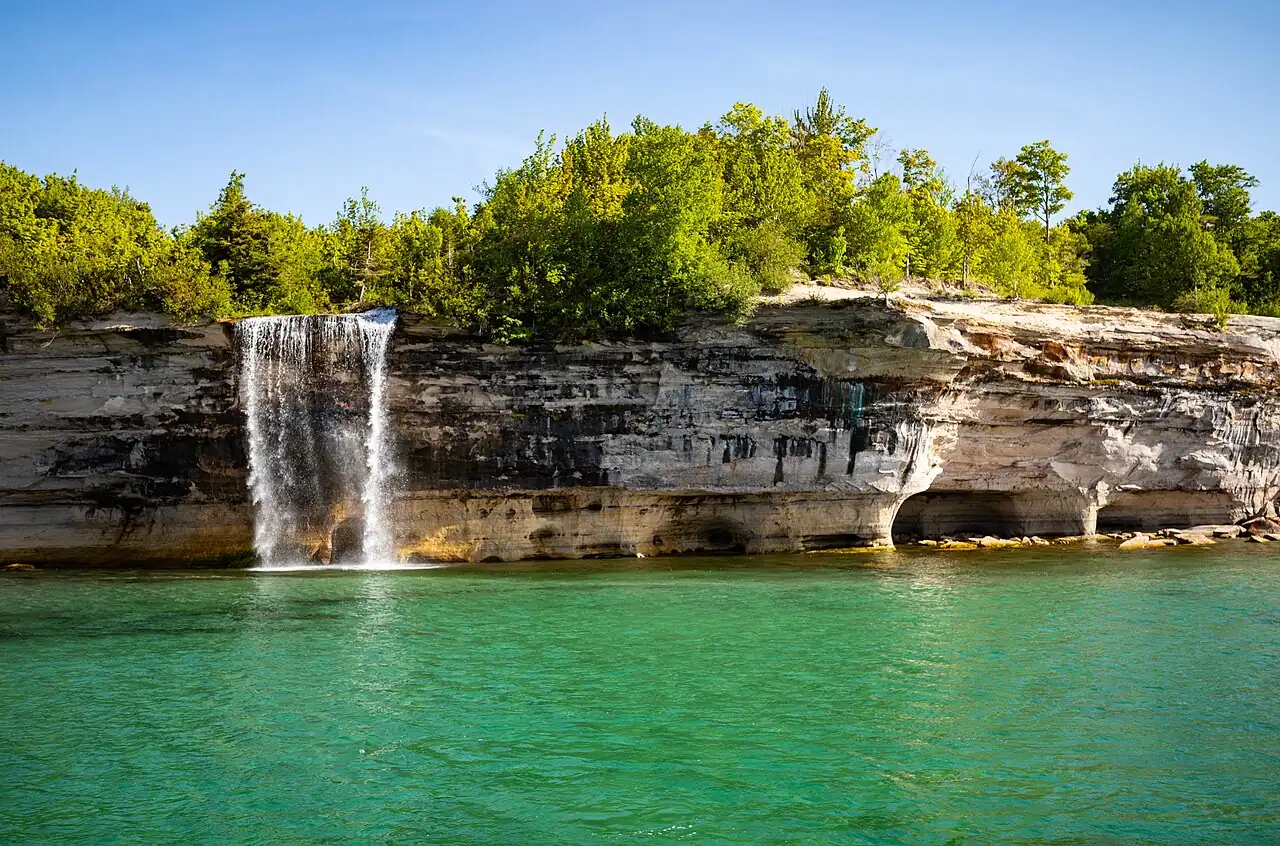
Miners Castle, Pictured Rocks National Lakeshore, Michigan — rboed / Wikimedia Commons
Featured image record. Published Jun. 2, 2024. Accessed Jul. 12, 2026. CC BY 2.0; attribution required; local resizing disclosed.
-
Data Center of CMC Telecom — Daoducquan / Wikimedia Commons
Published Jan. 12, 2017. Accessed Jul. 12, 2026. CC BY-SA 4.0; local crop and resize disclosed; derivative remains CC BY-SA 4.0.


Media rights and provenance
Miners Castle contextual featured photograph
Creator: rboed
Original source: Wikimedia Commons file record
Rights basis: CC BY 2.0. Commercial reuse permitted with attribution.
Modification scope: Resizing permitted; attribution and an indication of changes are required.
Required credit: Photo: rboed / Wikimedia Commons (CC BY 2.0). Local copy resized. Contextual U.P. landscape, not a proposed site.
AI provenance: Documentary photograph. No AI-generated imagery used.
CMC Telecom data-center interior photograph
Creator: Daoducquan
Original source: Wikimedia Commons file record
Rights basis: CC BY-SA 4.0. Commercial reuse permitted with attribution and share-alike compliance.
Modification scope: Cropping and resizing permitted; derivatives remain under CC BY-SA 4.0 and changes must be indicated.
Required credit: Photo: Daoducquan / Wikimedia Commons (CC BY-SA 4.0). Local crop and resize. Illustrative, not a U.P. facility.
AI provenance: Documentary photograph. No AI-generated imagery used.