The pasty you buy in Houghton, Ishpeming or Escanaba is not a Cornish pasty. Not as an opinion. As a matter of law in Britain, where the name has been protected since 2011.
The UK government announced the protection that February, granting the Cornish pasty Protected Geographical Indication status under the European food names scheme. The rule is narrow. Only pasties made in Cornwall, to a registered specification, can be sold under the name.
The specification is equally specific. In the government’s own words, a genuine Cornish pasty needs to contain chunks of beef, potato, onion and swede, all encased in the famous D shaped crust. A U.P. pasty made in Calumet with carrots in it is a pasty. It is just not that one.

How it got to the Copper Country
Cornish miners brought it. They arrived in the U.P. during the copper rushes of the early 1800s, bringing with them a hand held meat pie built for a twelve hour shift underground.
The Finns picked it up after they arrived in 1864. Folklorists William and Yvonne Lockwood documented how Finnish workers learned the dish from the Cornish miners already in the mines, and the swap that came with it: carrots for rutabaga, in some kitchens permanently.
That is the actual reason the pasty reads as Finnish to a lot of people up here. It came in Cornish and got adopted by nearly everyone who worked underground after that.
The one thing almost everyone gets wrong
The story you have heard is that the thick crimped edge was a handle. Miners with arsenic on their hands held the pasty by the crust, ate the rest, and threw the handle away. It gets repeated constantly, including in the UK government’s own 2011 announcement, which stated that tin miners in Cornwall could use the crimped crust as a handle.
The evidence for it is thin. Old photographs of Cornish miners show pasties carried in paper or muslin bags, and eaten end to end rather than held by the edge. The earliest Cornish recipe book, published in 1929, describes eating a pasty from one end to the other as the correct way to do it.
It is a good story. It is not documented practice, and it is worth separating the two.

Rutabaga, and the other argument
Rutabaga is the dividing line in U.P. kitchens, and it splits along the same Cornish and Finnish seam the Lockwoods described. Traditional Cornish filling uses swede, which is what Cornwall calls rutabaga. Plenty of U.P. bakers use carrots instead, or both, or neither.
Seasoning stays minimal either way. Salt and pepper, and then the second argument starts, because a pasty is served with ketchup or with gravy and there is no neutral ground on that question anywhere north of the bridge.
Where this leaves the U.P. pasty
Protected status does not make the Cornish version better. It makes the name a legal term in Britain and nothing more. What the U.P. has is a hundred and eighty years of the same food, adapted by a second immigrant group, cooked continuously through the collapse of the mining industry that brought it here, and still sold on the same highways.
Yooper Hub note: tell us your shop and your side of the ketchup question. We will add the count to this piece.
Sources: UK Government announcement on Cornish pasty Protected Geographical Indication status, February 2011; NPR, March 2017, citing folklorists William and Yvonne Lockwood.
More worth reading


Yooper Hub community
The conversation
Know something this story missed? Corrections and additions get read by an editor and folded into the article, with credit.
Real neighbors, real names. A Yooper Hub editor reads your first comment before it appears; after that you’re a known neighbor and your comments post right away. No account required. Community guidelines
Nothing here yet. A sentence is plenty: a correction, a name, or what you remember about this place.
Sources, credits, and reporting details
Sources & accountability
How this story was reported
Editorial methodArchival synthesis
Last verifiedSep. 9, 2026
Corrections statusNo material correction note is recorded on this article.
AI assistanceResearched and drafted with AI tools. Reviewed and approved by editor Keegan O’Brien.
Verification note: The ledger establishes the Cornish pasty PGI from the 22 February 2011 DEFRA announcement, the current gov.uk register entry and product specification (Cornish Pasty Association: beef, potato, swede/turnip, onion, D-shaped, side-crimped, made in Cornwall), and EU Regulation 717/2011 (20 July 2011), plus NPR 2017 for the Lockwood folklore finding, the 1864 Finnish wave and the carrot-for-rutabaga swap. The article deliberately does not claim the pasty was 'invented' in Cornwall or give an exact arrival year in the U.P.; note that the February 2011 date is the UK announcement, while formal EU registration was 20 July 2011, and that the arsenic 'handle' story appears in the PGI specification itself, not only the press release.
Primary sources
-
Cornish pasties can't be pirated (press release) — Department for Environment, Food & Rural Affairs (UK)
Published Feb. 22, 2011. Accessed Sep. 9, 2026.
Supports both the 2011 protection claim and the article's point that the government's own announcement repeated the crust-handle story.
-
Protected food name: Cornish Pasty (PGI) — Department for Environment, Food & Rural Affairs (UK)
Published Jan. 4, 2021. Accessed Sep. 9, 2026.
Register page shows EU registration date 23 July 2011 (publication in the Official Journal); the regulation itself is dated 20 July 2011.
-
Cornish Pasty PGI product specification — Cornish Pasty Association (applicant), published by DEFRA
Accessed Sep. 9, 2026.
The specification also repeats the arsenic crust-handle story ('The crust (crimped edge) was used as a handle which was then discarded due to the high levels of arsenic in many of the tin mines'), so the folklore is in the registered document, not only the press release.
-
Commission Implementing Regulation (EU) No 717/2011 entering a name in the register of protected designations of origin and protected geographical indications (Cornish Pasty (PGI)) — European Commission, via legislation.gov.uk
Published Jul. 20, 2011. Accessed Sep. 9, 2026.
Establishes that the legal registration date is July 2011; February 2011 is the UK announcement date.
Additional reporting
-
In Michigan, The Pasty Isn't X-Rated. It's A Portable Pie With History Baked In — NPR, The Salt (Erin Wisti)
Published Mar. 16, 2017. Accessed Sep. 9, 2026.
Secondary summary of the Lockwoods' work; the Lockwoods' original paper ('Pasties in Michigan's Upper Peninsula: Foodways, Interethnic Relations, and Regionalism') was not fetched.
-
Cornish Pasty Myths & Legends — Warrens Bakery (Victoria Clark)
Published May. 18, 2021. Accessed Sep. 9, 2026.
Cornish bakery blog; corroborates the photographic evidence point.
-
Pasty — Wikipedia
Accessed Sep. 9, 2026.
Used only for the 1929 recipe-book citation, which was not independently fetched.
Photo and media credits
-
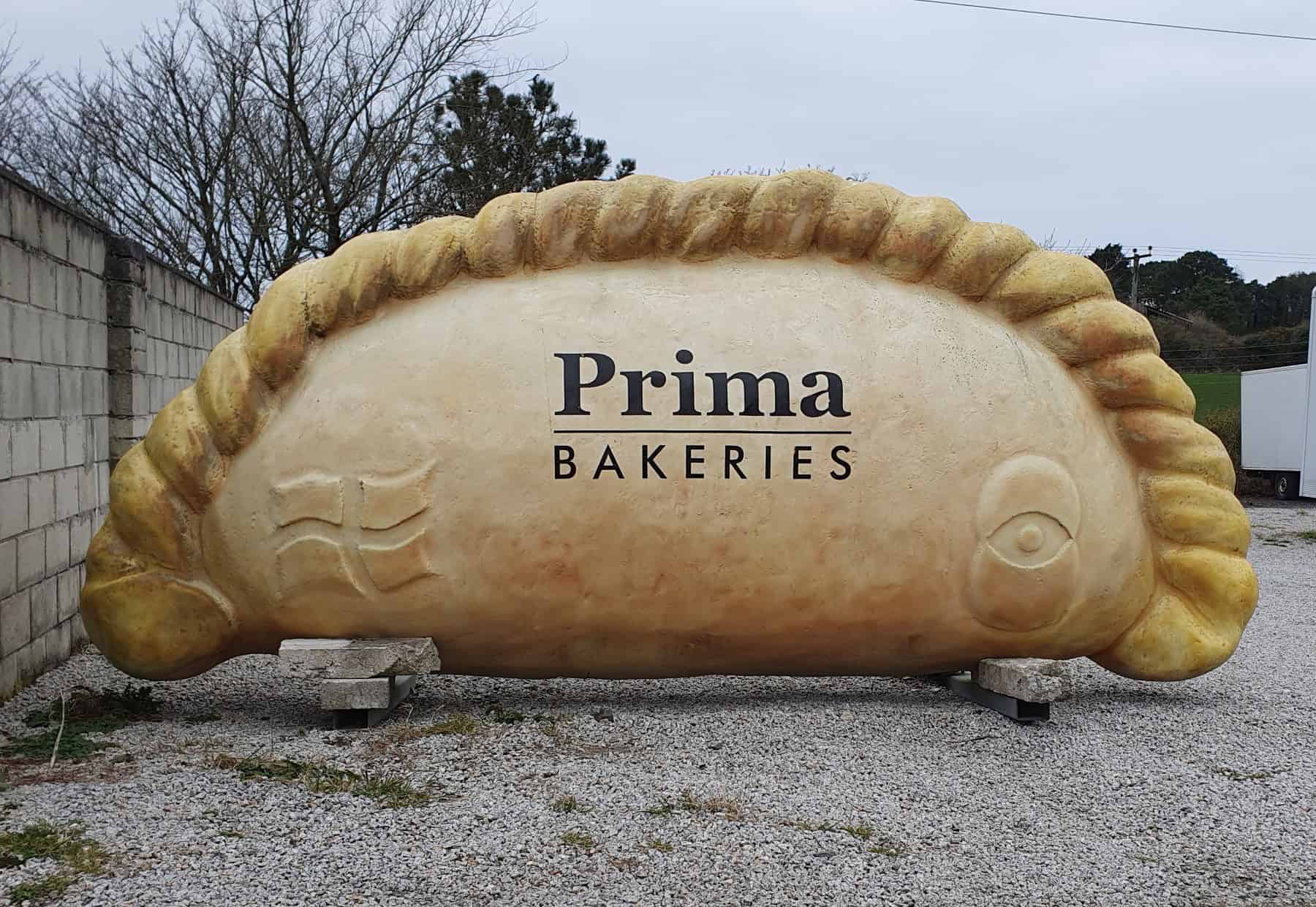
Prima Bakeries pasty sign, Wheal Rose, Scorrier, Cornwall – March 2023.jpg (featured image) — Mutney, via Wikimedia Commons
Featured image record. Published Mar. 1, 2023. Accessed Sep. 9, 2026. CC BY-SA 4.0.
Featured image replaced Sept 9 2026 (attachment 2807): the previous featured image (2595) had no photographer or license on record. Original 3743×2580, resized to 1800×1241 q90. Commons file identified Sept 9 2026 via the Commons API from the author credit and matching aspect ratio.
