Cross the Manistique River on Deer Street today and you will not notice a thing. It is a short, plain concrete bridge on M-94, the kind you drive over while thinking about something else. Which makes it easy to miss that for most of a century, this was one of the most famous odd bridges in America — the one Ripley’s “Believe It or Not” told the whole country about, because the road you were driving on sat four feet below the surface of the river you were crossing.
The story starts with paper. In the late 1910s the Manistique Pulp and Paper Company — owned, of all things, by the Minneapolis Tribune Publishing Company, which wanted a steady supply of newsprint — needed serious water power for its new mill on the river. The obvious answer was a dam. The problem with the obvious answer was that a dam high enough to do the job would have put much of downtown Manistique underwater. So the engineers did something gloriously backwards: instead of raising the river behind a dam, they gave the river a second story. They built a concrete flume — essentially an elevated river channel — running some 3,000 feet, 200 feet wide and 20 feet deep, carrying the Manistique’s flow at a higher elevation from a dam upstream down to the mill’s turbines and grinders at a rate of about 650,000 gallons an hour, drawing on a drainage basin of some 1,400 square miles.
The road inside the river
Then they had to get the town’s main street across it. In 1919 the company built a roughly 300-foot reinforced-concrete girder bridge directly through the upper part of the flume — not over the water so much as inside it. The deck sat four feet below the water level, and the bridge’s thick, tall concrete railings did a job no ordinary railing does: they were walls, holding the river out of the road. The old Lions Club marker that still stands at the bridge puts the local physics plainly: “This design results in the river helping to support the bridge.” Engineers will tell you the reinforced concrete deserves most of the credit, but the town has never let that spoil the tale — people called it the Siphon Bridge, or simply the Floating Bridge, and drivers came from all over to motor across a river below its own surface. Ripley’s made it national. Even the leftovers had an afterlife: when the old iron bridge it replaced came down, its steel girders were recycled into building projects across Schoolcraft County.
Still there, hiding in plain sight
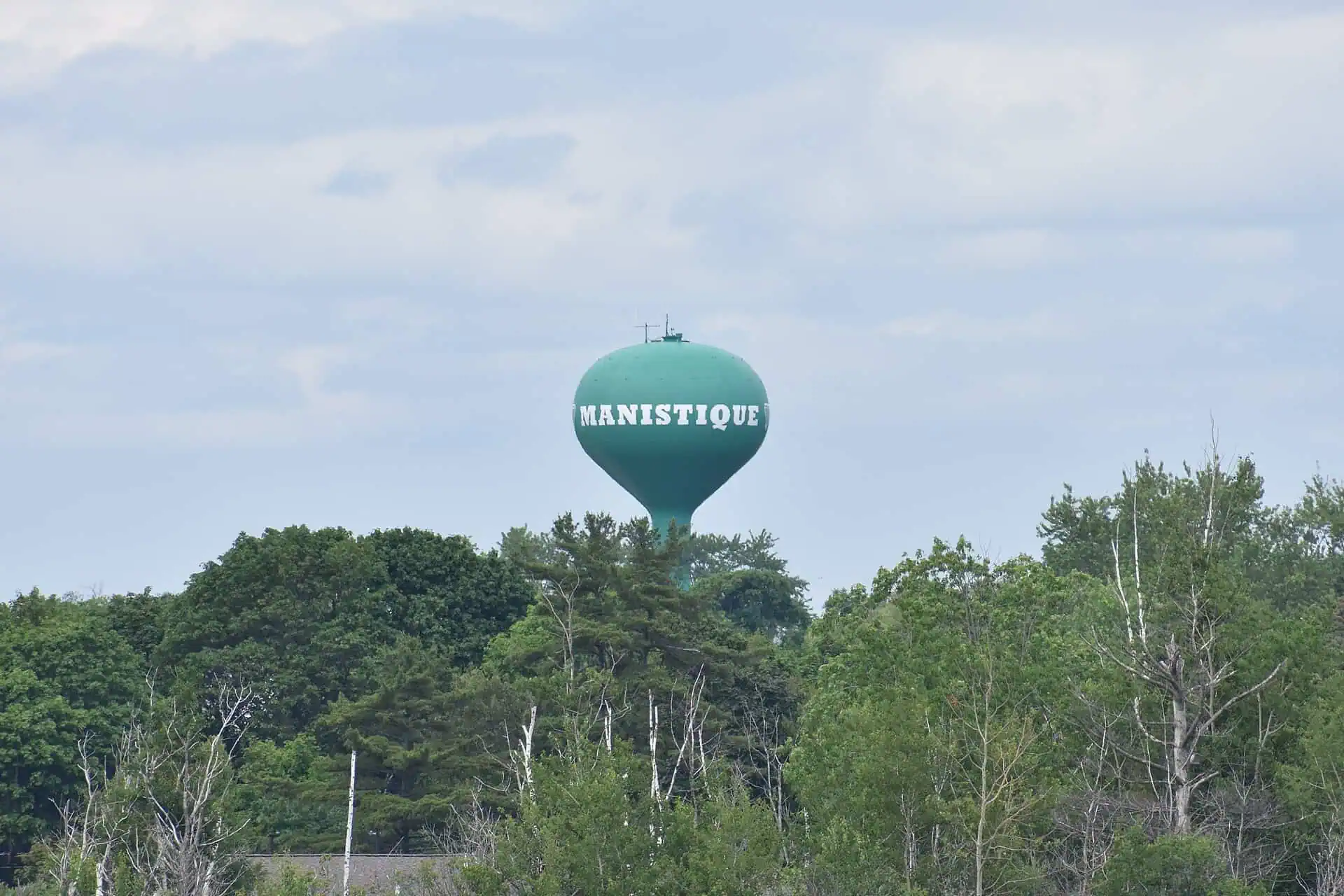
The strangeness has since gone quiet. In later years the mill lowered the water in the flume below road level, so the below-the-river effect now lives mostly in old photographs — there is a well-known 1970s shot showing the water sitting above the roadway with the “Believe It or Not” sign mounted proudly on the bridge. The bridge itself has been restored and still carries M-94 traffic through downtown, still threaded through its giant concrete flume. Beside it stands the other half of Manistique’s brick-and-concrete skyline: the ornate water tower a local contractor, Swedish-born Fridolph Danielson, put up in 1921 and 1922. It pumped the city’s water until 1966, did a short stint as the Hall of Justice, and today anchors the historical society’s corner of town, right next to the marker.
Every town in the U.P. has a bridge over a river. Manistique is the only one that looked at that arrangement and decided it was negotiable. When the dam would not fit the town, they raised the river instead — and for a few glorious decades, the main road through Manistique ran four feet below it, dry as a sermon, while the Manistique River flowed past at eye level on its way to make the next morning’s newspaper.
Go See It
Siphon Bridge, Manistique
- Hours
- No hours or access rules are listed by any source we read, and the Google Maps listing has none.
- Cost
- No fee is listed.
- Season
- No season is listed.
- Drive
- From Marquette: 1 hr 33 min (87.8 mi) via M-28 E and M-94 E (Google Maps, read Oct. 5, 2026)
From the Bridge: 1 hr 30 min (91.2 mi) via US-2 W (Google Maps flags tolls on this route; usual traffic, read Oct. 5, 2026) - Nearby
- Schoolcraft County Historical Park on Deer Street between Weston Street and the river. Its museum is open in the summer months; hours and phone are not listed (Manistique Tourism Council).
More worth reading


Sources, credits, and reporting details
Sources & accountability
How this story was reported
Editorial methodArchival synthesis
Last verifiedJul. 21, 2026
Corrections statusNo material correction note is recorded on this article.
AI assistanceResearched and drafted with AI tools. Reviewed and approved by editor Keegan O’Brien.
Verification note: Initial ledger, verified 2026-07-21 during publication prep. Construction, flume specifications, Ripley recognition and present-day status checked against the county historical society, the marker text, and bridge references. Sole direct quotation is the eleven-word marker sentence. Featured image CC BY 4.0, credit TCP04, resized without cropping; it shows the adjacent water tower and is identified as such. No AI-generated or AI-assisted media.
Primary sources
-
The Historic Bridges of Manistique — Schoolcraft County Historical Society
Featured image record. Accessed Jul. 21, 2026. Local historical society; cited.
-
Believe It or Not historical marker, Manistique — The Lions Club via Historical Marker Database
Featured image record. Accessed Jul. 21, 2026. Public marker text; brief quotation with attribution.
Sole direct quotation in the article is the eleven-word marker sentence.
Additional reporting
-
Siphon Bridge — SAH Archipedia (Kathryn Bishop Eckert, Buildings of Michigan)
Featured image record. Accessed Jul. 21, 2026. Scholarly reference; cited.
-
Siphon Bridge — HistoricBridges.org
Featured image record. Accessed Jul. 21, 2026. Copyright HistoricBridges.org; cited.
-
Essay contest first prize: history of the Siphon Bridge — Schoolcraft County Historical Society
Featured image record. Published May. 16, 2016. Accessed Jul. 21, 2026. Local historical society; cited.
-
Siphon Bridge and water tower pages — Schoolcraft County Historical Society
Featured image record. Accessed Jul. 21, 2026. Local historical society; cited.
Photo and media credits
-
Manistique Water Tower.jpg — TCP04 / Wikimedia Commons
Featured image record. Published Jul. 1, 2026. Accessed Jul. 21, 2026. CC BY 4.0; credit TCP04.
No openly licensed photograph of the bridge itself was available; the adjacent landmark is used and identified accurately.
