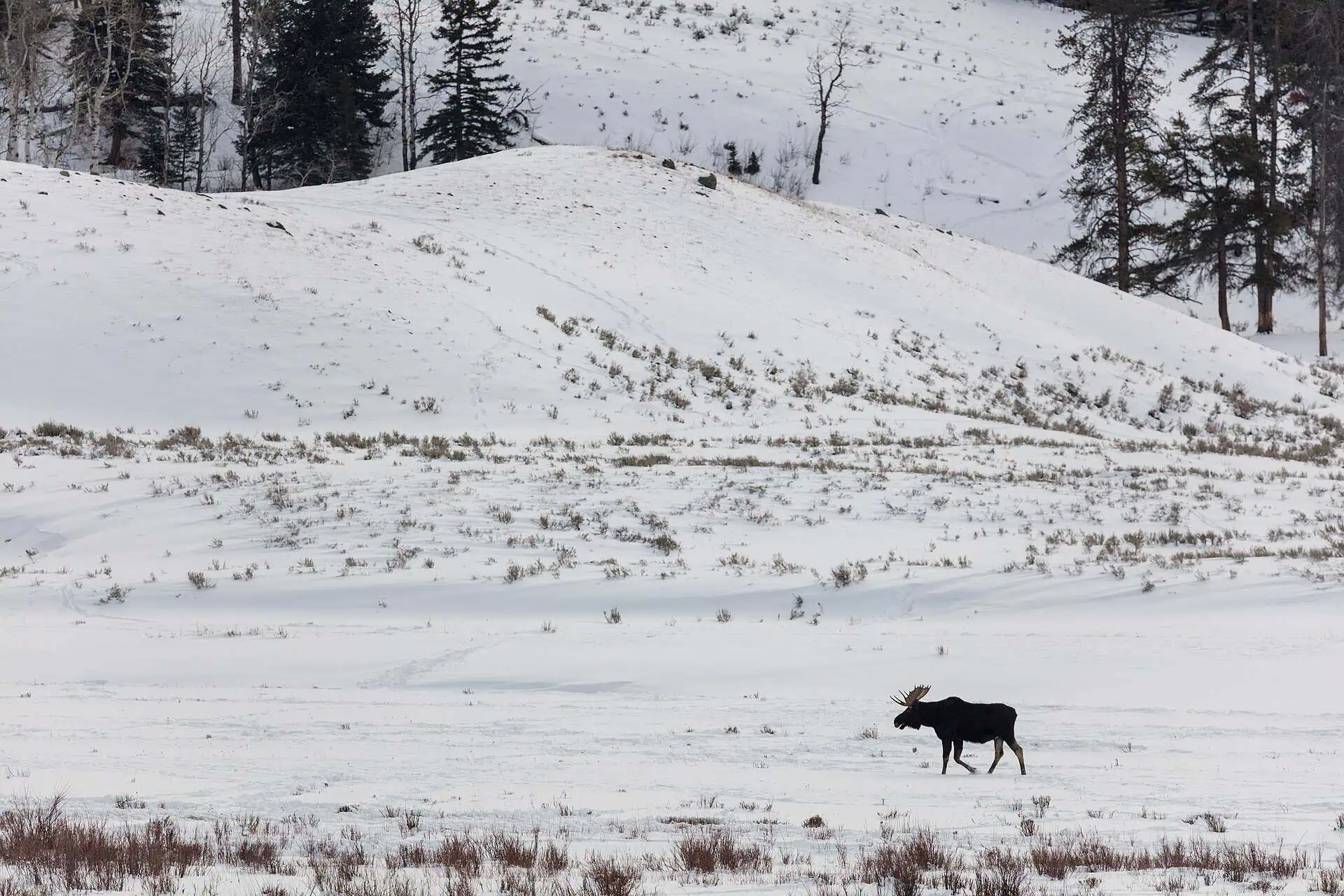
In the dead of winter in 1985, if you happened to be near Algonquin Provincial Park in Ontario, you might have looked up and seen something that did not make any sense: a full-grown moose, blindfolded and fast asleep, dangling from a cable beneath a helicopter. It was not a hoax. It was the start of one of the strangest and most successful wildlife operations in Michigan history, and the reason there are moose in the U.P. today.
Moose belong here. They were all over the Upper Peninsula once. But by the late 1800s they had been all but wiped out, cut down by unregulated hunting and by the logging boom, which cleared the old forests and brought in deer carrying a brainworm parasite that is harmless to deer and deadly to moose. By 1951 a Marquette newspaper ran a headline asking whether the last moose had already left the U.P. The state decided to bring them back.

How you move a half-ton animal 600 miles
The plan, nicknamed the “moose lift,” sounds insane and mostly was. A small chase helicopter would herd a moose out onto a frozen lake, where a biologist could hit it with a tranquilizer dart. Once the animal went down, a second helicopter carrying a sling crew moved in. Three people worked in wind chills that at times approached 100 below zero, sometimes pulling off their gloves, to wrestle a groggy 900-pound moose into a harness. Then the helicopter lifted it off the ice and flew it, hanging in the open air, up to 14 miles back to base camp.
There the moose got a full medical check and a radio collar, was loaded into a crate, and began a nonstop 600-mile truck ride to a release site north of Lake Michigamme in Marquette County. The very first moose to arrive, on January 23, 1985, was a 965-pound pregnant cow. Almost 400 people drove out to watch her walk free, in 35-below cold.

Paid for in turkeys
Here is the part that still makes people laugh. Michigan did not buy the moose. It traded for them. Ontario wanted to build a huntable population of wild turkeys, which Michigan had, so the two governments swapped. Michigan sent turkeys north and got moose in return. As one DNR official dryly admitted, it was “not a pound-for-pound exchange.” Sportsmen’s groups helped cover the roughly 60,000-dollar cost of the whole operation.
They did it twice, 29 moose in 1985 and another 30 in 1987. By the second round the releases had become a spectacle. Somewhere between 500 and 700 people packed into viewing stands, and cars backed up six miles down the Peshekee Grade to watch a truck let moose loose in the woods.
Fifty-nine moose, and counting
The gamble worked. Those 59 animals became a self-sustaining herd. The population climbed past 200 by the early 1990s and today runs around 500 moose ranging across Marquette, Baraga, and Iron counties. Biologists had hoped for 1,000 by the year 2000 and did not quite get there, but the herd is stable and slowly growing, which for a wildlife reintroduction counts as a big win. As one DNR biologist put it, not all reintroductions work. This one did.
If you want to see one, your best odds are around Van Riper State Park and Craig Lake State Park west of Marquette, or over in the eastern U.P. near Seney National Wildlife Refuge and Tahquamenon Falls, where a smaller, separate group of moose lives. Drive slow, watch the tree line at dawn and dusk, and remember that the animal you are looking at may be descended from one that once rode into the U.P. under a helicopter.
Sources, credits, and reporting details
Sources & accountability
How this story was reported
Legacy source review pending. This published article has not yet passed Yooper’s current source-readiness gate.
Editorial methodNot yet classified
Image provenanceAI imagery status not yet declared
Accountable reviewerNot yet assigned
Last verifiedNot yet recorded
Sources: the Michigan Department of Natural Resources; the Friends of Algonquin Park; the Michigan Wildlife Council; and contemporary coverage in the Marquette Mining Journal.
Direct links, claim-level support, dates, credits, and editorial accountability may still be incomplete.