Years before the forty-niners headed west, a rush for copper built the Keweenaw, and the Quincy Mine still towers over it
Everybody knows the California Gold Rush. Almost nobody knows that years before the forty-niners headed west, a different rush was happening right here in the U.P. It was for copper, and it built this whole place.
They still call this corner of the U.P. the Copper Country, and the name is earned.
What made the Keweenaw Peninsula so special was the copper itself. Most places have to dig up ore and smelt the metal out of it. Here, the ground held huge amounts of pure, native copper, the metal already in solid form, sometimes in chunks you could practically pick up.
People had known about it for a very long time. Native peoples were mining copper here roughly 7,000 years ago, hammering it into tools and trade goods, in what is some of the oldest metalworking known anywhere on the continent.

Then in the 1840s, after a state geologist named Douglass Houghton (the man Houghton city and county are named for) surveyed the region and confirmed how much copper was down there, the rush was on. Prospectors and mining companies poured in. It is often called the first major mining rush in the country, and it kicked off years before the gold rush out west.
The copper pulled in tens of thousands of people from all over the world. Cornish miners came with hard-rock mining know-how. Finns, Italians, Croatians, Slovenians, and dozens of other groups followed, turning the Copper Country into one of the most diverse places in the Midwest. They are the reason the U.P. has Finnish saunas, Cornish pasties, and so much of the character it still has today.

The numbers got staggering. Two giant companies, Calumet and Hecla and the Quincy Mining Company, came to dominate, and over the decades the region produced something like 11 billion pounds of copper. For a stretch, the Keweenaw was the biggest copper producer in the world.
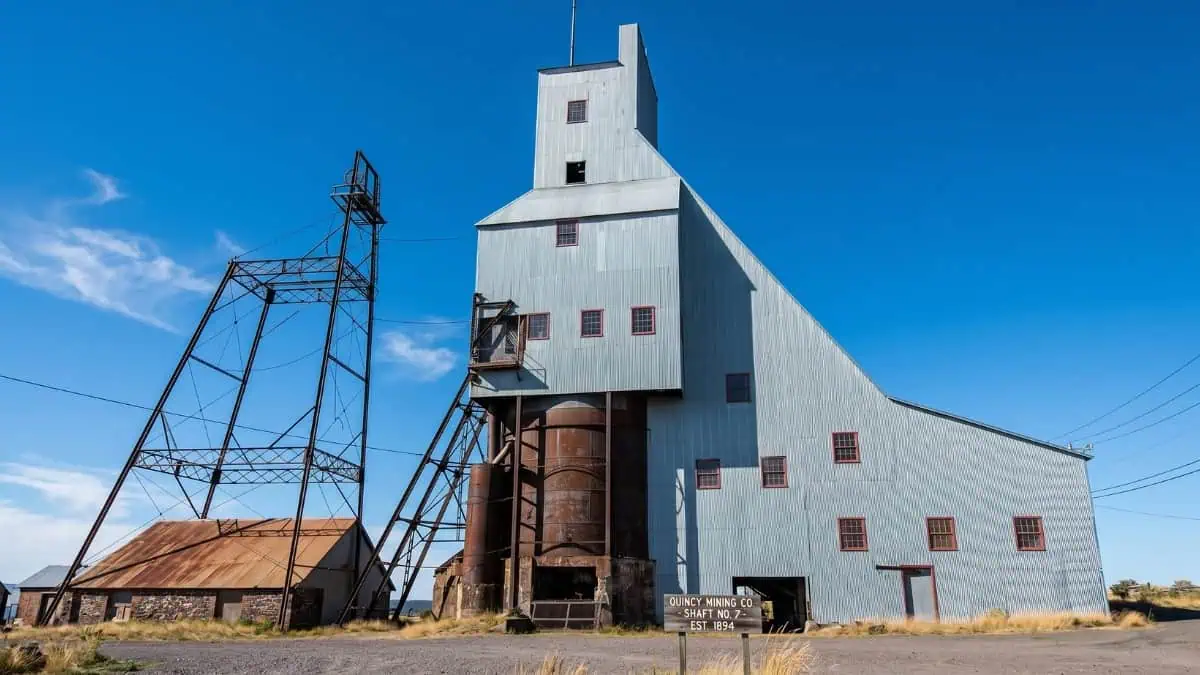
The most famous survivor is the Quincy Mine, perched on the hill above Houghton and Hancock. They called it Old Reliable, because it turned a profit year after year for decades. Its main shaft eventually went down more than 9,000 feet at an angle, which at the time made it the deepest mine shaft in the world.
To haul rock and miners up and down that shaft, Quincy installed a Nordberg steam hoist so big it is often called the largest steam hoist ever built. You can see it today, and you can ride a tram down into the mine itself, which sits at a constant chilly 43 degrees. The towering shaft house still looms over the towns below.
Nothing lasts forever. As cheaper copper turned up elsewhere and the Depression hit, the mines slowly wound down. Quincy closed for good in 1945, and the last of the big native copper mines shut its doors in 1968. The boom was over, but it had already built the towns, the roads, and the communities that are still here.
So next time you are up in the Copper Country and you see that big iron headframe standing watch on the hill, give it a nod. Long before anyone went west chasing gold, a rush right here pulled the world to the U.P., and you are still standing in what it built.
Featured image credit: “QuincyMineNo2Shafthouse.jpg” by Keweenaw National Historical Park / Dan Johnson, public domain, via Wikimedia Commons.
Explore more: Keweenaw Stories
More worth reading


Yooper Hub community
The conversation
Know something this story missed? Corrections and additions get read by an editor and folded into the article, with credit.
Real neighbors, real names. A Yooper Hub editor reads your first comment before it appears; after that you’re a known neighbor and your comments post right away. No account required. Community guidelines
Nothing here yet. A sentence is plenty: a correction, a name, or what you remember about this place.
Sources, credits, and reporting details
Sources & accountability
How this story was reported
Editorial methodAggregation
Last verifiedJul. 13, 2026
Corrections statusNo material correction identified in the July 13, 2026 source review.
AI assistanceResearched and drafted with AI tools. Reviewed and approved by editor Keegan O’Brien.
Verification note: CEO-directed review checked the central claims against 1 direct public evidence link on July 13, 2026. No material correction was identified.
Primary sources
-
Direct evidence for: Before the Gold Rush, There Was a Copper Rush, and It Happened Right Here in the U.P. — National Park Service
Accessed Jul. 13, 2026.
Direct public evidence reviewed against the article on July 13, 2026.
Photo and media credits
-
Quincy Mine No. 2 — Creator or rights holder named in the WordPress attachment caption
Featured image record. Accessed Jul. 13, 2026. public domain.
Supports: Featured image used by this article.
Quincy Mine No. 2 shaft house and hoist house. Photo by Keweenaw National Historical Park / Dan Johnson, public domain, via Wikimedia Commons.