If you have ever driven Highway 41 between Baraga and L’Anse, you have probably seen him: a 35-foot figure standing on a bluff over Keweenaw Bay, snowshoes in one hand, a cross in the other.
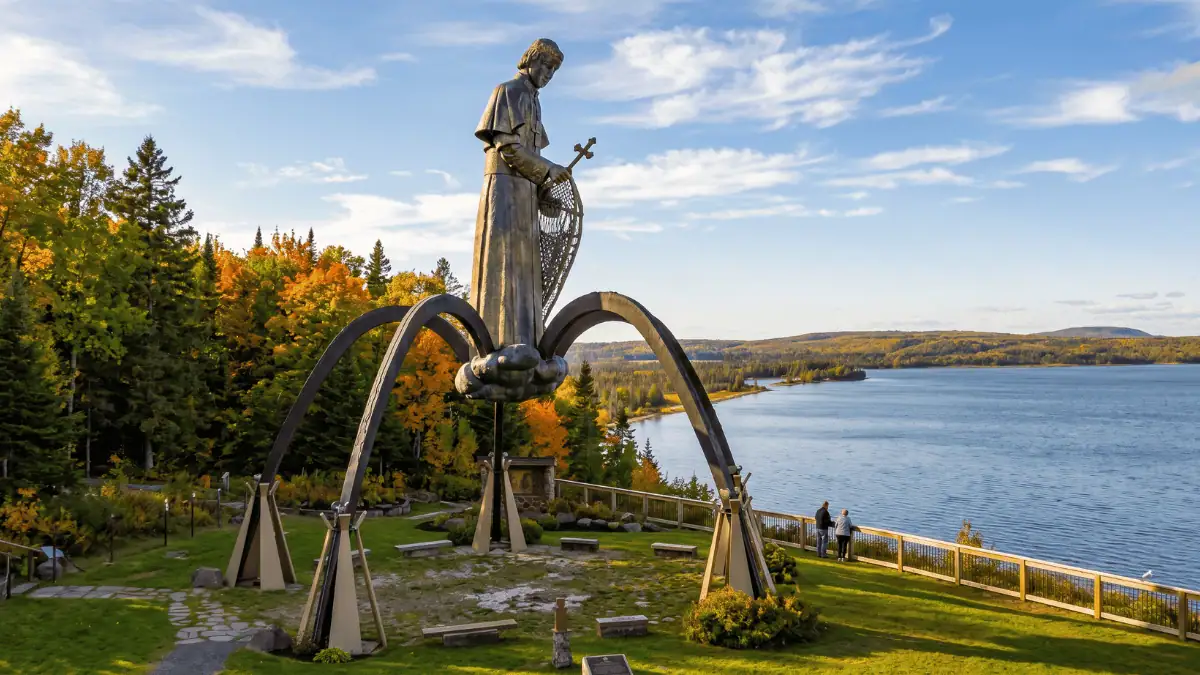
That is the Snowshoe Priest. And the man he honors might be the most remarkable Yooper who never called himself one.
His name was Frederic Baraga, and he was born in 1797 into a wealthy family in what is now Slovenia. He studied law, became a priest, and then in 1830 gave up a comfortable life in Europe to sail to America and minister in the wilderness of the Upper Great Lakes.

What he found here was a land of brutal winters and missions scattered hundreds of miles apart, with no roads between them. So Baraga walked. He traveled by canoe, horse, and dog sled, but mostly he strapped on snowshoes and went, sometimes covering as much as 700 miles in a single winter to reach the people in his care.
He kept it up well into his 60s, trudging through snow that buries fence posts, and that is how he earned his nickname.

But Baraga was far more than a hardy traveler. He had a gift for languages and ended up fluent in eight of them. He lived among the Ojibwe and Ottawa, learned their languages deeply, and did something no one had done before: he wrote them down.
His Ojibwe grammar and his Dictionary of the Otchipwe Language, finished in the 1850s, were the first of their kind, and parts of them are still studied today. He also used his standing to push back on the forces of his day, working to keep the tribes from being forced off their land.

By 1853 he had been made the first bishop of the U.P.’s brand-new Catholic diocese, first based in Sault Ste. Marie and later moved to Marquette. He served until his death in 1868.
More than a century later, his story is still going. In 2012 the Catholic Church declared him “Venerable,” an early step on the long road to possible sainthood. He is one more larger-than-life figure this rugged country has produced, right alongside the Ishpeming kid who grew up to win a Nobel Prize.
The statue itself went up in 1972, sculpted by Jack Anderson. Baraga stands on five great arches, one for each of the missions he founded, and at night the whole thing is lit against the dark over the water. It is free to visit, there is a little chapel and a gift shop known for homemade ice cream, and the view of the same Keweenaw Bay where a family was once rescued from a sinking sailboat is worth the drive on its own.
So next time you pass that giant figure on the bluff, slow down and take him in. Long before the highways and the towns, one man crossed this whole wild country on foot, one snowshoe step at a time.
Featured Image: Photo by Mandic2406, CC0, via Wikimedia Commons.
More worth reading


Yooper Hub community
The conversation
Know something this story missed? Corrections and additions get read by an editor and folded into the article, with credit.
Real neighbors, real names. A Yooper Hub editor reads your first comment before it appears; after that you’re a known neighbor and your comments post right away. No account required. Community guidelines
Nothing here yet. A sentence is plenty: a correction, a name, or what you remember about this place.
Sources, credits, and reporting details
Sources & accountability
How this story was reported
Editorial methodAggregation
Last verifiedJul. 13, 2026
Corrections statusNo material correction identified in the July 13, 2026 source review.
AI assistanceResearched and drafted with AI tools. Reviewed and approved by editor Keegan O’Brien.
Verification note: CEO-directed review checked the central claims against 1 direct public evidence link on July 13, 2026. No material correction was identified.
Primary sources
-
Direct evidence for: He Snowshoed 700 Miles a Winter Across the U.P. Now a Giant Statue Honors Him — Bishopbaragashrine
Accessed Jul. 13, 2026.
Direct public evidence reviewed against the article on July 13, 2026.
Photo and media credits
-
Shrine of Bishop Baraga in Baraga Michigan — Creator or rights holder named in the WordPress attachment caption
Featured image record. Accessed Jul. 13, 2026. CC0.
Supports: Featured image used by this article.
Shrine of Bishop Baraga in Baraga, Michigan. Photo by Mandic2406, CC0, via Wikimedia Commons. Featured image: Shrine of Bishop Baraga in Baraga, Michigan. Photo by Mandic2406, CC0, via Wikimedia Commons.