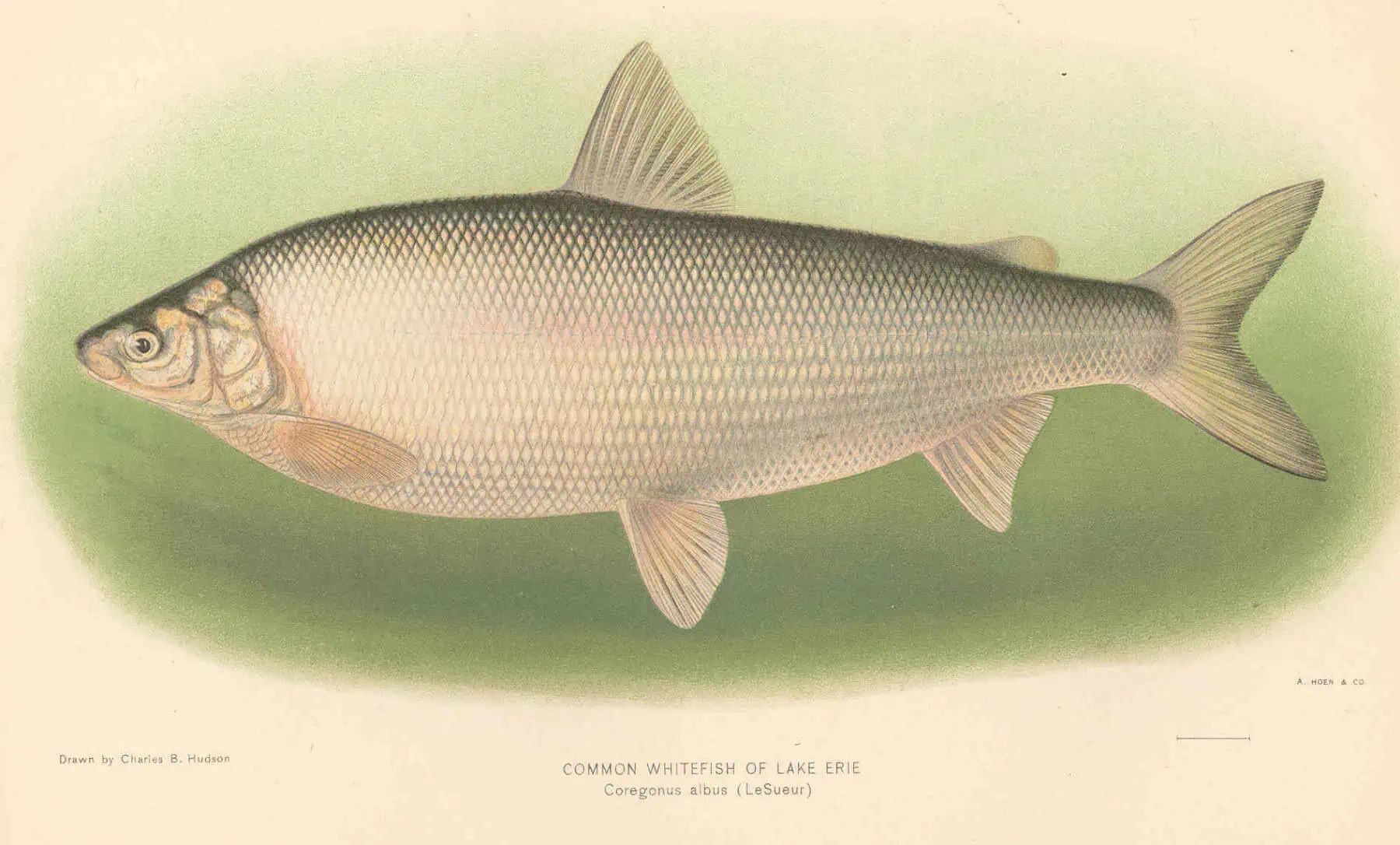
Michigan put $350,000 into its budget this year to bank the genetics of Great Lakes whitefish stocks. Not to rebuild them. To preserve what they are made of, in case they are gone.
The state’s own fisheries chief called the amount what it is. Randy Claramunt: “It’s a drop in the bucket when you look at the scale of the problem.”
The part nearly every story gets wrong
Whitefish coverage almost always lands on fishing pressure, and it ends with quotas. Michigan DNR fisheries biologist Steve Lenart puts it flatly: “There’s no regulatory fix for what the problem is.”
The failure is not adults being caught. It is young fish not surviving to become adults. Quagga mussels stripped out the bottom of the food web and cleared the water, and the fry that used to have something to eat do not.
You can close a season on a fish that is being overharvested. You cannot legislate plankton back into a lake.
And the scope is smaller than the headlines
“Great Lakes whitefish are collapsing” is not accurate as written. The collapse is in Lakes Michigan and Huron.

Lake Superior stocks are stable, and that is not an impression. It is the finding of the peer-reviewed assessment of the Lake Superior fish community and fisheries from 2001 through 2022, whose subtitle is “An era of stability.”
The distinction matters here more than most places, because Lakes Michigan and Huron historically supplied over 80 percent of Michigan’s commercial whitefish catch. The lake that is fine is not the lake that fed the industry.
The numbers behind the alarm
The Great Lakes Fishery Commission sets a benchmark for Lake Michigan whitefish commercial yield of 4 to 6 million pounds a year. From 1995 to 1999 the fishery averaged around 7.5 million. From 2000 to 2012 it ran near 5 million. Between 2019 and 2021 it fell below 2 million lakewide.
The commission’s own rating on that indicator is “Does Not Meet,” trend downward, confidence high.
Wisconsin’s Natural Resources Board cut its Lake Michigan commercial whitefish quota by nearly 40 percent for 2026.
What $350,000 buys
Claramunt has estimated the real cost of genetic rescue at $200,000 to $300,000 per year, per stock. That covers collecting spawners, rearing offspring, and holding captive broodstock.

There are at least a dozen vulnerable stocks. The appropriation is one time and covers roughly one stock for one year.
Who decides how the fish get divided
In the eastern U.P. the answer is not the DNR alone. Harvest in the 1836 Treaty waters is allocated under the 2023 Great Lakes Consent Decree, negotiated between the State of Michigan, the federal government and the tribal governments whose treaty-reserved fishing rights those waters carry. The decree is a public document and it is the actual rulebook for who fishes where.
What this means at the fish counter
Here is the useful part, and it is worth knowing before the smoked fish orders go in this fall.
“Fresh Lake Michigan whitefish” on a menu or a market case in 2026 is a claim worth asking about. Depending on the season and the supplier it may be Superior-caught, Canadian, or tribal-caught under the decree, and none of those are the same thing as the label.
The question to ask is simply which lake it came out of. Anyone selling it honestly will know, and a supplier who cannot say is telling you something too.
More worth reading


Yooper Hub community
The conversation
Know something this story missed? Corrections and additions get read by an editor and folded into the article, with credit.
Real neighbors, real names. A Yooper Hub editor reads your first comment before it appears; after that you’re a known neighbor and your comments post right away. No account required. Community guidelines
Nothing here yet. A sentence is plenty: a correction, a name, or what you remember about this place.
Sources, credits, and reporting details
Sources & accountability
How this story was reported
Editorial methodAggregation
Last verifiedSep. 9, 2026
Corrections statusNo material correction note is recorded on this article.
AI assistanceResearched and drafted with AI tools. Reviewed and approved by editor Keegan O’Brien.
Verification note: Ledger establishes the $350,000 one-time state appropriation for whitefish genetic rescue, the DNR quotes (Claramunt 'drop in the bucket', Lenart 'no regulatory fix'), the $200,000-$300,000 per stock per year cost estimate, the GLFC Lake Michigan yield indicator (7.5M lb 1995-99, ~5M lb 2000-12, under 2M lb 2019-21, 'Does Not Meet'), Wisconsin's 40% quota cut, the 2023 Great Lakes Consent Decree, and the peer-reviewed 'era of stability' Lake Superior assessment. The article deliberately does not claim 'Great Lakes whitefish are collapsing' lakewide and does not name a number of stocks beyond 'at least a dozen'. Editorial caution: the article says 'Michigan put $350,000 into its budget this year'; sources describe the money as one-time FY2026 state budget funding to DNR Fisheries, but no appropriations bill line item was fetched.
Primary sources
-
Fish Community Objective Indicator: Annual commercial yield of lake whitefish between 4 and 6 million lbs (Lake Michigan) — Great Lakes Fishery Commission
Published Nov. 9, 2023. Accessed Sep. 9, 2026.
Page shows 'Updated 2023-11-09'.
-
Great Lakes (1836 Treaty waters) fisheries management and the 2023 Great Lakes Decree — Michigan Department of Natural Resources
Accessed Sep. 9, 2026.
DNR page links the decree PDF: https://www.michigan.gov/dnr/-/media/Project/Websites/dnr/Documents/Fisheries/TCU/2023-GL-Consent-Decree-Archive/2023GreatLakesDecree.pdf (not separately fetched).
-
Lake Superior fish community and fisheries, 2001–2022: An era of stability — Journal of Great Lakes Research (Goldsworthy et al.), via USGS Publications Warehouse
Published Jan. 22, 2025. Accessed Sep. 9, 2026.
DOI 10.1016/j.jglr.2024.102414.
Additional reporting
-
Michigan fisheries get one-time funding for whitefish restoration — Michigan Public (Anna Barnes)
Published Jul. 20, 2026. Accessed Sep. 9, 2026.
Same story republished by Great Lakes Echo 2026-08-30 (https://greatlakesecho.org/2026/08/30/michigan-fisheries-get-one-time-funding-for-whitefish-restoration/) with identical quote.
-
Michigan Senate to consider funding whitefish recovery efforts — Bridge Michigan (Kelly House)
Published Apr. 29, 2026. Accessed Sep. 9, 2026.
Article attributes the estimate to DNR officials in the context of Claramunt's testimony; the article's 'Claramunt has estimated' wording is slightly stronger than the source.
-
What to know about Michigan whitefish crisis, from limits to solutions — Bridge Michigan (Kelly House)
Published Oct. 10, 2025. Accessed Sep. 9, 2026.
In this piece 'drop in the bucket' is a Samantha Tank quote about federal funding, not Claramunt; the Claramunt version is in the Michigan Public story above.
-
With no time to spare, Michigan hatches a Great Lakes whitefish rescue plan — Bridge Michigan / Associated Press (Kelly House)
Published Sep. 8, 2026. Accessed Sep. 9, 2026.
AP syndication of the Bridge Michigan story; original Bridge URL not fetched.
-
New reduced Lake Michigan whitefish quota goes into effect for commercial fishers — Wisconsin Public Radio (Royce Podeszwa)
Published Mar. 13, 2026. Accessed Sep. 9, 2026.
Outdoor News (2026-01-02) dates the NRB vote to Dec. 10, 2025; the Wisconsin DNR whitefish management page does not publish the quota figures.
Photo and media credits
-
FMIB 42895 Common Whitefish of Lake Erie – Coregonus albus (LeSueur).jpeg (featured image) — Charles Bradford Hudson (U.S. Fish Commission), via Wikimedia Commons
Featured image record. Accessed Sep. 9, 2026. Public domain.
Commons file identified Sept 9 2026 via the Commons API from the author credit and matching aspect ratio.
.jpeg)