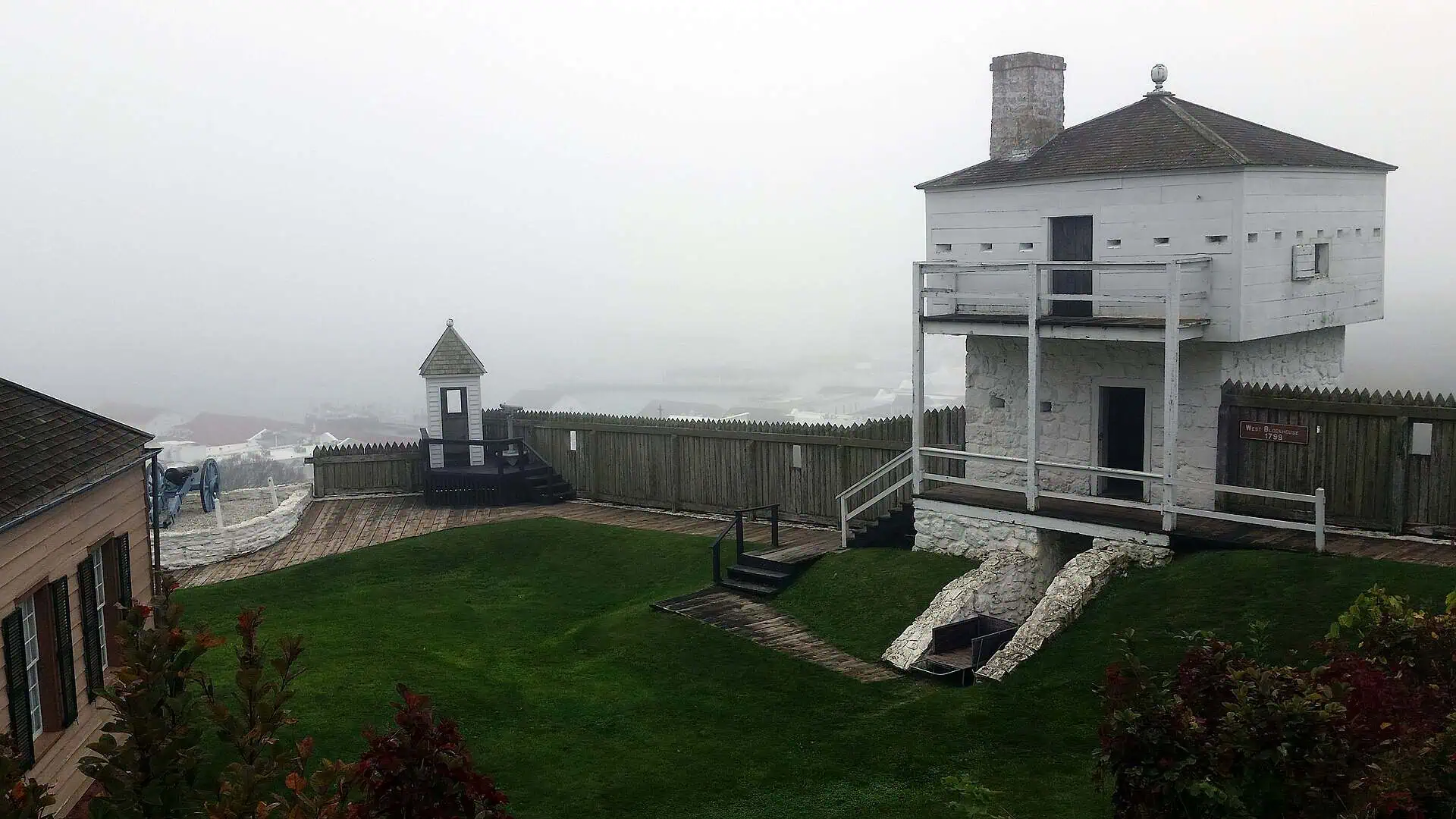
British soldiers were still garrisoned on Michigan soil in 1828. Not as visitors, and not as a rumor. A functioning British Army post sat on Drummond Island, at the far eastern end of the Upper Peninsula in what is now Chippewa County, for thirteen years after the War of 1812 ended.
They stayed six of those years after a boundary commission ruled the island was American.
The reason they were there at all is on the state historical marker on the island, erected by the Michigan History Division in 1977. It reads: Forced by the Treaty of Ghent to evacuate the fort they had captured on Mackinac Island during the War of 1812, the British selected this island as an alternate military post.

They lost Mackinac, so they built a replacement
The British took Fort Mackinac in 1812 and held it through the war. The Treaty of Ghent, signed in December 1814, made them hand it back. Lieutenant Colonel Robert McDouall moved his command roughly forty miles east to Drummond Island in 1815 and started building.
The location was not sentimental. It sat close to the traditional gathering point at the Straits, which is what the marker means when it says the post was meant to sustain English control of the Indians and the Upper Great Lakes fur trade.
Not stubbornness, and not an accident
The version that circulates online is that the British simply refused to leave, or that nobody told them where the border was. The record is more specific than that. An international boundary commission did not resolve which channel through the archipelago carried the line until 1822, and when it did, Drummond Island fell on the American side.
The garrison then stayed another six years. Britain withdrew its forces to the naval station at Penetanguishene, Ontario, in November 1828. The marker says it flatly: the British abandoned the stronghold in 1828, six years after Drummond Island was ruled United States territory.

What was actually up there
This was not a token blockhouse. Michigan Technological University’s Military History of the Upper Great Lakes project puts the settlement at 300 to 450 people during construction, with two story officers’ quarters with fireplaces and stone reinforcement, timber houses, a sawmill, a lime quarry and a lumber yard, alongside cedar bark lodges.
The purpose was influence rather than defense. The same project records more than 3,000 Native visitors a year by 1819, rising to an estimated 4,500 in the 1820s, drawn by British gift distribution and the fur trade. Black Hawk was among the people who came through.
What is left
Almost nothing, and the way it ended explains why. Accounts of the 1828 evacuation describe troops leaving behind food, furniture and personal belongings because there was no cargo space for them. The 1977 marker closes with the current state of the site: now summer cottages occupy this rocky countryside and only a few ruined chimneys survive as reminders of the conflict between British and American sovereignty in the Old Northwest.
Yooper Hub note: if you have been out to the fort site on Drummond Island, send us a photo of the chimneys and we will add it here with credit.
Sources: Michigan History Division state historical marker for Fort Drummond (1977); Michigan Technological University, Military History of the Upper Great Lakes project, entries by Aaron Ortiz and Niklas Romero.
More worth reading


Yooper Hub community
The conversation
Know something this story missed? Corrections and additions get read by an editor and folded into the article, with credit.
Real neighbors, real names. A Yooper Hub editor reads your first comment before it appears; after that you’re a known neighbor and your comments post right away. No account required. Community guidelines
Nothing here yet. A sentence is plenty: a correction, a name, or what you remember about this place.
Sources, credits, and reporting details
Sources & accountability
How this story was reported
Editorial methodArchival synthesis
Last verifiedSep. 9, 2026
Corrections statusNo material correction note is recorded on this article.
AI assistanceResearched and drafted with AI tools. Reviewed and approved by editor Keegan O’Brien.
Verification note: The ledger establishes the 1815 move from Fort Mackinac, the 1822 boundary ruling and the November 1828 withdrawal to Penetanguishene from the 1977 Michigan History Division marker text, the NRHP listing (69000069, listed 1969-10-01), the Treaty of Ghent text, and two Michigan Tech Military History of the Upper Great Lakes posts for the settlement size and Native visitor figures. The article does not claim the British 'refused' to leave or that the fort was a defensive work; it does not name the exact number of troops.
Primary sources
-
Fort Drummond, Michigan Historical Marker no. 109 (Michigan History Division, 1977), transcribed at HMDB — Michigan History Division, Department of State (marker); Historical Marker Database (transcription)
Accessed Sep. 9, 2026.
Marker erected 1977 by Michigan History Division. michmarkers.com, the editor's cited source, now serves unrelated gambling content and could not be used; HMDB carries the full inscription and marker number. Marker spells the commander 'McDonall'; the article uses 'McDouall'.
-
Fort Drummond, National Register of Historic Places, NRIS 69000069 — National Park Service, NPGallery
Published Oct. 1, 1969. Accessed Sep. 9, 2026.
Nomination PDFs linked from the asset page: npgallery.nps.gov/GetAsset/16772216-431d-4110-8964-0c809e894172/ and /GetAsset/c2ec4124-f1b1-4868-b775-f866d7bb7e12/ (not fetched).
-
Treaty of Ghent, 1814 — Avalon Project, Yale Law School
Published Dec. 24, 1814. Accessed Sep. 9, 2026.
Supports the article's statements that the treaty forced the return of Fort Mackinac and that an international boundary commission later ruled on the island.
Additional reporting
-
Fort Drummond Occupation — Military History of the Upper Great Lakes, Michigan Technological University (Aaron Ortiz)
Published Oct. 21, 2017. Accessed Sep. 9, 2026.
Student-authored university project; typed additional. Also records that McDonall learned of the peace five months after the treaty was signed.
-
Fort Drummond, the Forgotten Fort — Military History of the Upper Great Lakes, Michigan Technological University (Niklas Romero)
Published Nov. 15, 2019. Accessed Sep. 9, 2026.
Student-authored university project; typed additional.
-
Fort Drummond (Drummond Island, Michigan) — Wikipedia
Accessed Sep. 9, 2026.
Cites Samuel Fletcher Cook, Drummond Island: The Story of the British Occupation, 1815-1828 (1896), the source of the article's third image.
Photo and media credits
-
Historic Fort Mackinac.jpg (featured image) — Shonebrooks, via Wikimedia Commons
Featured image record. Accessed Sep. 9, 2026. CC BY-SA 4.0.
Commons file identified Sept 9 2026 via the Commons API from the author credit and matching aspect ratio.
