Tomorrow is August 25. On that date in 1896, a Tuesday, the village of Ontonagon stopped existing between about one in the afternoon and dark.
It had been a dry summer. Forest fires had been smoking up the country since the beginning of the month, and fire had been smoldering for weeks in the swamps along the west bank of the Ontonagon River, south of town. Nobody was much alarmed. Ontonagon was a company town of about 2,300 people, and the company was the Diamond Match Company, which had come to the Copper Country in 1884, employed close to a thousand local men, cut as much as 100 million board feet a year, and had, on the day in question, tens of millions of feet of dry, seasoned lumber stacked in its yards at the edge of the village.
On the morning of the 25th the wind came up hot and hard from the south, gusting, by later estimate, to something like 75 miles an hour. It picked burning brands out of the swamp and dropped them into the lumber piles. Diamond Match sent men with hoses. It did not matter. Around one o’clock the fire alarm sounded and the sawmill was already burning. By two the town was ablaze.
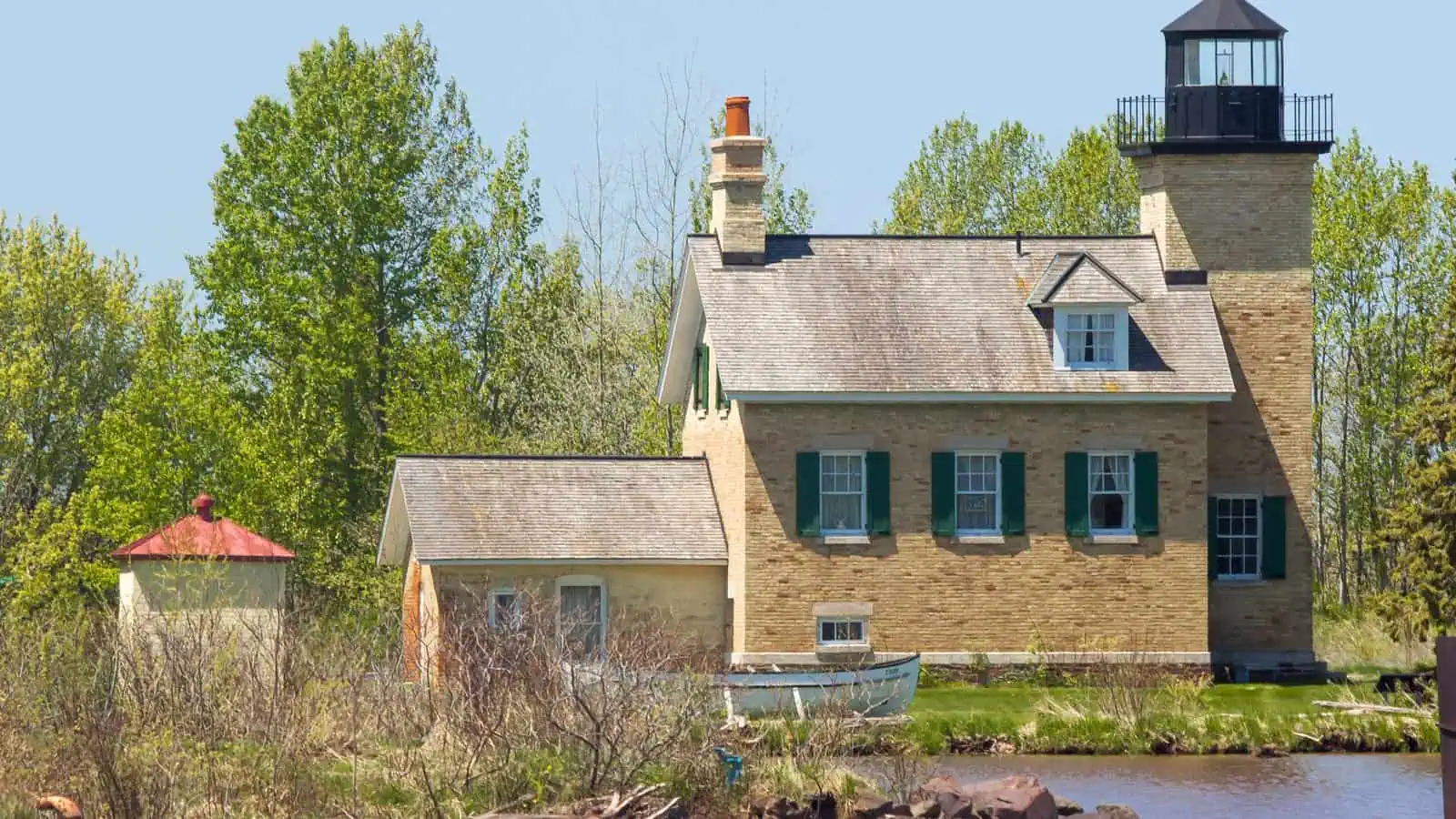
James Corgan kept the lighthouse at the river mouth, and he wrote it down in the station log the way keepers wrote everything down. The Diamond Match dwellings caught at 1:20. By two the town was on fire. Then it came for the light. Corgan, his wife, his son Harry and the hired girl spent the rest of the day carrying water and keeping the roofs and the outbuildings wet so they would not catch. The heat made even getting water hard. Corgan burned his feet. The lighthouse is still there.
Almost nothing else was. The count afterward was 344 buildings gone: four churches, three hotels, a bank, twelve stores, thirteen saloons, two newspapers, three schoolhouses, the opera house, the courthouse and the jail, nearly 300 houses, two iron bridges, the barge City of Straits, the entire Diamond Match plant, and forty million feet of lumber. A square mile burned. One person died, an elderly German woman named Mrs. Pirk. About 2,000 people had no home that night.
The relief was fast because it had to be. A tug came across from Baraga County the next evening with supplies. A woman named Julia Herbert fed 250 people at every meal for a day and a half. Families that still had roofs took in 110 of the homeless. The state militia put up 150 tents at the fairgrounds, a canvas town people called White City. Money and goods came in from across the peninsula, from lower Michigan, from Milwaukee and Green Bay. Four hundred people took the railroad’s offer of free passage out.
Diamond Match sent relief money. Then, in February 1897, it announced it would not rebuild in Ontonagon. The mill, the yards and the thousand jobs were gone with the buildings. The company and the village were already fighting over taxes on the logs Diamond Match held in the river, a fight that went all the way to the Supreme Court in 1903. But the decision that mattered to the town was the one in February. Ontonagon rebuilt, smaller, and stayed smaller.
The lighthouse the Corgans saved is owned by the Ontonagon County Historical Society now, and you can tour it from their museum on River Street. Corgan’s log is one of the reasons the day can be told hour by hour. It is a good thing to think about tomorrow: a family on a roof with buckets while a company town burned behind them, and a set of neat handwritten times.
Go See It
Ontonagon Lighthouse and County Historical Museum, Ontonagon
- Hours
- Museum: 7 days a week, 10 a.m. to 4 p.m. Lighthouse tours: 7 days a week, 11 a.m. to 3 p.m., mid-May to mid-October. Off-season tours by appointment, (906) 884-6165. Hours as shown on the Historical Society’s own site, which carries no update date.
- Cost
- The Historical Society’s site lists no prices. The Ontonagon chamber’s lighthouse page lists $5.00 per person (18 and over). The National Park Service place listing, undated, lists lighthouse tours at $7 for adults and museum tours at $5, children free. Call (906) 884-6165 to confirm.
- Season
- Lighthouse tours run mid-May to mid-October, by appointment after that (Historical Society). The Society lists no season dates for the museum; the NPS listing says mid-May to mid-October.
- Drive
- From Marquette: 2 hr 4 min (114 mi) via US-41 N and M-38 W
From the Bridge: 4 hr 42 min (277 mi) via M-28 W (Google Maps flags tolls on this route)
More worth reading


Yooper Hub community
The conversation
Know something this story missed? Corrections and additions get read by an editor and folded into the article, with credit.
Real neighbors, real names. A Yooper Hub editor reads your first comment before it appears; after that you’re a known neighbor and your comments post right away. No account required. Community guidelines
Nothing here yet. A sentence is plenty: a correction, a name, or what you remember about this place.
Sources, credits, and reporting details
Sources & accountability
How this story was reported
Editorial methodArchival synthesis
Last verifiedAug. 15, 2026
Corrections statusNo material correction note is recorded on this article.
AI assistanceResearched and drafted with AI tools. Reviewed and approved by editor Keegan O’Brien. Tool: Claude.
Verification note: Drafted 2026-08-15 for the 130th anniversary (the fire was 1896-08-25; the post runs 8/24 and says 'tomorrow'). Lumber lost is given as forty million feet (MTU Archives and Bohnak agree; one summary said fifty). Homeless is Bohnak's about 2,000; 2,300 is the village population. The Supreme Court case is characterized only as a tax dispute over logs in the boom.
Primary sources
-
Flashback Friday: Fire on the Banks of the Ontonagon — Michigan Tech Archives and Copper Country Historical Collections (Emily Riippa Schwiebert)
Published Aug. 14, 2020. Accessed Aug. 15, 2026.
Draws on the Ontonagon lighthouse journal and the Ontonagon County Historical Society.
-
August 25, 1896: The day Ontonagon burned — WLUC TV6 (Karl Bohnak)
Published Aug. 25, 2020. Accessed Aug. 15, 2026.
-
Ontonagon Lighthouse — Lighthousefriends.com
Accessed Aug. 15, 2026.
Additional reporting
-
Diamond Match Company v. Ontonagon, 188 U.S. 82 (1903) — U.S. Supreme Court, via Wikisource
Published Jan. 19, 1903. Accessed Aug. 15, 2026.
Syllabus only; the copy does not state the holding.
Photo and media credits
-
Ontonagon Lighthouse.jpg (featured image) — rossograph, via Wikimedia Commons
Featured image record. Published Jun. 6, 2019. Accessed Aug. 15, 2026. CC BY-SA 4.0.
Original 3681×2728, cropped 16:9 (box 0,328,3681,2399), resized to 1600×900 q85. Attachment 2438.
