Market Street on Mackinac Island runs one block back from the water, and most people walk it to get from the fudge shops to the fort without noticing the big white house at number 34. It is a plain, handsome Federal-style building, two stories and a row of dormers, hand-hewn timber under the clapboard, brick foundation, a double stair to the front door. It was built in 1817. For a few years it was one of the most important addresses in the American West.
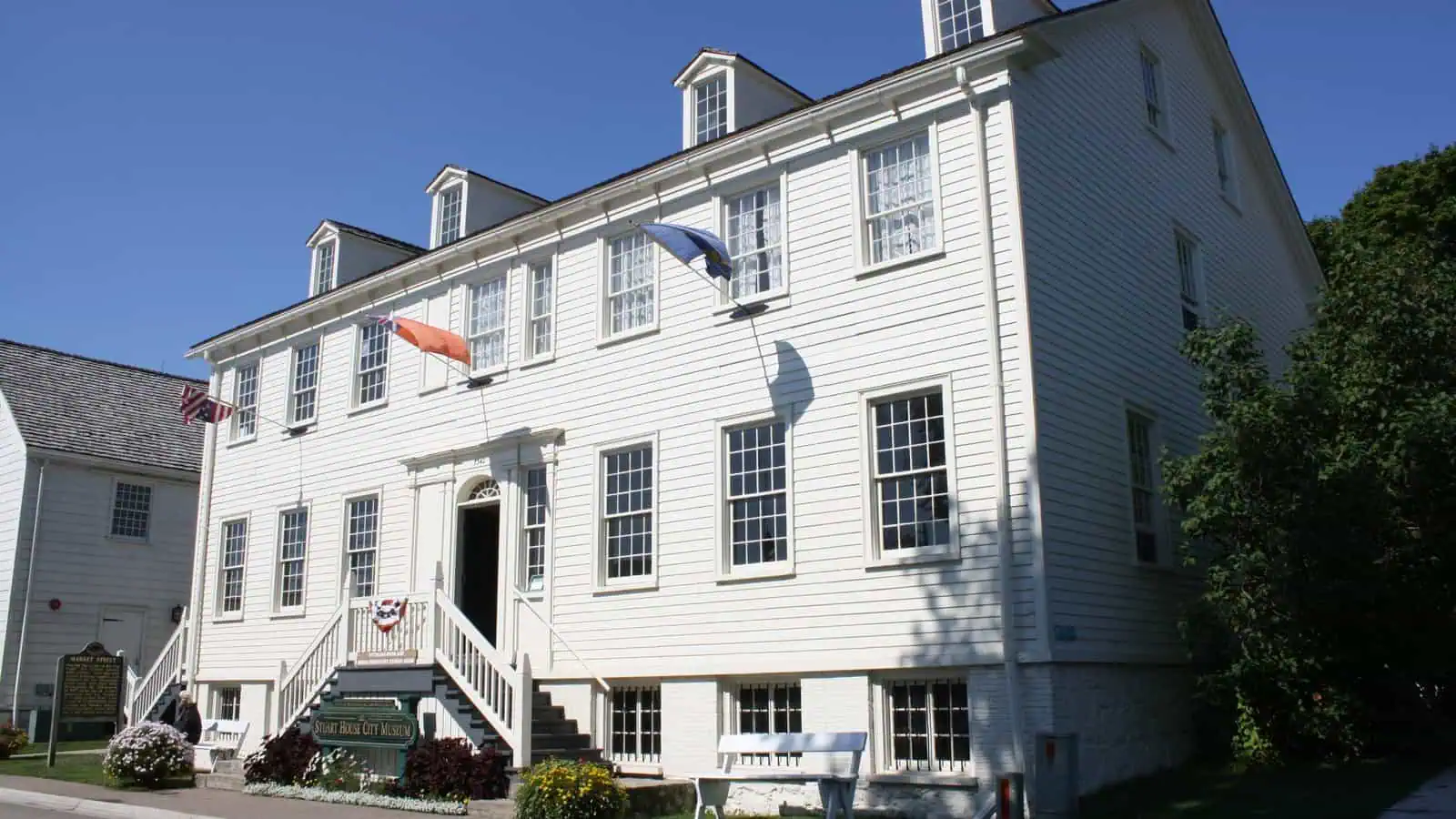
That needs explaining, because Mackinac Island is not in the West. But in 1817 the fur trade was the biggest business on the continent, and John Jacob Astor, the richest man in the country, ran his American Fur Company’s northern operations from this island. The house on Market Street was the Agent’s House: the home and office of the man who ran it for him. Furs came in from the whole upper Great Lakes and the country beyond, were sorted, graded and packed in the warehouse next door, and went east. In the peak year, 1822, more than $3 million in furs cleared through the island.
The first agent was Ramsay Crooks. His assistant, who arrived the same year and lived in the house as a guest, was a Scot named Robert Stuart. In 1820 Crooks moved on and Stuart took over. He held the job for the next fourteen years.
Here is who Robert Stuart was before Mackinac. In 1810, at 25, he had joined Astor’s Pacific Fur Company and sailed around Cape Horn on the Tonquin to help found Astoria, at the mouth of the Columbia River. When the ship was lost, he was chosen to carry the news overland to St. Louis. He left Astoria in 1812 with six men. Coming east through the Rockies that November, the party swung south of the route the westbound Astorians had used and crossed a broad, low saddle in the mountains where a wagon could go. It was South Pass. Stuart’s journal did not make it widely known, and it took until 1824 for trappers to find it again, but the gap he walked through is the one the Oregon Trail, the California Trail and the Mormon Trail all used. Something like half a million people went west through it. He reached St. Louis in April 1813.
Seven years later he was on Mackinac Island running a warehouse.
That was not a demotion. The Northern Department was the heart of Astor’s business, and the agent on the island was the man who dealt with the traders, the clerks, the voyageurs, the Odawa and Ojibwe hunters whose furs the whole system depended on, and the Army across the street at the fort. Stuart did it until 1834, when the trade was already fading and Astor was getting out. He left for Detroit in 1835, made money in real estate, served as Michigan’s state treasurer in 1840 and 1841, and died there in 1848.
The house outlived all of it. It was a boardinghouse by the Civil War. In 1871 a man named James F. Cable bought it, joined it to two neighboring buildings, and ran the whole thing as the John Jacob Astor House hotel, which is a very Mackinac Island thing to have done. The city bought it in 1900. The hotel kept operating until 1929, the buildings were separated again in 1941, and today it is the Stuart House City Museum, run by the City of Mackinac Island, with the American Fur Company’s own account books among the things on display. It has been a Michigan historic site since 1965 and on the National Register since 1971.
If you are on the island this summer, it is a five-minute detour from Main Street and it costs a few dollars. Stand in the front room and think about what came through it: the pelts, the ledgers, and a man who had walked from the Pacific to the Mississippi and then settled down to keep the books.
Go See It
Robert Stuart House (Stuart House City Museum), Mackinac Island
- Hours
- Daily, 11 a.m. to 4 p.m. The City says hours may vary with museum attendance.
- Cost
- $5 per person; $10 family rate; children 12 and under free.
- Season
- Opens in May and closes for the season in October. The City's last posted closing date was October 10, 2025 and it has not posted a 2026 date, so call (906) 847-8181 before a fall trip.
- Drive
- From Marquette: 2 hr 38 min (161 mi) via M-28 E and US-2 E, to the Arnold Transit ferry parking dock in St. Ignace
From the Bridge: 9 min (4.1 mi) via I-75 N, to the Arnold Transit ferry parking dock in St. Ignace (toll on the Bridge)
More worth reading


Yooper Hub community
The conversation
Know something this story missed? Corrections and additions get read by an editor and folded into the article, with credit.
Real neighbors, real names. A Yooper Hub editor reads your first comment before it appears; after that you’re a known neighbor and your comments post right away. No account required. Community guidelines
Nothing here yet. A sentence is plenty: a correction, a name, or what you remember about this place.
Sources, credits, and reporting details
Sources & accountability
How this story was reported
Editorial methodArchival synthesis
Last verifiedAug. 15, 2026
Corrections statusNo material correction note is recorded on this article.
AI assistanceResearched and drafted with AI tools. Reviewed and approved by editor Keegan O’Brien. Tool: Claude.
Verification note: Drafted 2026-08-15. The house history follows the National Register and Michigan State Historic Site records via Wikipedia; Stuart's South Pass crossing follows the standard biography. The 'half a million' overland emigrants line is a general estimate and hedged in the copy.
Primary sources
-
Robert Stuart House (Wikipedia, citing the National Register Information System, Michigan State Historic Sites record 9072 and the Stuart House City Museum) — Wikipedia contributors / National Register of Historic Places
Accessed Aug. 15, 2026.
The National Register nomination is the underlying record; NPGallery was not consulted directly.
-
Robert Stuart (explorer) (Wikipedia) — Wikipedia contributors
Accessed Aug. 15, 2026.
Additional reporting
-
Stuart House City Museum — Mackinac Island Tourism Bureau
Accessed Aug. 15, 2026.
Photo and media credits
-
Robert Stuart House Museum Mackinac Island.jpg (featured image) — Royalbroil, via Wikimedia Commons
Featured image record. Published Aug. 26, 2011. Accessed Aug. 15, 2026. CC BY-SA 3.0.
Original 1936×1288, cropped 16:9 (box 0,109,1936,1198), resized to 1600×900 q85. Attachment 2430.
