The Douglass House still stands on Shelden Avenue in Houghton, and the ground floor still has its bar. What is not obvious from the sidewalk is that the building came out of the most consequential architecture office in America.
It started small. The original was a three-storey frame structure put up in 1860, back when Houghton was a copper town finding out how big it was going to get. By the end of the century that was not enough. In 1899 a group of Houghton-area investors headed by John C. Mann incorporated the Douglass House Company, bought the hotel, and set about doubling it.
They did not hire locally.
The Chicago connection
The addition was designed by Henry L. Ottenheimer of Chicago and built by Paul F. P. Mueller, also of Chicago. Both men came out of Adler and Sullivan.
Ottenheimer apprenticed under Louis Sullivan from 1884 to 1889 and worked on drawings for the Auditorium Building, which is one of the landmark American buildings of the century. He was in that drafting room at the same time as a young Frank Lloyd Wright.
Mueller is the one whose later career makes you sit up. He was Adler and Sullivan’s office foreman, the man who turned drawings into buildings. He went independent in 1897 and Houghton got him two years later. After the Douglass House, Wright hired him again and again: the E-Z Polish Factory in 1905, then Unity Temple in Oak Park in 1907 and 1908, a job that bankrupted him, then Midway Gardens, and finally, with his son Ralph, the Imperial Hotel in Tokyo between 1921 and 1923.
So the hotel on Shelden Avenue was an early commission for the builder Frank Lloyd Wright would spend twenty years calling back.
What the money bought
The addition cost $125,000 to build and another $30,000 to $40,000 to furnish it, which in 1899 was a serious sum for a town of Houghton’s size. It took the hotel from 50 rooms to 100.
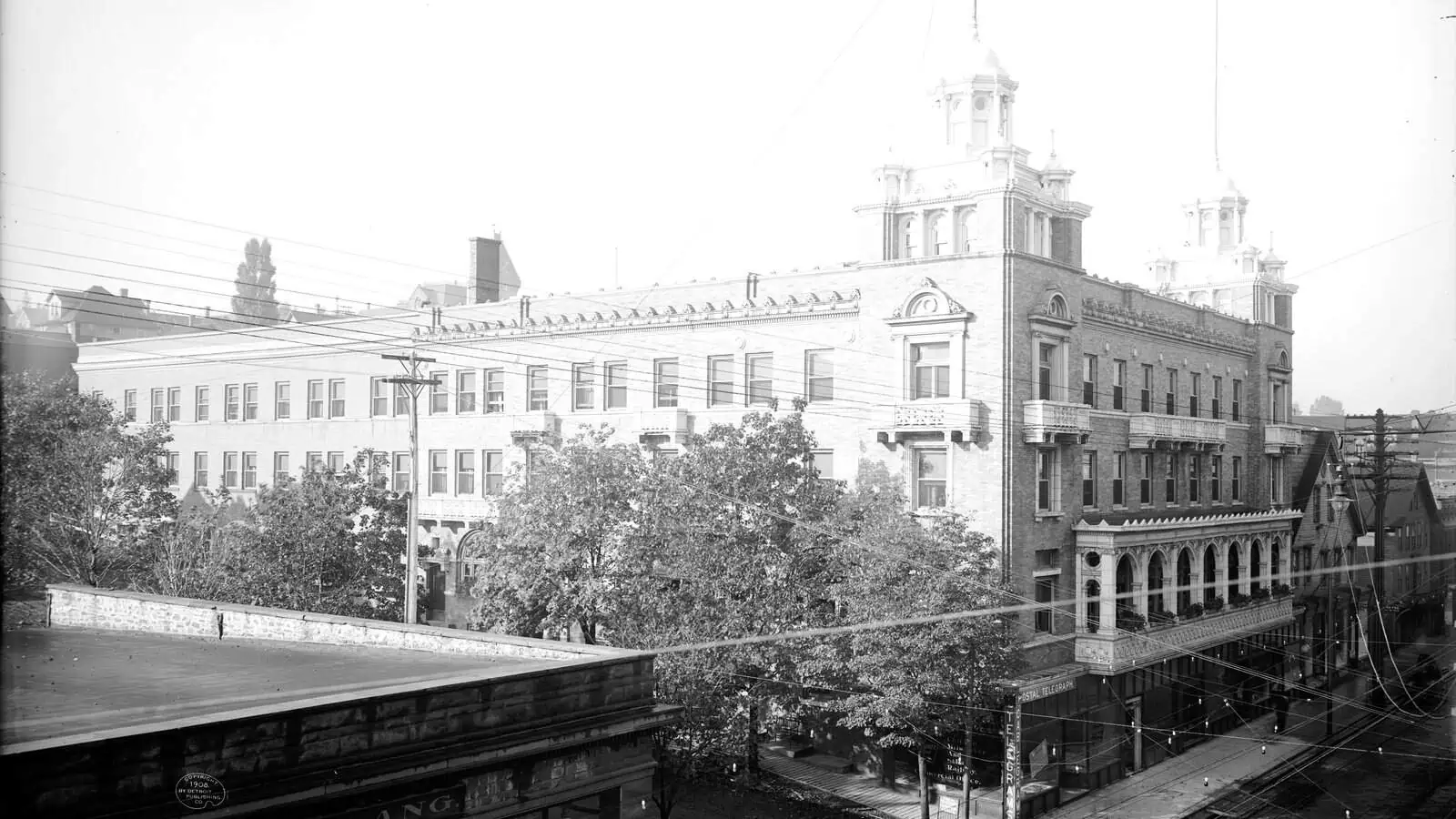
The style is Italian Renaissance, in buff-coloured brick with white-glazed terracotta trim. A loggia runs across the front with gold cupolas above it, and there are corner towers that were not in the original plans at all, which is the kind of detail that means somebody looked at the drawings partway through and decided to spend more.
The dance hall and the dining room did the real work. They were the social centre of Houghton, which in a copper town at the top of its boom meant they were the social centre of a place with money and a reason to celebrate it.
What it is now
The Douglass House went onto the National Register of Historic Places on May 13, 1982. Two years later, in 1984, it was converted into apartments.
The first-floor bar is still intact.
That is a better outcome than most grand hotels of that vintage got. It is not a museum and nobody pretends it is. People live in it, and you can still get a drink on the ground floor of a building put up by the man who built Unity Temple.
More worth reading


Sources, credits, and reporting details
Sources & accountability
How this story was reported
Editorial methodArchival synthesis
Last verifiedAug. 15, 2026
Corrections statusNo material correction note is recorded on this article.
AI assistanceResearched and drafted with AI tools. Reviewed and approved by editor Keegan O’Brien. Tool: Claude.
Verification note: TWO THINGS DELIBERATELY NOT IN THE COPY. (1) The widely retold anecdote, attributed to Chicago cultural historian Tim Samuelson, that Frank Lloyd Wright punched Ottenheimer and broke his glasses and Ottenheimer stabbed Wright in the neck with a drafting tool. Only informal secondhand retellings were found and it is a violent claim about two named real people. If sourced to Samuelson directly or to a Wright biography it is worth a paragraph; do not add it from a blog. (2) That the hotel is named for Douglass Houghton the state geologist. Very probably true, the city is, but no source read for this piece says so, so the article does not assert it. DEDUP NOTE: the screen flagged posts 1638 and 2048 on two shared tokens, which is normally the real-duplicate pattern; both were checked and are name collisions only, since both concern Douglass Houghton the man and the waterfall rather than the hotel.
Primary sources
-
Douglass House (Houghton, Michigan), National Register of Historic Places record — National Register of Historic Places, via Wikipedia
Accessed Aug. 15, 2026.
-
Frank Lloyd Wright and Paul Mueller: the architect and his builder of choice — arq: Architectural Research Quarterly
Accessed Aug. 15, 2026.
Additional reporting
-
Biographical material on Henry Leopold Ottenheimer (1868-1919) — Julia Bachrach Consulting
Accessed Aug. 15, 2026.
Photo and media credits
-
The Douglass House, Houghton, Michigan, c1908 (Detroit Publishing Co.) — Detroit Publishing Co., via Wikimedia Commons
Featured image record. Published Jan. 1, 1908. Accessed Aug. 15, 2026. Public domain.
Public domain Detroit Publishing plate, 9581×7535, circa 1908, the hotel within about a decade of the addition. 16:9 crop box (0,1400,9581,6789) down to 1600×900, trimming sky and overhead wires while keeping the corner cupolas, the arched loggia and the streetcar tracks. Detroit Publishing caption in the bottom margin is cropped out. Source scan is 72 megapixels and needs Image.MAX_IMAGE_PIXELS = None to open.
