The Hanka farm sits three miles west of US-41, off Tower Road, in Baraga Township. A Finnish immigrant family headed by Herman Hanka homesteaded the forty acres in 1896, and the family lived on it until 1966.
Seventy years. One family, one piece of ground, and then it stopped, and almost nothing about it was modernized on the way through.
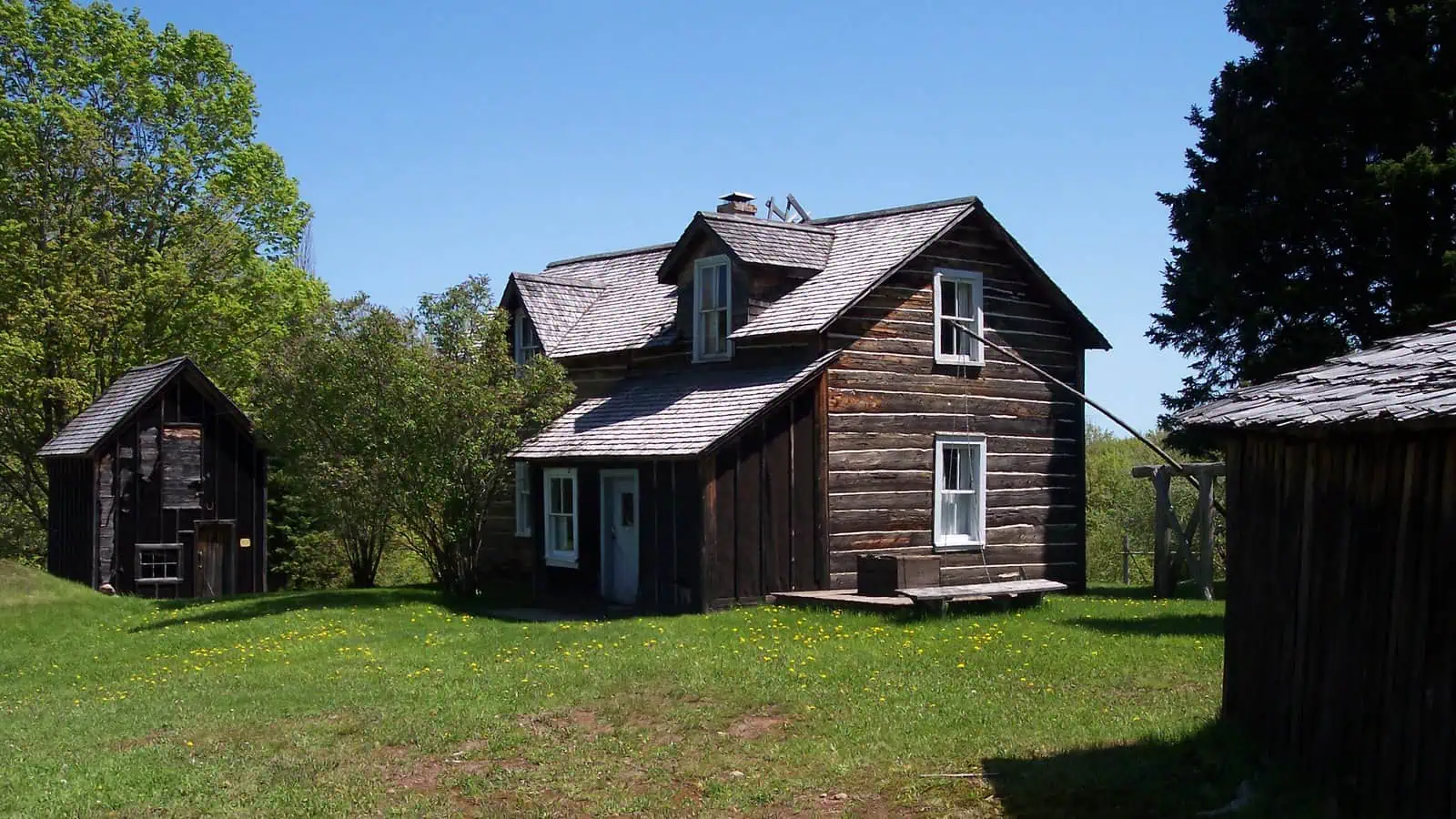
That is the whole reason the place matters. What stands there now is not a reconstruction or a village assembled out of buildings trucked in from elsewhere. It is the original farm on its original site, and it still reads, building for building, roughly the way it read in the 1920s. The National Archives caption on the photograph above puts it about as plainly as it can be put: log buildings from the 1920s sit on the lawn of a Finnish farmstead.
The buildings went up as the family could manage them, and the dates make a kind of autobiography. The farmhouse and the hay barn both date to around 1896, the first year. A root cellar followed around 1902. The cattle barn was raised in 1910, the horse barn around 1914, and sometime before 1915 the house itself got an addition, which is what happens when a household grows. Others have not survived: a milkhouse, a woodshed, an outhouse, a blacksmith shop.
A blacksmith shop, on a forty-acre farm. That tells you what self-sufficiency actually required out there. If a hinge broke, nobody was driving to town for a hinge.
And then there is the sauna, which also dates to about 1896.
Sit with that a moment. A family arrives in the woods of Baraga County with whatever they carried, faces a Michigan winter, and has to decide what gets built in the first season. They built the house, the hay barn to keep the animals fed, and the sauna. Not later, once things were comfortable. That year, alongside the roof over their heads.
To a Finnish family in 1896 the sauna was not a luxury item or an amenity. It was where you got clean, where you sweated out a hard week, where women gave birth, where the sick were tended. Building it first is not indulgence. It is a statement that the family intends to live here as themselves, not as people waiting to become something else.
Everything is hewn log, which is the other tell. This was built by hand, out of what was standing on the property, by people who knew how.
The farm also sits inside a larger story the museum is careful to tell. The Hankas were in copper country, and the museum’s own framing puts the homestead in relation to the mines: the connection between the copper mines, the miners, the conditions underground, and what happened to miners who were hurt on the job. A subsistence farm in the woods was not only a lifestyle. For a family in that world, land you owned and food you grew yourself was the only insurance that existed.
Volunteers took the site on in the early 1980s, and it went onto the National Register of Historic Places on July 19, 1984. It now operates as the Hanka Homestead Finnish Museum, open from Memorial Day through Labor Day on Tuesdays, Thursdays, Saturdays and Sundays, noon to four.
It is a short season and a small place, and that is rather the point. Nobody polished it into an attraction. A family lived exactly there for seventy years and left it recognizable.
More worth reading


Sources, credits, and reporting details
Sources & accountability
How this story was reported
Editorial methodArchival synthesis
Last verifiedAug. 15, 2026
Corrections statusNo material correction note is recorded on this article.
AI assistanceResearched and drafted with AI tools. Reviewed and approved by editor Keegan O’Brien. Tool: Claude.
Verification note: CLAIM DELIBERATELY NOT MADE: popular write-ups say Herman Hanka was maimed in a mine blast that killed his partner, and that this is why the family homesteaded. Wikipedia does not mention an accident, the Baraga County visitor listing does not contain it, and the museum itself declines to say it, describing only a general theme of injured miners. The copy follows the museum wording. Do not reinstate the blast, the injury or the dead partner without a primary record. Herman Hanka was a real person with descendants.
Primary sources
-
Herman and Anna Hanka Farm, National Register of Historic Places record — Wikipedia, NRHP record
Accessed Aug. 15, 2026.
-
Hanka Homestead Finnish Museum, about page — Hanka Homestead Finnish Museum
Accessed Aug. 15, 2026.
Photo and media credits
-
Hanka Homestead log buildings, by Gary Kaunonen, National Archives — Gary Kaunonen, National Archives, via Wikimedia Commons
Featured image record. Accessed Aug. 15, 2026. Public domain.
Public domain NARA photograph by Gary Kaunonen. 16:9 crop, box (0,140,2580,1591) from the 2580×1932 original down to 1600×900, trim taken mostly off the foreground lawn. The NARA caption, log buildings from the 1920s sit on the lawn of a Finnish farmstead, is quoted in the article body, so image and text are tied; if the image is swapped, check that quotation still holds. No photograph of the Hanka sauna exists on Commons and the sauna carries the article argument.
