Four miles north of Mohawk, in a small roadside park along US-41, there is a red-and-white ruler standing more than 30 feet in the air. Tourists pull over in July, laugh at it, and take a picture. It is not a joke. The Keweenaw snow thermometer is a measuring instrument, and there was one winter it was very nearly not tall enough.
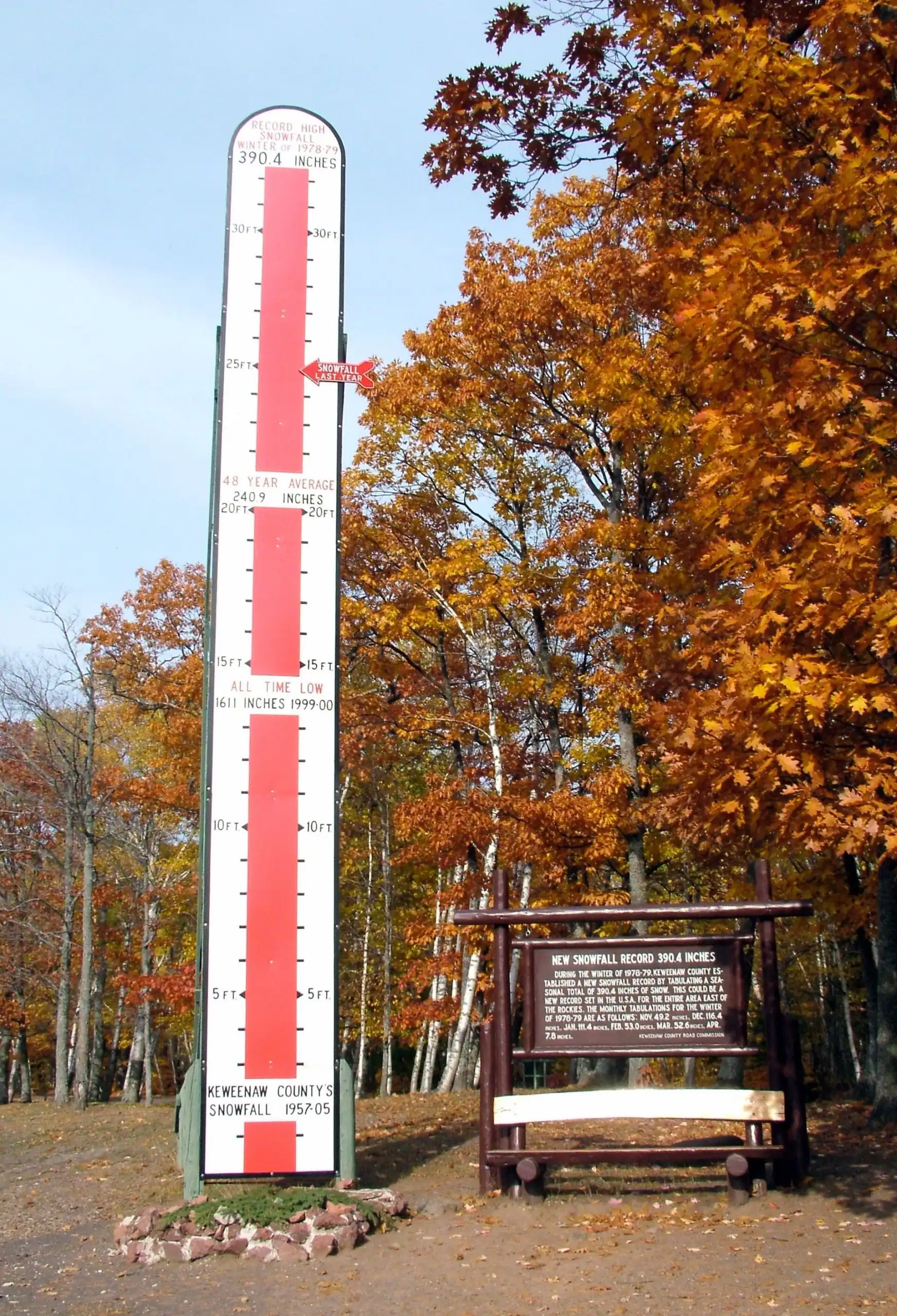
Every spring, the Keweenaw County Road Commission comes out and moves the arrow to show how much snow fell over the winter that just ended. Some years the arrow sits at a height you could touch. Near the top, permanently marked, is the number that made this stretch of highway famous.
390.4 inches
That is the seasonal total recorded for the winter of 1978–79. Thirty-two and a half feet of snow. Stand at the bottom of the gauge and look up at that mark, and you are looking at a three-story building made of snow.
The roadside marker lays out the arithmetic month by month, and the middle of that winter is where it stops being funny. November brought 49.2 inches. December brought 116.4. January added another 111.4. That is nineteen feet of snow in two months, on top of four feet that had already fallen, with February and March still holding 53.0 and 52.6 inches in reserve. The last of it came down in April: 7.8 inches, almost a courtesy.
The sign notes, with the flat confidence of a county road commission, that the season “could be a new record set in the USA for the entire area east of the Rockies.”
Where the number comes from
The measurements are not taken at the gauge. They come from Delaware, an old copper-mining settlement a few miles up the road that has quietly earned the nickname Snow Capital of the Midwest. The Keweenaw County Road Commission has kept an unofficial snowfall record there since 1910, and the long-run average works out to roughly 240 inches a year — twenty feet, in an ordinary winter, at a spot with no ski resort and no ceremony. It is the highest average of anywhere in the Great Lakes snowbelts. East of the Rocky Mountains, only a handful of mountaintops in New England beat it.
An older version of the sign, photographed decades ago and preserved in Michigan Tech’s Copper Country archive, put the peninsula’s driest recorded winter at 81.3 inches, back in 1930–31, alongside a 69-year average of 176.7 inches through 1979. Modern listings for the park cite an all-time low closer to 161 inches. Take whichever number you like. The Keweenaw’s worst winter for snow still buries the annual total of every major city in the continental United States.
The detail that makes it worse
Here is the part almost nobody mentions. The Delaware station is read once a day.
Official National Weather Service stations measure snowfall every six hours, and that matters more than it sounds like it should: snow settles and compacts under its own weight almost immediately, so measuring four times a day catches accumulation that a single daily reading has already lost. The Keweenaw’s monstrous numbers are gathered the slow, conservative way — which means the real totals falling on that peninsula are, if anything, undersold by the stick on the highway.
390.4 inches is the low estimate.
It has stood since 1979, which is either reassuring or ominous, depending on how you feel about a road commission that keeps a permanent mark at 32 feet just in case. US-41 runs past the gauge and keeps going north, through Copper Harbor and out to where the pavement finally quits. Every mile of it is plowed all winter by people who consider twenty feet a season to be normal, because for them it is.
The tourists are right to stop and take the picture. They are just wrong about which part is the joke.
More worth reading


Sources, credits, and reporting details
Sources & accountability
How this story was reported
Editorial methodArchival synthesis
Last verifiedJul. 22, 2026
Corrections statusNo material correction note is recorded on this article.
AI assistanceResearched and drafted with AI tools. Reviewed and approved by editor Keegan O’Brien.
Verification note: Initial ledger, verified 2026-07-22 during publication prep. The 390.4-inch record, the month-by-month tabulation, the Delaware station averages and the once-daily measurement practice were checked against the sources listed. Where the archival sign and current listings give different all-time lows, the article reports both and explains the discrepancy rather than choosing one. The world-record superlative claimed by a record-registry site is not repeated. Sole direct quotation is a fourteen-word fragment of the public roadside marker. Featured image CC BY-SA 2.5, credit Nick Nolte, resized without cropping. No AI-generated or AI-assisted media.
Primary sources
-
Roadside Upper Peninsula: Michigan World Largest Snow Gauge — 99WFMK (Townsquare Media)
Featured image record. Published Feb. 15, 2024. Accessed Jul. 22, 2026. Copyright Townsquare Media; brief quotation with attribution.
Sole direct quotation in the article is a fourteen-word fragment of the public roadside marker as reproduced here.
-
Snow thermometer, Copper Country Historical Images — Michigan Technological University Archives
Featured image record. Accessed Jul. 22, 2026. University archive; cited.
Archival photograph of an earlier sign; used to show the figures have been re-lettered over time.
Additional reporting
-
Delaware, Michigan — Wikipedia
Featured image record. Accessed Jul. 22, 2026. CC BY-SA text; cited.
Source of the measurement-frequency detail central to the closing section.
-
Keweenaw Snow Thermometer — Gribblenation
Featured image record. Published Feb. 9, 2019. Accessed Jul. 22, 2026. Copyright Gribblenation; cited.
Source of the modern all-time-low figure, which differs from the archival sign.
-
Keweenaw Snow Thermometer listing — Upper Peninsula Travel and Recreation Association
Featured image record. Accessed Jul. 22, 2026. Regional tourism association; cited.
-
The Snow Gage — Lost In Michigan
Featured image record. Published Feb. 24, 2025. Accessed Jul. 22, 2026. Copyright Lost In Michigan; cited.
-
World Largest Snow Thermometer — World Record Academy
Featured image record. Published Sep. 5, 2022. Accessed Jul. 22, 2026. Copyright World Record Academy; cited.
Record-registry site; used only for the monthly figures reproduced from the public marker, which match other sources. The world-record superlative is not repeated in the article.
Photo and media credits
-
Keweenaw Snow Thermometer.jpg — Nick Nolte / Wikimedia Commons
Featured image record. Accessed Jul. 22, 2026. CC BY-SA 2.5; credit Nick Nolte.
Supports: Featured image: the snow thermometer beside US-41 near Mohawk. Local copy resized without cropping.
